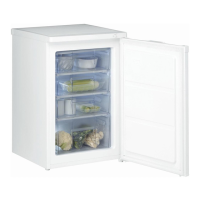
This document describes a freezer designed exclusively for domestic use. It provides comprehensive instructions for its use, maintenance, and installation, ensuring optimal performance and safety.
Function Description
The freezer is designed for storing already frozen food, freezing fresh food, and making ice cubes. It operates effectively within ambient temperatures ranging from +10°C to +32°C, with optimal performance achieved between +16°C and +32°C.
Important Technical Specifications
- Refrigerant: The appliance does not contain CFCs (chlorofluorocarbons) or HFCs (hydrofluorocarbons). Instead, it uses R134a or R600a (Isobutane). R600a is a naturally occurring, low environmental impact gas, but it is flammable, requiring caution to ensure refrigerant pipelines are not damaged.
- Freezing Capacity: The appliance data plate indicates the maximum amount of fresh food that can be frozen in 24 hours.
- Electrical Connection: The appliance requires an earthed electrical connection in accordance with local regulations. Voltage and power consumption details are provided on the rating plate. For Great Britain, the mains lead wires are coloured BLUE ("NEUTRAL"), BROWN ("LIVE"), and GREEN AND YELLOW ("EARTH"). A BS 1363A 13amp fused plug is used, with instructions for fuse replacement (13A fuse to BS 1362 type). For the Republic of Ireland, a 2-pin, side earth type plug may be used, with the GREEN AND YELLOW wire connected to the EARTH contact, and the supply to the socket fitted with a 16 amp fuse.
- Thermostat Settings: The thermostat knob allows adjustment of freezing power from 1 (minimum) to 4 (maximum). The recommended initial setting is 2-3.
- Storage Capacity: The storage capacity is calculated without the tray and the three upper baskets. For increased space, the freezer can be used without baskets.
Usage Features
- First-Time Use: Upon plugging in, the green power-on indicator and red temperature indicator LEDs will light up. An acoustic alarm (if supplied) may sound, indicating the internal temperature is not yet low enough. To silence the alarm, the fast freeze function should be switched on (yellow indicator LED will light up) and then switched off once the red LED turns off. The freezer temperature is factory set, so no initial thermostat adjustment is needed.
- Thermostat Adjustment: The thermostat setting can be adjusted based on ambient temperature, door opening frequency, and the amount of food to be frozen.
- LED Indicators and Acoustic Alarm:
- Green LED: Indicates the appliance is on.
- Red LED: Indicates the internal temperature is not sufficiently low for storing food. This occurs during first-time use, after defrosting/cleaning, when too much food is added, if the door is not properly shut, in case of a cooling system fault, or when the thermostat is adjusted to a higher setting. An acoustic alarm may also sound with the red LED.
- Yellow LED: Indicates the fast freeze function is active and silences the acoustic alarm.
- Fast Freeze Function: To freeze the maximum amount of food, press the fast freeze button 24 hours before placing unfrozen food in the freezer. The function should be switched off after 24 hours.
- Door Contact Pin: An acoustic alarm sounds if the freezer door is left open for more than 1 minute. Pulling the pin temporarily silences the alarm if the door needs to remain open for longer.
- Food Storage:
- Fresh food should be wrapped and sealed in aluminium foil, cling film, watertight plastic bags, or containers.
- Foodstuffs (except meat) should be fresh, mature, and of prime quality. Vegetables and fruits should be frozen soon after picking.
- Hot food must be cooled before placing in the freezer.
- Partially defrosted foods should be eaten immediately and not refrozen unless cooked.
- Frozen foods should be placed in the two top baskets. If used without the tray, ice packs should be arranged on top of food at the front of the top basket.
- A storage calendar helps ensure foods are used before expiry dates.
- A freezer thermometer can be used to check temperature between frozen packs.
- Ice Cube Making: Fill ice cube trays 2/3 full and place them on the tray or in a basket. Use a spoon handle to remove stuck trays; avoid sharp instruments. Bend the tray slightly or run water on the bottom for aluminium trays.
- Switching Off: Turn the thermostat anticlockwise to position to switch off the appliance. The green LED will turn off, but the appliance remains connected to the mains power supply.
- Door Opening: If the door doesn't open immediately after closing, wait a few minutes for vacuum compensation.
Maintenance Features
- Defrosting and Cleaning:
- Defrost the freezer compartment once or twice a year, or when ice on walls reaches 3 mm thickness.
- Ideally, defrost when the freezer is nearly empty.
- If frozen food is present, switch on the fast freeze function for a few hours before defrosting to chill food.
- Remove food, wrap it in newspaper, and store it in a cool place or portable cooler.
- Disconnect the freezer from the mains power supply.
- Leave the door open to melt frost.
- Pull out the defrost water drain and place a basin underneath.
- Clean the interior with a sponge, warm water, and neutral detergent. Avoid abrasive substances.
- Rinse and dry thoroughly.
- Close the freezer, select fast freeze function, return food, and wait several hours before deselecting fast freeze.
- Prolonged Disuse: Empty, disconnect, defrost, and clean the freezer. Leave doors open to prevent odours.
- Door Seal: Clean the door seal with water and dry thoroughly. Do not apply oil or grease.
- Air Circulation: Ensure vents and grilles are unobstructed.
- Troubleshooting: A guide is provided for common issues such as the appliance not working, insufficient/excessive temperature, water collection, and LED indicator problems.
- After-Sales Service: Instructions for contacting after-sales service are provided, including specifying the problem, model, service number, address, and telephone number. The direction of door opening can be changed by after-sales service, but this is not covered by warranty.
- Installation: Install away from heat sources (heaters, radiators, cookers) and direct sunlight. Maintain minimum distances from coal/paraffin stoves (30 cm) and electric stoves (3 cm). Install in a dry, well-ventilated place. Clean the interior and fit accessories. Check the door seal for damage after installation.
- Electrical Safety: Ensure electrical connections comply with local regulations. The appliance must be earthed. The manufacturer disclaims liability for injuries or damage due to non-compliance. If the plug and socket are incompatible, a qualified electrician should replace the socket. Do not use extension leads or adaptors. The appliance must be disconnectable from the mains by unplugging or a two-pole switch.

 Need help?

 To Next Page
 General