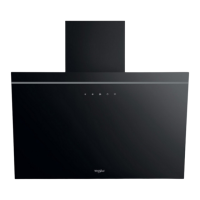
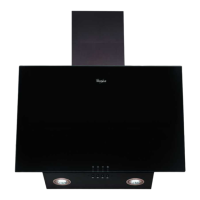
This document provides instructions for the installation, use, and maintenance of a Whirlpool cooker hood, model AKR 5390/1 IX. The manual is available in multiple languages, including English, German, French, Dutch, Italian, Spanish, Portuguese, and Greek.
Function Description
The Whirlpool cooker hood is designed to extract cooking fumes and vapors from the kitchen. It can operate in two modes:
- Ducting (Suction) Version: In this mode, fumes are conveyed outside the building through a special pipe connected to the hood's air outlet.
- Filtering (Recirculation) Version: In this mode, the aspirated air is degreased and deodorized using an activated charcoal filtering system before being fed back into the room. The hood is typically supplied ready for ducting operation, and an accessory kit is required for conversion to filtering mode. If an active charcoal filter is supplied, it must be removed for ducting operation.
The hood features a control panel with controls for aspiration speed selection and a light switch to illuminate the cooking area.
Important Technical Specifications
The technical data for the hood are as follows:
- Height: 18 cm
- Width: 59.8 cm
- Depth: 30-45.5 cm
- Diameter of the exhaust tube: 12 cm
The appliance is designed, tested, and manufactured according to various safety, performance, and EMC standards, including EN/IEC 60335-1, EN/IEC 60335-2-31, EN/IEC 62233 for safety; EN/IEC 61591, ISO 5167-1, ISO 5167-3, ISO 5168, EN/IEC 60704-1, EN/IEC 60704-2-13, EN/IEC 60704-3, ISO 3741, EN 50564, IEC 62301 for performance; and EN 55014-1, CISPR 14-1, EN 55014-2, CISPR 14-2, EN/IEC 61000-3-2, EN/IEC 61000-3-3 for EMC.
The electrical connection requires a mains power supply corresponding to the rating indicated on the plate inside the hood. If a plug is provided, it should be connected to an accessible socket compliant with current regulations. If not fitted with a plug or if the socket is not accessible, a double-pole switch must be installed to ensure complete disconnection from the mains under over-current category III conditions. The wiring connections are: yellow/green for ground, blue for neutral (N), and brown for live (L).
Usage Features
General Safety:
- Always disconnect the hood from the mains before cleaning or maintenance.
- Wear work gloves for all installation and maintenance.
- Children aged 8 and above, and persons with reduced capabilities, can use the appliance under supervision and after receiving instructions on safe use and understanding the hazards.
- Children should not tamper with controls or play with the appliance.
- Cleaning and user maintenance should not be done by children without supervision.
- Ensure sufficient ventilation in the room when the hood is used with other gas or fuel-burning appliances.
- Do not flambé under the hood or remove filters during cooking.
- Frying should be done carefully to prevent oil from overheating and igniting.
- Accessible parts of the hood may become hot during use.
- Do not connect to the mains until installation is complete.
- Follow local regulations for fume discharge.
- Do not discharge air into a flue used for other combustion appliances.
- Never use the hood without correctly mounted lamps or grids.
- The hood should not be used as a support surface unless specified.
- Use only supplied fixing screws or correct types if not supplied, ensuring correct length.
Controls:
The control panel includes:
- ON/OFF light switch (a): To control the cooking area lights.
- Speed OFF (b): To turn off the aspiration.
- 1-speed selection (c): For low aspiration speed.
- 2-speed selection (d): For high aspiration speed.
Environmental Impact Reduction:
- Switch on the hood at minimum speed when starting to cook and keep it running for a few minutes after cooking.
- Increase speed only for large amounts of smoke/vapor; use boost speed(s) only in extreme situations.
- Replace charcoal filter(s) when necessary for odor reduction efficiency.
- Clean grease filter(s) when necessary for grease filter efficiency.
- Use the maximum diameter ducting system for optimal efficiency and minimal noise.
Maintenance Features
Cleaning:
- Clean the hood regularly, both inside and outside (at least once a month).
- Use only a cloth dampened with neutral liquid detergent.
- DO NOT use tools, instruments, abrasive products, or alcohol for cleaning.
Anti-Grease Filters:
- These filters trap cooking grease particles.
- Clean once a month using non-aggressive detergents, either by hand or in a dishwasher (low temperature, short cycle).
- Discoloration may occur in a dishwasher but does not affect filtering capacity.
- To remove, pull the spring release handle.
Charcoal Filter (for filtering version):
- Absorbs unpleasant odors.
- Saturation depends on cooking type and grease filter cleaning regularity.
- Replace the cartridge at least every four months.
- CANNOT be washed or regenerated.
- To install: Remove grease filters, apply one charcoal filter to each side, hook it onto the hood, then refit the grease filters.
Replacing Lamps:
- Disconnect the appliance from electricity.
- Ensure lamps are cooled down before touching.
- Remove the grill.
- Replace the damaged lamp with an E14 2.5W max LED lamp. Refer to the "ILCOS D" leaflet for details.
- Refit the grill.
Power Cable Replacement:
The hood is supplied with a special power cable. If damaged, a new one must be requested from Technical Service.
Malfunctions:
Before calling Technical Service, check:
- If the hood is not working: Power connection, speed selection.
- If the hood performs inefficiently: Motor speed, kitchen ventilation, charcoal filter condition.
- If the hood turned off during normal functioning: Power connection, omnipolar disconnection device.
If issues persist, disconnect the appliance for 5 seconds, reconnect, and try again. If the problem continues, contact Technical Assistance.
Disposal:
The appliance is marked according to European directive 2012/19/EC (WEEE). Dispose of the product correctly at an appropriate collection point for electrical and electronic equipment recycling, following local environmental regulations. Contact local authorities or the retailer for more information on treatment, recovery, and recycling.

 Need help?
 General





 To Next Page