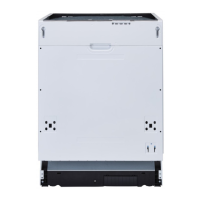
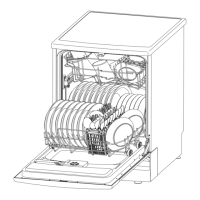
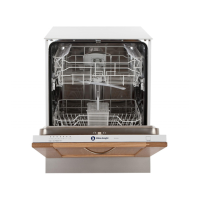
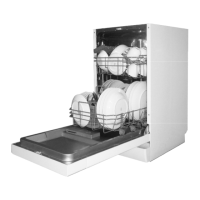
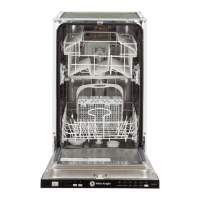
This document is a user manual for the White Knight DW1460WA Dishwasher, a 14-place setting appliance designed for normal domestic use. It provides comprehensive instructions for operation, installation, maintenance, and troubleshooting.
Function Description
The White Knight DW1460WA is an automatic dishwasher designed to clean dishes and utensils. It utilizes various wash cycles, detergents, and rinse aids to ensure thorough cleaning and streak-free drying. The appliance features a water softener system to manage water hardness, a detergent dispenser for optimal cleaning, and a rinse aid dispenser to prevent spots and streaks. It is equipped with upper and lower baskets for loading dishes and a cutlery basket for silverware. The dishwasher offers multiple wash programs tailored for different levels of soiling and types of dishes, including Intensive, Normal, ECO, Glass, 90 Min, and Rapid cycles.
Important Technical Specifications
- Model: DW1460WA
- Place Settings: 14
- Energy Efficiency Class: A++ (highest efficiency)
- Annual Energy Consumption: 266 kWh/annum (based on 280 standard cleaning cycles using cold water fill and low power modes)
- Energy Consumption of Standard Cleaning Cycle: 0.94 kWh
- Power Consumption of Off-mode: 0.25 W
- Power Consumption of Left-on Mode: 0.45 W
- Annual Water Consumption: 3220 L/annum (based on 280 standard cleaning cycles)
- Drying Efficiency Class: A
- Standard Cleaning Cycle: ECO 45°C
- Program Duration of Standard Cleaning Cycle: 186 min
- Noise Level: 49 dB(A) re 1 pW
- Installation: Free standing
- Dimensions:
- Height: 845 mm
- Width: 598 mm
- Depth: 600 mm (with the door closed)
- Water Pressure (Flow Pressure): 0.04-1.0 MPa (0.4-10 bar)
- Power Supply: 220-240 V~ 50 Hz, 1760-2100 W (refer to rating label for specific details)
- Maximum Permissible Inlet Water Pressure: 1 MPa
- Minimum Permissible Inlet Water Pressure: 0.04 MPa
Usage Features
- Control Panel: Features On/Off button, Half Load button, Display indicators (for remaining time, running state, delay time, program indicators, rinse aid indicator, add salt indicator, half load function indicator, delay time, water faucet indicator), Delay button, Program button, and Start/Pause button.
- Water Softener System: Manually adjustable based on water hardness in your area. Requires dishwasher salt to eliminate lime and minerals from water. Salt consumption can be adjusted from H1 (0-5 °dH) to H6 (35-55 °dH).
- Detergent Dispenser: Designed for automatic dishwasher detergents. Supports powdered, concentrated, and tablet detergents. Users are advised to use only detergents specifically made for dishwashers and to add detergent just before starting a cycle.
- Rinse Aid Dispenser: Automatically adds rinse aid during the final rinse to prevent water droplets, spots, and streaks, and to improve drying. The dispenser has six or four settings for adjusting the amount of rinse aid dispensed.
- Loading Baskets:
- Upper Basket: Designed for delicate and lighter dishware such as glasses, coffee and tea cups, saucers, small bowls, and shallow pans. Its height can be adjusted to accommodate larger utensils. Features folding back cup shelves.
- Lower Basket: Recommended for large and difficult-to-clean items like pots, pans, lids, serving dishes, and bowls. Features folding spikes for better stacking.
- Cutlery Basket: For silverware, ensuring items are placed separately with sharp points down to prevent damage and ensure proper cleaning.
- Wash Programs:
- Intensive (60°C): For heavily soiled crockery, pots, pans, and dishes with dried-on soiling.
- Normal (55°C): For normally soiled loads, such as pots, plates, glasses, and lightly soiled pans.
- ECO (45°C): Standard program, most efficient in terms of combined energy and water consumption for normally soiled tableware.
- Glass (40°C): For lightly soiled crockery and glass.
- 90 Min (65°C): For normally soiled loads that need a quick wash.
- Rapid (45°C): A shorter wash for lightly soiled loads that do not need drying.
- Program Modification: A running cycle can be modified if it has been running for a short time. If detergent has already been released, the detergent dispenser must be refilled.
- Adding Forgotten Dishes: Possible any time before the detergent cup opens by pausing the machine, opening the door, adding dishes, closing the door, and restarting.
- Automatic Power Off: The appliance will power off automatically after 30 minutes without any operation once the working cycle has finished.
- Safety Features: Warning against opening the door during a wash cycle due to hot water, and instructions for proper earthing.
Maintenance Features
- Filtering System: Consists of a coarse filter, a flat (main filter), and a microfilter. Prevents food remnants and other objects from entering the pump. Filters should be cleaned regularly, ideally after each wash cycle for larger particles, and the entire assembly once a week.
- Cleaning the Dishwasher:
- Control Panel: Clean with a lightly dampened cloth, then dry thoroughly.
- Exterior: Use a good appliance polish wax. Avoid sharp objects, scouring pads, or harsh cleaners.
- Door: Clean the edge with a soft, warm, damp cloth. Do not use spray cleaners to avoid water penetration into the door lock and electrical components. Avoid abrasive agents or paper towels on the stainless steel surface.
- Spray Arms: Clean regularly to prevent clogging from hard water chemicals. Upper spray arm is removed by rotating clockwise, lower spray arm by pulling upward. Wash with soapy, warm water and use a soft brush for jets.
- Protect Against Freezing: In winter, users should cut off electrical power, turn off water supply, disconnect and drain the water inlet pipe, and remove the filter at the bottom of the tub to soak up remaining water.
- After Every Wash: Turn off water supply and leave the door slightly open to prevent moisture and odors.
- Long Periods of Non-Use: Run an empty wash cycle, remove the plug, turn off water supply, and leave the door slightly open to prolong door seal life and prevent odors.
- Seals: Periodic cleaning with a damp sponge prevents food from trapping and causing odors.
- Intended for normal domestic use only.
- Can be used by children aged 8 and above, and persons with reduced capabilities, with supervision or instruction.
- Children should not play with the appliance, and cleaning/maintenance should not be done by children without supervision.
- For indoor, household use only.
- Do not immerse the unit, cord, or plug in water or other liquid to protect against electrical shock.
- Unplug before cleaning and maintenance.
- Clean with a soft cloth moistened with mild soap, then wipe dry.
- Appliance must be earthed; improper connection can result in electric shock.
- Do not modify the plug or use without a proper earthed outlet.
- Do not abuse, sit on, or stand on the door or dish rack.
- Do not operate unless all enclosure panels are in place.
- Open the door carefully during operation to avoid hot water squirting out.
- Do not place heavy objects on or stand on the door when open.
- Load sharp items with points down or horizontally to avoid damaging the door seal.
- Check detergent powder is empty after wash cycle.
- Only wash dishwasher-safe plastic items.
- Use only detergent and rinse additives designed for automatic dishwashers. Never use soap, laundry detergent, or hand washing detergent.
- Do not leave the door open to prevent tripping hazards.
- If the supply cord is damaged, it must be replaced by the manufacturer or service agent.
- Ensure the power cord is not excessively bent or flattened during installation.
- Do not tamper with controls.
- Connect to water mains using new hose sets; do not reuse old hose sets.
- Packaging material could be dangerous for children; dispose of properly at a recycling center, cutting off power supply cable and making door closing device unusable.
- Do not use extension cords or adapter plugs. Do not cut or remove the earthing connection from the power cord.
- Ensure proper ground exists before use.
- Dishwasher detergent is corrosive; keep out of reach of children.

 Need help?
 General

 To Next Page