© by WilTec Wildanger Technik GmbH Item 52170 Page 13
http://www.WilTec.de
http://www.aoyue.eu 05 2021-1
http://www.teichtip.de
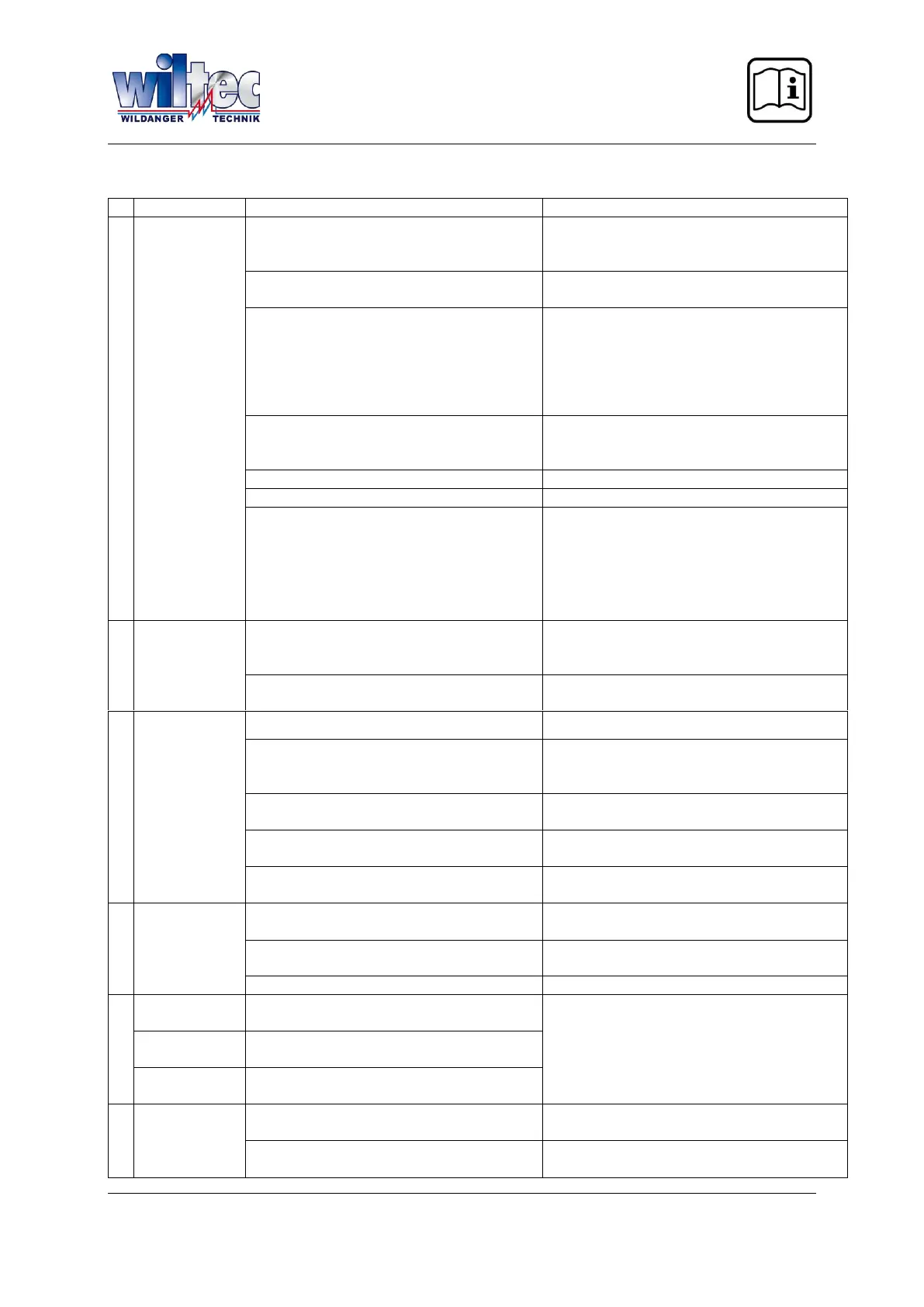
Troubleshooting (Problems with the chicks)
Too much
egg white or
too many
unfertilised
eggs
(a) Wrong ratio of male and female ani-
mals
(a) Check the mating conditions accord-
ing to the recommendations of the breed-
er.
(b) Male animal is malnourished
(b) Feed the roosters separately, so that
the chickens do not take most of the food.
(c) Interruption of male animals during
mating
(c) Do not use too many male animals;
keep the breeding roosters together; build
a non-permanent solid separation walls
between the individual breeding coop or
separate them within bigger breeding
coops.
(d) Damaged combs and gills on the
roosters
(d) Ensure that their coop is comfortable
and there is enough suitable drinking
water.
(e) A young rooster is required.
(f) An unsterile rooster is required.
(g) The egg has been stored for too long
or under the wrong circumstances be-
forehand
(g) Do not keep the eggs for more than
ten to twelve days; store them at a cool
temperature (8–15 ℃) with a relative hu-
midity of 75–80 %. Turn the eggs at least
once a day around their longitudinal axis.
Blood dots,
which point
to an early
death of the
embryo
(a) Temperature of the incubator is too
high or too low
(a) Check the thermometers, thermostat
and the electricity, follow the instructions
of the manufacturer.
(b) Eggs were not turned properly
(b) Turn the eggs frequently, at least 4–
5 times a day; always turn them into the
opposite direction.
(c) Inefficient feeding if the death rate is
high on days 10 and 14
(d) Ventilation of the incubator faulty
(d) Increase the air flow by normal
means.
(e) Only use eggs from healthy stock;
check the hygiene measures.
Eggs, which
will not hatch
(a) Inefficient humidity in the incubator
(a) Increase the evaporation surface with
water or sprays.
(b) Too high humidity at a too early
stage
(b) Check the humidity temperature
measurements.
(c) Problems with the food
(a) Temperature too high in the incuba-
tor
(a) (b) (c) Adjust the temperature regula-
tion accordingly/ adjust it properly.
(b) Temperature too low in the incubator
(c) Temperature in the incubator most
likely too high
(a) Temperature is too high in the incu-
bator
(b) Temperature in the incubator is too
low


 To Next Page
 Loading...