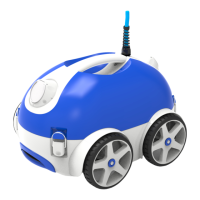
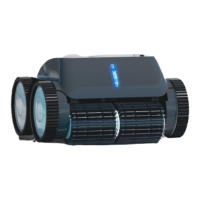
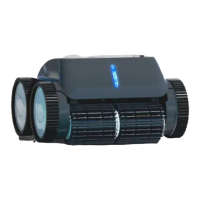
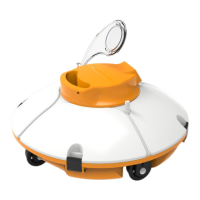
The Winny Robotic Pool Floor Cleaner, model FRISBEE-HJ1101J, is an automatic, rechargeable device designed specifically for cleaning the floors of flat-bottomed swimming pools. Its primary function is to filter pool water and remove suspended particles, offering an environmentally friendly alternative to traditional pool cleaning methods that often require water replacement.
Function Description
The cleaner operates autonomously, navigating the pool floor to collect debris and filter the water. It is equipped with a filtration system that captures suspended particles, contributing to cleaner and clearer pool water. The device is designed to run for a specific working cycle, after which it ceases operation. A key operational feature is its ability to automatically reverse direction upon encountering a wall, ensuring comprehensive coverage of the pool floor.
Usage Features
Before operation, users must ensure the cleaner is properly prepared. This involves installing the swing plate and floating handle, as well as the scraper, which is crucial for preventing dirt leaks during operation. A critical step before submerging the cleaner is to discharge any trapped air. This is achieved by holding the cleaner vertically in the water until no bubbles emerge, then powering it on, rotating it 90 degrees, and submerging it horizontally until a significant amount of air is released from the nozzle. When placing the cleaner into or removing it from the pool, it is advised to orient the cleaner's bottom towards the pool wall to prevent scratches.
The device is rechargeable, and charging is initiated by plugging it into the supplied adapter and charging line. It is important to power off the cleaner and clean the charging port before connecting it for charging. A red indicator signifies that the battery is charging, while a green indicator confirms that charging is complete. The cleaner should be charged in a cool, ventilated area and not covered, to prevent overheating of internal components.
The cleaner's running path can be adjusted by modifying the angle of its front and back wheels. The chassis features grooves marked A, B, and C for the wheel limit piles. By default, the limit piles are installed on positions C (left) and A (right). To adjust the wheel angle, users push the wheel buckle, pull down the wheel components, and then re-install the limit pile into a different groove on the chassis. Several recommended settings are provided: B-C for most pools, C-A when the turning angle is too large, C-C for large swimming pools, and B-A for round pools. These adjustments allow the user to optimize the cleaner's movement for different pool shapes and sizes, ensuring efficient cleaning coverage.
After the cleaning cycle is complete, the cleaner will stop running. The floating handle can be used with a lengthened connecting rod to pull the cleaner to the edge of the pool for removal. Upon lifting the cleaner out of the water, a buzzer will sound, indicating it's time to power off the device by pressing the switch.
Maintenance Features
Regular maintenance is essential for the longevity and effective operation of the robotic pool cleaner. After each use, it is crucial to power off the cleaner and clean the filter tray. To access the filter tray, the cleaner must be opened by releasing its clips, and the top cover and chassis separated. The filter tray can then be removed, cleaned, and the chassis also cleaned. Once cleaned, the components should be reassembled, ensuring the top cover is tightly fastened to the chassis. When reassembling, align the arrow near the top cover's buckle with the hole position near the chassis's buckle.
For long-term storage, the cleaner should be charged every three months to maintain battery life between 40% and 60%. Failure to do so can lead to over-discharge and permanent battery damage. The cleaner should be stored in a cool, ventilated place, away from direct sunlight and any heat sources. It is also important to avoid piercing the cleaner's shell with sharp objects or subjecting it to impacts.
Troubleshooting guidance is provided for common issues. For instance, if the buzzer is silent or the impeller doesn't rotate after power-on, it might indicate a low battery, requiring a recharge. If the swing plate gets stuck, the cleaner should be removed from the pool, and the swing plate manually rotated. If the cleaner's coverage is incomplete, adjusting the wheel position as described in the manual is recommended. If the pool's water circulation system is running, it should be shut down during cleaner operation. For more complex issues, such as internal faults or charger malfunctions, contacting customer service is advised. Only certified professionals should disassemble the sealed driving kit of the cleaner.


 To Next Page
 General