6 7
EN
FR
DE
ES
IT
BG
CS
DA
EL
ET
FI
HR
HU
IS
LT
LV
NL
NO
PL
PT
RO
SK
SL
SV
TK
General precautions
- Follow operation and storage conditions as described in the technical specifications section of this guide. Otherwise, measurement results may be im-
pacted.
- Exposing the device to prolonged lint or dust might damage the device or reduce its life.
- Do not submerge the device in water or liquids.
- The USB port should only be used for charging the device or connecting the provided USB-C to audio adapter during stethoscope recordings. To recharge
the baery, use a power supply that complies with the safety standards of the country in which it is used and that matches the voltage of the power outlet.
- Do not try to repair or modify this device yourself. Do not open or disassemble the device for baery replacement.
- The baery inside the device will stop charging when the temperature is less than 0°C (+/-5°C or ) or over 45°C (+/-5°C).
- Do not use the device or the provided accessories if they are damaged. Do not shake the unit violently. Damaged sensors may lead to incorrect measure-
ments. Inspect for warping, surface damage or corrosion. The sensor lens is fragile, do not touch it with your fingers
- Do not interconnect this equipment with other equipment or use accessories, detachable parts, or materials not described in the instructions for use. Use
of parts and components other than those specified or provided by the manufacturer of this equipment could result in increased electromagnetic emissions
or decreased electromagnetic immunity of this equipment and result in improper operation.
- Portable RF communications equipment (including peripherals such as antenna cables and external antennas) should be used no closer than 30 cm (12
inches) to any part of the device, including cables specified by the manufacturer. Otherwise, degradation of the performance of this equipment could result.
- Use of the device adjacent to other equipment should be avoided because it could result in improper operation such as poor recording with the ECG meas-
urement. If such use is necessary, the device and the other equipment should be observed to verify that they are operating normally.
Sel-Monitoring Precautions (pulse oximeter)
- If blood oxygen (SpO2) values indicate hypoxemia,
do not self-diagnose and self-medicate. Confirmation
by a medical professional is required. Your physician
uses the measurements along with other symptoms
and your medical history in their treatment decision.
This cannot be replaced by a pulse oximeter.
- The blood oxygen result is not intended for self-di-
agnosis or self-screening of lung disease.
- Do not change your treatment plan on your own.
Never alter oxygen delivery seings or medical treat-
ment prescribed by your physician.
- Do not rely only on the readings. Reading can pro-
vide a false sense of security to a lung or health con-
dition that has not yet aected your blood oxygen.
- Do self-monitor your oxygen and pulse rate as rec-
ommended by your healthcare provider. This does not
mean diagnosing and treating.
- Do familiarize yourself with your normal (baseline)
SpO2 levels. Focus on changes from your baseline
over time and not solely on a single measurement at
any given moment
- Do seek medical aention if you are not feeling well
even if your readings are normal.
- Do review the information on the limitations and
ways to improve the accuracy of the reading provided
in this manual.
Factors that may degrade perormance of the meas-
urement of blood oxygen (pulse oximetry) include:
- Poor circulation, skin pigmentation, skin thickness,
skin temperature, current tobacco use, and use of fin-
gernail polish
- Bright sunlight
- Presence of strong electromagnetic fields
- Failure to position fingertip on the device correctly
- Taoos on the fingers in the region of the optical
sensor
- Excessive motion of the arm or fingers
- Low blood perfusion caused by room temperature
below the recommended operation range, or by cer-
tain conditions such as Raynaud’s syndrome
- Significant levels of dysfunctional hemoglobin (car-
boxyhemoglobin, methemoglobin)
- Venous pulsations
- Intravascular dyes such as cardiogreen or methyl blue
- Blood-flow restrictions due to arterial catheters,
blood pressure cus, or infusion lines
- Hypotension, serious vasoconstriction, serious ane-
mia, or hypothermia
Accessory:
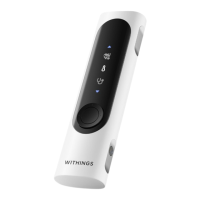
The Withings BeamO is to be used with a soware
accessory, the Withings BeamO companion app. It
allows the installation of the device and displays the
results of performed measurements. It is part of the
Withings App.


 To Next Page