Wistron Neweb Corporation
11 of 17
Transmit
center
frequency
tolerance
The transmitted center frequency tolerance shall be ±20 ppm maximum.
802.11a:
The leakage of the center frequency component shall not exceed -15 dB relative to
overall transmitted power or, equivalently, +2 dB relative to the average energy of the
rest of the sub-carriers.
802.11b:
The RF carrier suppression, measured at the channel center frequency, shall be at least
15 dB below the peak SIN(x)/x power spectrum.
802.11g:
The leakage of the center frequency component shall not exceed -15 dB relative to
overall transmitted power or, equivalently, +2 dB relative to the average energy of the
rest of the sub-carriers.
802.11n:
For all 20 MHz modes of transmission
The leakage of the center frequency component shall not exceed -15 dB relative to
overall transmitted power or, equivalently, +2 dB relative to the average energy of the
rest of the sub-carriers.
For all 40 MHz modes of transmission
The center frequency leakage shall not exceed -18 dB relative to overall transmitted
power, or, equivalently, +2 dB relative to the average energy of the rest of the sub-carriers.
Transmit
power on
ramp and
power down
ramp time
The transmitting power-on ramp for 10% to 90% of maximum power m shall be no greater than 2 µs.
The transmitting power-down ramp for 90% to 10% of maximum power shall be no greater than 2 µs.
Receiver
maximum
input level
802.11a
Modulation Code Rate IEEE Spec (1Rx dBm)
>-30
802.11b
Modulation IEEE Spec (1Rx dBm)
DBPSK >-10
DQPSK >-10
CCK >-10
802.11g
Modulation Code Rate IEEE Spec (1Rx dBm)
>-20
802.11na
Modulation Code Rate IEEE Spec (1Rx dBm)
>-30
802.11ng
Modulation Code Rate IEEE Spec (1Rx dBm)
>-20
802.11ac
Modulation Code Rate IEEE Spec (1Rx dBm)
>-30
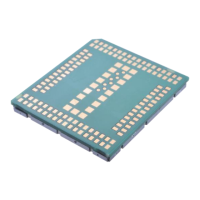
51.45+/-0.15.mm x 40.00+/-0.15mm x 1.0+/-0.1mm 4L FR4
802.11a: 6, 9, 12, 18, 24, 36, 48, 54Mbps
802.11b: 1, 2, 5.5, 11Mbps
802.11g: 6, 9, 12, 18, 24, 36, 48, 54Mbps
802.11n: @800GI(400GI)
20MHz BW
1 Nss: 65(72.2) Mbps maximal


 To Next Page
 Loading...