This document describes the WOLF-Garten electric chainsaws, models CSE 2035 and CSE 2240. It serves as an instruction manual covering assembly, operation, and maintenance to ensure optimal performance and user safety.
Function Description:
The WOLF-Garten electric chainsaw is designed for cutting wood. It is an electrically powered tool intended for garden use, built in accordance with current safety regulations to protect the consumer. The chainsaw is equipped with safety features to prevent accidental operation and to stop the chain quickly in case of kickback.
Important Technical Specifications:
For CSE 2035:
- Voltage - Power: 230 V - 2000 W
- Power frequency: 50 Hz
- Sprocket speed (no load): 7600 min⁻¹
- Bar length: 35 cm
- Cutting length: 300 mm
- Chain pitch: 3/8” / 9.53 inch/mm
- Chain (guide thickness): 0.05” / 1.27 mm
- Motor pinion: 6 teeth
- Mass: 4.6 kg
- Sound pressure level Lwa: 106.3 dB(A) K=3
- Guaranteed sound power level Lwa (2000/14/EC): 109 dB(A)
- Vibration: 4.7 m/s² K=1.5
- Bar: Oregon 140SDEA041
- Chain: Oregon 91PJ052X
For CSE 2240:
- Voltage - Power: 230 V - 2200 W
- Power frequency: 50 Hz
- Sprocket speed (no load): 7600 min⁻¹
- Bar length: 40 cm
- Cutting length: 350 mm
- Chain pitch: 3/8” / 9.53 inch/mm
- Chain (guide thickness): 0.05” / 1.27 mm
- Motor pinion: 6 teeth
- Mass: 4.7 kg
- Sound pressure level Lwa: 106.1 dB(A) K=3
- Guaranteed sound power level Lwa (2000/14/EC): 109 dB(A)
- Vibration: 5.3 m/s² K=1.5
- Bar: Oregon 160SDEA041
- Chain: Oregon 91PJ057X
Usage Features:
General Safety:
- Always read the manual before use.
- Do not allow children or untrained individuals to operate the chainsaw.
- Wear appropriate personal protective equipment (PPE) including a safety helmet, noise-damping earplugs, protective goggles or visor, protective gloves, protective trousers, and sturdy non-slip shoes.
- Always hold the chainsaw with both hands.
- Maintain a stable and secure stance.
- Keep the work area clear of people, animals, and objects (minimum 10m distance recommended).
- Avoid accidental starting by ensuring the switch is in the "Off" position before plugging in.
- Protect the power cable from heat, oil, and sharp edges.
- Do not operate the chainsaw above shoulder height.
- Do not use the chainsaw while in a tree.
- Do not start the chainsaw if it is upside down or if the chain is touching anything.
- Be aware that the chain continues to rotate for a short period after the trigger is released.
- Avoid cutting thin twigs and bushes as they can get caught in the chain and cause injury.
- Be cautious when working on slopes, uneven, or slippery ground.
- Do not cut wire mesh.
- Do not perform complex tasks without sufficient experience; consult an expert if in doubt.
Starting and Stopping:
- To start, hold the front handle with the left hand and the rear handle with the right hand. Press the "lock off" safety button (2) with your thumb and then press the start button (3).
- To stop, release the start button.
- The chainsaw has a motor protection device that disconnects the motor if the effort is too high. To restart, release the trigger, ensure the chain can rotate, and then press the trigger and lock-off button again.
Chain Brake:
- The chainsaw is equipped with a safety chain brake (10) that stops the chain in a fraction of a second in case of kickback.
- To reset the chain brake after activation, release the trigger, wait for the motor to stop, and pull the brake lever fully back to position "1".
- Always check chain tension before restarting after brake activation.
Kickback Prevention:
- Kickback can cause serious injury. It occurs when the tip of the bar touches an object, or when the top part of the bar is used for cutting, causing the chainsaw to be violently thrown back towards the operator.
- To minimize kickback, use the bottom of the bar (pulling technique) which tends to move the chainsaw towards the trunk.
- When cutting, keep the spiked bumper (16) against the wood.
- Ensure the chain is sharp and properly tensioned.
- Insert the chain into an existing cut at maximum speed and with extreme caution.
- Only withdraw the bar from the cut when the chain is moving.
Cutting Techniques:
- Cutting a log supported at both ends (Fig. 12): To prevent the bar from getting stuck, cut 1/3 of the diameter from top to bottom, then cut the remaining part from the bottom.
- Cutting a log supported on a sawhorse or with a free end (Fig. 13): Cut 1/3 of the diameter from bottom to top, then cut the remaining part from the top.
- Felling a tree (Fig. 14, 15, 16):
- Carefully assess all conditions: felling direction, natural lean, surrounding obstacles, wind direction, and speed.
- Make a directional notch on the side the tree is intended to fall. The notch depth should be 1/4 of the trunk diameter, with an angle of at least 45° between the upper and lower cuts. The intersection line of these cuts should be perfectly horizontal and 90° to the felling direction.
- Make the felling cut on the opposite side, 3-5 cm above the directional cut line.
- Use wedges to control the felling and prevent the bar from binding.
- The felling cut should be parallel to the directional cut line, with a distance of at least 1/10 of the trunk diameter between them. The uncut part of the trunk acts as a hinge to guide the tree's fall.
- Maintain a safety distance of 2.5 times the tree's height. Ensure no one is in the danger zone before and during felling.
- Cutting planks: Secure planks with clamps or straps.
Maintenance Features:
Daily Maintenance:
- Check the integrity of the power cable and plug (9).
- Check the condition of the air intake (8).
- Ensure the chain (6) and bar (5) lubrication system is adequate.
- Clean the chain brake and check its proper function.
- Rotate the bar daily to ensure even wear.
- Check the bar for wear.
- Ensure the lubrication hole allows oil to pass through.
- Clean the chain guide.
- Check chain tension, sharpen the blade, and remove any irregularities.
- Check the condition of the chain sprocket.
- Ensure the oil reservoir and oil filter are clean.
Chain Sharpening (Fig. 8):
- Disconnect the plug from the mains supply.
- Wear work gloves.
- Ensure the chain is properly tensioned and does not move during sharpening.
- Block the chain by moving the brake lever (10) forward.
- Use a round file with a diameter 1.1 times the height of the cutting tooth.
- File horizontally at a 30° angle to the bar, filing from the inside to the outside of the tooth.
- Apply the same number of strokes to each tooth for uniform sharpening.
- File perpendicularly to the bar's plane for the horizontal angle.
- Every 5 sharpenings, check the difference between the cutting edge height and the depth gauge limiter; use a caliper if recommended.
Lubrication System (Fig. 10):
- The chain is automatically lubricated by a pump.
- Use new chain oil. The oil viscosity depends on the air temperature.
- Never use recycled or poor-quality oil, as it can damage the pump, bar, and chain.
- Consult an authorized service center for oil selection.
- Never operate the chainsaw without oil. Regularly check the oil level and refill when it drops below one-quarter.
- If the lubrication system malfunctions, check the oil filter in the reservoir for cleanliness. If necessary, take the chainsaw to an authorized service center.
Periodic Maintenance Table:
The manual includes a detailed periodic maintenance table with recommended intervals for visual checks, general cleaning, air cooling slots cleaning, chain brake function, throttle trigger function, screw tightening, chain lubrication, sharpness, tension, and replacement, drive sprocket wear and lubrication, and bar cleaning, wear, and replacement. These intervals are for normal use and should be reduced for heavy or intensive use.

 Need help?
 General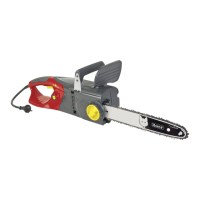

 To Next Page