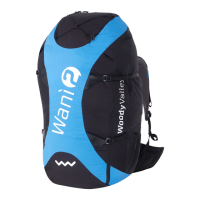
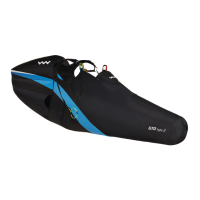
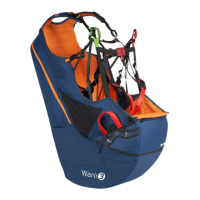
The Woody Valley QUADRO series is a range of manually deployable rescue parachute systems designed for paragliding pilots in emergency situations. These systems are constructed from high-quality, lightweight materials and feature a quadratic canopy with a single middle line that pulls down the apex, ensuring fast inflation and moderate sink rates. Woody Valley emphasizes meticulous research and pilot collaboration in the development of their products, aiming for high reliability and maximum material strength.
Function Description:
The QUADRO rescue system is deployed by pulling a handle, which opens the outer container and releases the parachute. The pilot then forcefully throws the reserve package away. As the suspension lines tighten, the container detaches, and the reserve parachute opens. In an emergency, a sharp pull on the handle is required. If the glider is rotating, throwing the reserve against the rotation can accelerate inflation. In case of a collision and entanglement with another glider, care should be taken not to throw the reserve into the entanglement, as this can delay opening. Pilots are advised to practice reaching the rescue handle and, if sufficient height is available, to first attempt to resolve the problem and stabilize the glider before deploying the rescue. Releasing the rescue handle after deployment is also crucial.
Important Technical Specifications:
The QUADRO series includes several models: 100 light, 120 light, 140 light, and 220 light, each with specific technical data:
- Certification: All models are LTF/EN certified.
- Quadro 100 light: EP 218.2018
- Quadro 120 light: EP 321.2021
- Quadro 140 light: EP 242.2018
- Quadro 220 light: EP 263.2019
- Working Load:
- Quadro 100 light: 100 kg
- Quadro 120 light: 120 kg
- Quadro 140 light: 140 kg
- Quadro 220 light: 220 kg
- Area (m²):
- Quadro 100 light: 31.20
- Quadro 120 light: 35.50
- Quadro 140 light: 44.80
- Quadro 220 light: 69
- Number of Cells:
- Quadro 100 light: 20
- Quadro 120 light: 24
- Quadro 140 light: 24
- Quadro 220 light: 28
- Weight including container (kg):
- Quadro 100 light: 0.98
- Quadro 120 light: 1.31
- Quadro 140 light: 1.45
- Quadro 220 light: 2.43
- Minimum Volume (cm³):
- Quadro 100 light: 4100
- Quadro 120 light: 5200
- Quadro 140 light: 5600
- Quadro 220 light: 9000
- Maximum Payload (kg):
- Quadro 100 light: 100
- Quadro 120 light: 120
- Quadro 140 light: 140
- Quadro 220 light: 220
- Minimum Payload (kg):
- Quadro 100 light: 65
- Quadro 120 light: 80
- Quadro 140 light: 95
- Quadro 220 light: 150
- Middle Line: All models have 1 middle line.
- Rate of Descent Max. Payload:
- Quadro 100 light: 5.47 m/s
- Quadro 120 light: 5.25 m/s
- Quadro 140 light: 5.49 m/s
- Quadro 220 light: 5.14 m/s
- Opening Time (s):
- Quadro 100 light: 3.23
- Quadro 120 light: 3.99
- Quadro 140 light: 3.12
- Quadro 220 light: 3.99
The rescue system is not suitable for speeds exceeding 32 m/s (115 km/h). Its material is strong nylon, with bands sewn into main seams for reinforcement. The base and side edges are also reinforced. The lines are grouped into a strap that connects the rescue system to the harness. The system is sewn to NATO standards, ensuring professional craftsmanship and approval after inspection. A specially designed inner container prevents lines from getting caught and accelerates opening speed.
Usage Features:
- Compatibility: QUADRO series rescue parachutes are compatible with all Woody Valley harnesses and most other manufacturers' harnesses, provided proper installation and compatibility checks are performed by an instructor or dealer.
- Installation:
- Connection Bridle: The connection bridle attaches to the harness bridle using a screw-lock karabiner with a breaking strength of at least 2,400 kg. Elastic bands should hold the bridles in position within the karabiner to prevent rotation and lateral strain. The screw-lock must be tightly shut.
- Rescue Handle: The rescue handle connects to one of the three loops on the Quadro inner container (one in the middle, two on the sides). The specific loop depends on the harness manual. The handle must be firmly connected.
- External Container: If the harness lacks a built-in container, an optional Woody Valley front container can be used. It's crucial to ensure the external container is of suitable size and that the bridle connects to both main carabiners.
- Tandem Reserve: For tandem use, a V-line is added and connected to the main or exclusive rescue attachment point on each spreader bar. If the V-line has an auxiliary suspender, it connects to risers B and C of the glider after passing through the main carabiners. This setup facilitates a B-C-stall upon emergency parachute deployment.
- Winch Launch: For winch towing, follow the instructions from the harness, paraglider, and winch manufacturers. Ensure rescue system deployment is possible in any situation, especially with a front container.
- Important Installation Points:
- Only use the original release handle provided with the harness.
- The container must have a suitable volume.
- If using an inner container with an asymmetric attachment loop, it must be placed so the attachment loop remains close to the release handle, preventing twisting during deployment.
- The connection between the release handle and safety pin must be shorter than the connection between the release handle and inner container.
- Install the release handle so the connecting line is not under tension and the safety pin is not pulled out.
- After each packing, a test deployment from the flying position must be performed to ensure proper operation.
- Only insert the rescue parachute into the harness after its back protection is installed.
- Compatibility Check (Regularly): A control of every new combination of rescue system and harness/outer container must be carried out by an authorized person (producer, dealer, or flight instructor). The activation in flight position must be correct and conform to construction guidelines. This check must be documented. The throwing movement should be practiced every time the rescue system is repacked.
- Preflight Check: Before each takeoff, ensure the rescue container is closed correctly and the release handle is properly positioned. If the V-line is removed after flights (e.g., with a front container), correct bridle attachment must also be checked.
Maintenance Features:
- Care Instructions:
- Do not store the rescue system near acids, grease, oils, or paint.
- Avoid extreme temperatures (over 30°C) or humidity (over 55-65%).
- A humid or wet canopy requires repacking.
- UV exposure deteriorates the fabric.
- Clean only with clean, fresh water.
- Wet cloth stored in warm conditions can mold and lose structural strength; such systems must be checked by the manufacturer.
- Do not fold or store the rescue system unless it is completely dry.
- Repairs: Only original parts can be used for repairs to maintain certification. Damaged parts that impede deployment must be sent to the manufacturer or authorized persons for repair.
- Use Limitations: The QUADRO series rescue parachutes have a lifespan of 15 years, provided packing and checking regulations are observed. Certification is no longer valid thereafter. The certified lifespan can be extended by three years if checked by the manufacturer.
- Packing Interval: The rescue system must be aired and repacked every 6 to 12 months. Without regular certified inspections, the guarantee is void.
- Check Interval: The rescue system must be checked every 2 years. If opened after a flight accident, it must be checked immediately. Packing and checks must be documented, otherwise the guarantee is cancelled.
- Spare Parts: Rubber bands and the deployment bag are available from local dealers or Woody Valley.
- Responsible Disposal: Rescue parachutes are made from special materials requiring special waste disposal. Ensure correct disposal when decommissioned, or send to Woody Valley for proper handling.
- Environmental Regulations: Respect the environment by not littering, staying on marked trails, and avoiding loud noises.
The QUADRO series is strictly prohibited for use beyond the maximum recommended weight, for skydiving, with damaged canopy, lines, connection belt or seams, or without regular checks. The effectiveness of the rescue parachute relies on correct folding, and it is advisable for qualified and experienced folders to perform this task. If folding it yourself, follow instructions carefully and contact staff if in doubt. Before packing, the canopy should be spread out for about six hours, ideally aired overnight. A release control must be carried out, with a release force between 5 and 7 daN. Packing with two people on a clean surface is helpful, using packing weights and a line to fix packing loops. Mandatory tools include packing rubbers and the original container. Two fixing points are suggested for tensioning lines.

 Need help?
 General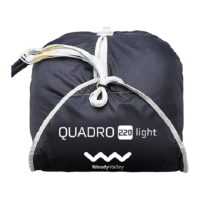

 To Next Page