EasyManua.ls Logo

Wurlitzer 3020 - General Description; Cycle of Operation for Wireless Wallbox; Introductory; Cycle of Coin Registration

Wurlitzer 3020
58 pages
Print Icon
To Next Page IconTo Next Page
To Previous Page IconTo Previous Page
Loading...
Service
Instructions
Section I
General
Description
S E R
VI
C
E~
I-NSTRUCTIONS
SECTION
I
GENERAL
DESCRIPTION
CYCLE
OF OPERATION FOR
WIRELESS
WALLBOX
INTRODUCTORY
The
Wurlitzer
Wireless
Remote
Control
System
provides
for
transmission
of
pulses
over
60 cycle
wir·
ing
circuits
from
wallboxes
to
the
phonograph.
The
source
of
the
signals
is a
transmitter
in
the
wallbox
which
sends
out
radio
frequency
pulses.
The
device
which
responds
to
these
signals
or
pulses is
the
radio
impulse
receiver, located
in
the
phonograph.
The
receiver actuates
the
stepper,
which
in
turn
sets
up
the
circuit
required
for
obtaining
the
desired
se-
lection
on
the
phonograph.
Generally,
external
wiring
is
not
required
with
the
Wireless
Remote
Control
System; wallbo:ices
are
sim-
ply
plugged
into
the
elec·
the
coin
relay closes
the
motor
is
started
through
con-
tacts 3
and
4,
the
register
circuit
is
completed
.through
contacts
7
and
8
and
the
selector
circuit
is isolated
through
contacts 5
and
6.
When
the
coin
relay is
energized,
contacts 5
and
6
break
the
selection
ci~cuit
while
the
coins
are
being
registered.
·
The
coins
are
held
on
the
coin
switch
by
the
coin
gate,
as
the
coin
disc
contact
rotates
in
a
clockwise
direction
from
the
at
rest
position
.
The
coin
swi
tch
,
which
is
still
closed, is
disconnected
from
the
coin
relay
circuit
(
Segment
A
of
coin
disc)
and
connected
into
the
accumulator
coil
circuit
(
Segment
B
of
coin
tric
wiring
outlets
and
the
receiver
is
plugged
into
the
stepper
in
the
phono·
graph.
TO
SELECTOR
SWITCHES
CYCLE
OF
COIN
REGISTRATION
The
coin
disc
contact
arm
in
its
~
rest
position,
sets
up
a
circuit
for
the
54
or
10¢
or
254
coin
switch
and
the
coin
relay.
When
a
coin
is
inserted
it
passes
through
the
slug
rejector
and
falls
against
the
"
coin
switch.
The
coin
switch
closes, rhus
closing
the
coin
relay. (See
Figures
1,
2
and
3.)
This
relay
interlocks
through
contacts 1
and
2
until
near
the
end
of
the
revolution
when
the
release
switch
opens
it.
When
COIN SWITCH
COIN
RELAY
TO
SEL
PLATE
TO
117
v.
TO MOTOR
TO
24
" ·
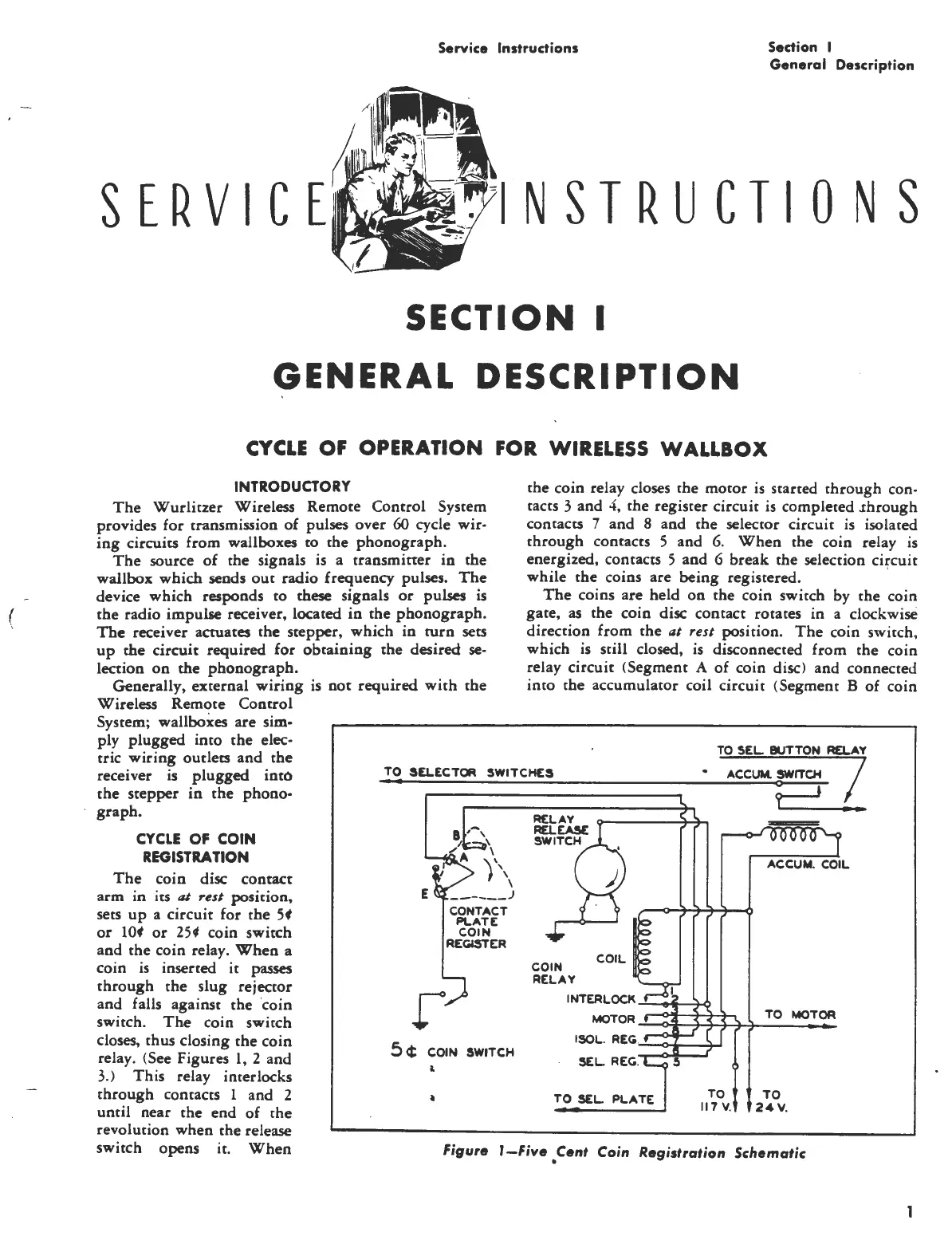
Figure
l-Five
Cent
Coin
Registration
Schematic
1

Table of Contents