The Thyone-I module is a radio sub-module designed for wireless communication in a variety of applications, including control systems, remote controls, and sensor nodes. It operates in the globally available 2.4 GHz license-free band, offering robust and secure data transmission in both point-to-point and mesh configurations. The module comes pre-loaded with the WE-ProWare radio stack, ensuring high flexibility and reliability.
Function Description
The Thyone-I module facilitates wireless communication by interfacing with a host system via a serial UART. This allows for easy configuration and control of the radio using a simple command interface. For cable replacement applications, the module also features a transparent mode, enabling it to function as a serial-to-radio adapter.
Key functional features include:
- Long Range Mode: Utilizes a radio profile with channel coding for extended range, achieving a data rate of 125 kbit/s.
- High Throughput Mode: Offers a radio profile with 2 Mbit/s data transmission over the air, resulting in an effective end-to-end throughput of approximately 400 kbit/s.
- Clear Channel Assessment (CCA): Implements a CSMA-CA based CCA mechanism ("listen before talk") to minimize packet collisions in the heavily used 2.4 GHz ISM band. This feature can be enabled or disabled, and a threshold can be configured to determine when a channel is considered busy.
- Low Power Mode: Optimized for battery-driven applications, the module can enter a sleep mode with extremely low current consumption (< 0.4 µA). In this mode, the UART and radio interfaces are shut down, and GPIOs B1-B6 are set to input to prevent leakage current.
- Network Addressing: Supports unicast, multicast, and broadcast data transmission. Each module can have a unique 4-byte source address, and a 1-byte group-ID can be configured for multicast groups. Automatic address resolution filters out packets not addressed to the module.
- Acknowledgement and Retries: Configurable radio acknowledgement and retry mechanisms improve communication reliability. Retries are not performed for broadcast messages.
- Repeater Mode: Allows the module to function as a repeater to extend transmission range and create a simple flooding mesh network. Repeaters retransmit received packets after a random back-off time, and a time-to-live (TTL) parameter can limit the number of hops.
- Packet Sniffer Mode: Can be configured as a sniffer, disabling address resolution and forwarding all received packets over UART. ACKs are disabled in this mode, and encrypted packets are forwarded only if the correct key is present.
- Encryption/Decryption: Supports hardware-accelerated, symmetric 128-bit AES encryption for secure wireless links. Encryption is disabled by default and requires setting a key and encryption mode.
- Local/Remote Digital I/O Control: Offers up to 6 programmable digital I/O pins that can be configured and controlled by a local host via UART or by a remote host over the radio link. PWM functionality is available for some GPIOs.
- Secure Firmware Update: Allows firmware updates over the UART interface. The bootloader verifies image signatures and versions before overwriting, ensuring security.
- Radio Test Mode: Provides essential test features for RF performance evaluation, including transmitting a carrier, random or predefined packets, and receiving on specific channels. This mode is intended for design verification and compliance tests only.
Important Technical Specifications
- Dimensions: Extremely small, measuring 8 x 12 x 2 mm, comparable to a nano-SIM card.
- Weight: Less than 1g.
- Operating Frequency: 2.4 GHz license-free band, utilizing 39 different 1 MHz channels from 2403 MHz to 2479 MHz. Default channel is 21 (2445 MHz).
- Modulation: GFSK modulation without frequency hopping.
- Supply Voltage (VDD): Recommended operating range of 1.8V to 3.6V (typical 3V). Absolute maximum is +3.9V.
- Ambient Temperature: Recommended operating range of -40°C to 85°C.
- Power Consumption:
- TX current consumption (RF_TX_POWER = 8): 18.9 mA
- TX current consumption (RF_TX_POWER = 0): 8 mA
- RX current consumption: 7.7 mA
- Sleep (system off mode): 0.4 µA
- Output Power:
- Conducted (RF_TX_POWER = 8): +6 dBm
- Integrated antenna (RF_TX_POWER = 8, e.r.p): +4 dBm
- Configurable from -40 dBm to +8 dBm.
- Input Sensitivity (BER=1E-3):
- Conducted (1Mbps): -92 dBm
- Integrated antenna (1Mbps): -90 dBm
- Sensitivity at different data rates (PER 1%): -90 dBm (1000 kbit/s), -87 dBm (2000 kbit/s), -94 dBm (500 kbit/s), -98 dBm (125 kbit/s).
- UART Interface: Supports baud rates from 1200 to 1,000,000 (standard 115200), 8 data bits, 1 stop bit, and configurable parity (none, even). Flow control (RTS/CTS) is supported.
- Flash Endurance: 10,000 write/erase cycles for user settings.
- Antenna Options: On-board PCB antenna for compact designs or external 50Ω RF connection for applications requiring longer range or specialized antennas.
- GPIOs: 6 configurable digital I/O pins (B1-B6) for remote and local control, with options for input (with/without pull resistor), output, or PWM.
Usage Features
- Quick Start: The module is pre-flashed, tested, and ready for use out-of-the-box, compliant with regulatory requirements. Minimal pin connections (VDD, GND, UART, /RESET, antenna) are required for basic operation.
- Configuration: Module parameters (User settings) are stored in flash memory and can be read or modified via the command interface. Changes to non-volatile parameters require a module reset to take effect.
- Transparent Mode: Enables easy serial cable replacement by transparently forwarding UART data over the radio link. Can be entered via pin configuration or command.
- Command Interface: A structured command interface allows the host microcontroller to manage configuration and operation through predefined packets. Commands are categorized into Requests, Confirmations, and Indications/Responses.
- Firmware Update: Supports secure firmware updates over UART using a dedicated bootloader mode. Windows-based tools (Thyone-I updater tool, Nordic nrfutil tool) are available for this purpose.
- Remote GPIO Control: Allows configuring and controlling GPIOs on a remote device via radio link, enabling distributed control systems.
Maintenance Features
- Firmware Updates: Regular firmware updates are available to improve functionality and address known issues. It is recommended to check for the most recent firmware version, data sheet, and user manual.
- Design-in Guide: Provides advice for schematic and layout, including recommendations for power supply stability, ESD protection, antenna placement, and microstrip antenna line dimensioning.
- Manufacturing Information: Details on moisture sensitivity level (MSL3), reflow soldering profiles, and cleaning procedures are provided to ensure proper manufacturing and handling.
- Safety Recommendations: Emphasizes the user's responsibility to ensure product compliance with regulations and safety in the destination country and environment, especially in areas with explosion risk or where interference may occur.
- Regulatory Compliance Information: Includes EU Declaration of Conformity, FCC Compliance Statement, IC Compliance Statement, and TELEC radio law approval details, along with requirements for OEM integrators regarding labeling and antenna usage.
- Known Issues: A dedicated section lists known issues and their workarounds or affected firmware versions, aiding in troubleshooting and application design.

 Need help?
 General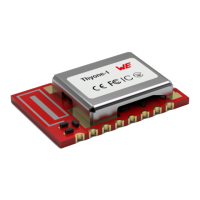

 To Next Page