@
XENOX MV9
Note:
-
metal and voltage
detector
Dear Customer,
Before using the detector, please read the
attached operating instructions.
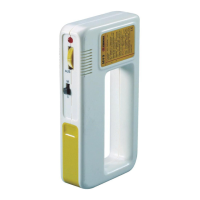
Legend (see Fig. 1)
1.
2.
3.
4.
5.
6.
LED display for metal detection or
voltage detection
Adjuster wheel for switching on and
adjusting detector
Metal detection (M) and voltage
detection
(v)
selector switch
Battery compartment cover
Sensor unit for metal detection and
voltage detection
Audio signal
Inserting and replacing battery
1. Open battery compartment 4 (Fig.
I).
2. Connect battery; do not to transpose
the positive and negative terminals.
3. Replace battery compartment cover.
Detectina metal or
voltaae
The sensitivity of the detector must be
reset before each use.
When resetting the detector, make sure
that there are no metal components
(wristwatches) or current-carrying wires
within a one-metre radius.
During adjustment, hold the device in the
position (vertical or horizontal) in which
the wail is to be scanned.
Hold the detector as you would for wall
scanning.
1. Set the selector switch to
“M”
for
metal detection or
“V”
for voltage
detection 3 (Fig. 1).
2. Switch on the detector using adjuster
wheel 2 (Fig. 1).
If the detector is set to
‘IV”,
an immediate
intermittent audio signal will sound briefly
and then stop.
3. Rotate the adjuster wheel until LED 1
(Fig. 1) illuminates and the audio signal
sounds (Setting M = continuous audio
signal, setting V = intermittent audio
signal)
4. Slowly rotate the adjuster wheel in the
reverse direction until the audio signal
stops and the LED extinguishes.
Note:
The less the adjuster wheel is rotated in
the reverse direction, the more sensitive
the setting and the greater the
penetration depth become (required
especially for flat-webbed house wire).
5. Slide the detector slowly and uniformly
in a horizontal motion over the wall
surface (Fig. 2).
Note-
4
Due to incorrect use or unfavourable
environmental influences, it is possible
that metal or electrical conductors
will not be properly detected.
The manufacturer cannot therefore
guarantee certainty of detection.


 To Next Page