Need help?
Do you have a question about the Xiaomi Mi 8 and is the answer not in the manual?
Details about MIUI, the customized Android OS with frequent updates and user-friendly features.
Information on the SIM card tray, Nano-SIM placement, and dual SIM capabilities and limitations.
Guidelines for environmentally responsible disposal and recycling of the product.
Covers battery safety, hearing protection, operating temperature, and charging safety.
Lists restricted environments and precautions for medical device interference.
Precautions for aircraft, driving, charging, humidity, and secure OS updates.
Declaration of compliance with EU Radio Equipment Directive 2014/53/EU.
Information on EU operation, country-specific restrictions for 5GHz Wi-Fi, and manufacturer details.
Details on the mobile phone's supported frequency bands and maximum radio-frequency power.
Compliance with FCC Part 15 rules for digital devices and managing interference.
Government requirements for radio wave exposure and the device's compliance with SAR limits.
Instructions on how to access the device's electronic label for certification information.
Specific SAR values and operating temperature range for the device.
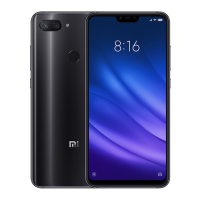
This document serves as the user guide for the Mi 8, a digital mobile phone manufactured by Xiaomi Communications Co., Ltd. It provides essential information for setting up, using, and maintaining the device, along with important safety and regulatory details.
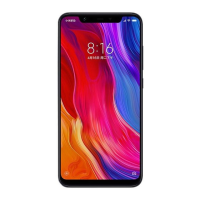
The Mi 8 is a smartphone designed for communication, entertainment, and various mobile computing tasks. It operates on MIUI, a customized Android-based operating system, offering a user-friendly interface and frequent updates. The device supports dual SIM functionality, allowing users to manage two different network services simultaneously. It is equipped with standard mobile phone features such as making calls, sending messages, and accessing the internet. The device also includes a camera for capturing photos and videos, and volume and power buttons for physical control.
Initial Setup: To begin using the Mi 8, users need to long-press the power button to turn on the device. Following the on-screen instructions will guide them through the initial configuration process, which typically includes setting up language, Wi-Fi, and Google account details.
Physical Controls: The device features volume buttons on its side, allowing users to adjust audio levels for calls, media, and notifications. A power button is also located on the side, used for turning the device on/off, locking/unlocking the screen, and accessing power options.
Charging and Connectivity: The Mi 8 is equipped with a USB Type-C port at the bottom for charging and data transfer. Users should only use the included or authorized cable and power adapter to charge the device to prevent fire, electric shock, or damage. After charging, the adapter should be disconnected from both the device and the power outlet.
SIM Card Installation: The device supports dual Nano-SIM cards, which can be inserted into the SIM card tray. Dual 4G SIM functionality requires support from local telecom operators and may not be available in all regions. Similarly, VoLTE support is region and operator dependent. System updates may be applied to optimize network performance.
Software and Updates: The Mi 8 comes pre-installed with MIUI, an Android-based OS known for its frequent updates and user-friendly features. Users are encouraged to update the phone's operating system using the built-in software update feature or by visiting authorized service outlets. Updating software through unauthorized means may damage the device, lead to data loss, or create security issues.
Safety Precautions: Users are advised to follow relevant laws and regulations regarding phone usage. The device should not be used in potentially explosive environments, such as fueling areas or areas with high concentrations of chemicals or dust. It is also recommended to turn off wireless devices in hospitals, operating rooms, and intensive care units to avoid interference with medical equipment. A minimum separation of 15 cm should be maintained between the mobile phone and pacemakers. Users should avoid using the phone near hearing aids or cochlear implants to prevent interference. Aircraft safety regulations must be respected, and the phone should be turned off on board aircraft when required. When driving, the phone should be used in accordance with traffic laws. To avoid lightning strikes, the phone should not be used outdoors during thunderstorms. It is also advised not to make calls while the phone is charging. The phone should not be used in high-humidity environments like bathrooms to prevent electric shock, injury, fire, or charger damage.
Battery Care: The Mi 8 is equipped with a built-in battery. Users should not attempt to replace the battery themselves to avoid damaging the battery or the device. The battery must be recycled or disposed of separately from household waste, following local regulations. Mishandling the battery can cause fire or explosion. Users should not disassemble, hit, crush, or burn the battery. If the battery shows any deformation, its use should be stopped immediately. Short-circuiting the battery should be avoided to prevent overheating, burns, or other personal injuries. The battery should not be placed in high-temperature environments, as overheating can cause an explosion.
Device Protection: The device should be kept dry. Users should not attempt to repair the device themselves. If any part of the device does not work properly, users should contact Mi customer support or bring the device to an authorized repair center. Incompatible devices should not be connected to the Mi 8.
Environmental Responsibility: The Mi 8 product and its battery should be disposed of correctly. The marking on the product indicates that it should not be disposed of with other household waste within the EU. To prevent environmental harm and promote sustainable reuse of materials, users should recycle the device responsibly through return and collection systems or by contacting the retailer where it was purchased.
Operating Temperature: The device's optimal operating temperature range is 0℃ to 40℃. Using the device outside this temperature range may cause damage.
Adapter Accessibility: For AC/DC Adapters, the socket-outlet should be installed near the equipment and be easily accessible.
RF Exposure Guidelines: Body-worn SAR testing has been conducted at a separation distance of 5 mm. To meet RF exposure guidelines during body-worn operation, the device should be positioned at least this distance away from the body. If an approved accessory is not used, ensure that any product used is free of metal and positions the phone at the indicated distance from the body. If a body-worn accessory is not used and the device is not held at the ear, the handset should be positioned a minimum of 1.0 cm from the body when switched on.
FCC Compliance: The device complies with part 15 of the FCC Rules, meaning it will not cause harmful interference and must accept any interference received. Changes or modifications not expressly approved by the party responsible for compliance could void the user's authority to operate the equipment.
E-label for Certification Information: The device includes an electronic label for certification information. This can be accessed by navigating to Settings > About Phone > Verification, or by typing "Verification" into the search bar within Settings.
 General
| Panel type | AMOLED |
|---|---|
| Screen shape | Curved edge screen |
| Pixel density | 402 ppi |
| Display diagonal | 6.21 \ |
| Display resolution | 2248 x 1080 pixels |
| Contrast ratio (typical) | 60000:1 |
| Graphics card | Adreno 630 |
| Wireless charging | No |
| Assisted GPS (A-GPS) | - |
| Processor family | Qualcomm Snapdragon |
| Processor frequency | 2.8 GHz |
| Audio formats supported | AAC, AAC+, FLAC, MP3, MP4, PCM, WAV |
| Video formats supported | H.264, H.265, HEVC, MKV, MP4, MPEG, XVID |
| RAM type | LPPDDR4X |
| RAM capacity | 6 GB |
| Internal storage capacity | 64 GB |
| Platform | Android |
| App distribution platform | Google Play |
| Flash type | LED |
| Rear camera type | Dual camera |
| Front camera type | Single camera |
| Maximum frame rate | 240 fps |
| Video recording modes | 720p, 1080p, 2160p |
| Rear camera aperture number | 1.8 |
| Resolution at capture speed | 1280x720@240fps, 1280x720@30fps, 1920x1080@120fps, 1920x1080@240fps, 1920x1080@30fps, 3840x2160@30fps |
| Video capture resolution (max) | 3840 x 2160 pixels |
| Rear camera resolution (numeric) | 12 MP |
| Front camera resolution (numeric) | 20 MP |
| Second rear camera aperture number | 2.4 |
| Talk time (3G) | - h |
| Battery capacity | 3400 mAh |
| 4G standard | LTE-TDD |
| 2G standards | GSM |
| 3G standards | TD-SCDMA, WCDMA |
| SIM card type | NanoSIM |
| Wi-Fi standards | 802.11a, Wi-Fi 5 (802.11ac), 802.11b, 802.11g, Wi-Fi 4 (802.11n) |
| Bluetooth version | 5.0 |
| SIM card capability | Dual SIM |
| Mobile network generation | 4G |
| Subscription type | No subscription |
| USB connector type | USB Type-C |
| Multimedia Messaging Service (MMS) | Multimedia Messaging Service (MMS) is a standard way to send messages that include multimedia content to and from a mobile phone over a cellular network |
| Form factor | Bar |
| Product color | White |
 Weight and Dimensions
| Depth | 7.6 mm |
|---|---|
| Width | 74.8 mm |
| Height | 154.9 mm |
| Weight | 175 g |

 To Next Page