Need help?
Do you have a question about the Xiaomi Mi 9T and is the answer not in the manual?
Details on dual SIM card support, primary card selection, and VoLTE.
Risk of explosion from incorrect battery replacement and safe disposal instructions.
Advice on preventing hearing damage from prolonged high volume usage.
Guidelines on using authorized accessories, operating temperature, and safe charging practices.
Precautions against battery damage, short circuits, and guidance on device repair.
Rules for phone use in hazardous or sensitive environments like hospitals or aircraft.
Information on updating the phone's operating system safely and potential risks.
Statement of compliance with EU Radio Equipment Directive 2014/53/EU.
Details on Specific Absorption Rate compliance for general population exposure.
Information on indoor use restrictions for specific frequency bands in EU countries.
Specifications for power adapters and receiver category.
Lists supported frequency bands and maximum radio-frequency power levels.
Statement on compliance with Part 15 of FCC Rules and interference guidelines.
FCC SAR limits and guidelines for body-worn accessories and device placement.
Warning about unauthorized modifications voiding user authority.
Accessing electronic labels and details on highest SAR values for the device.
This document is a user guide for the Mi 9T smartphone, providing essential information on its features, setup, safety, and regulatory compliance. The guide is structured to help users understand and operate their device effectively and safely.
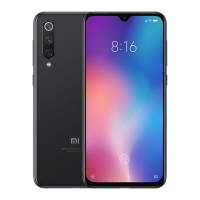
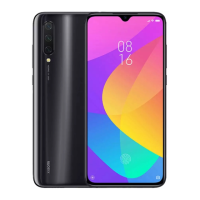
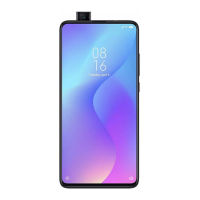
The Mi 9T is a smartphone featuring a pop-up selfie camera, which is a distinctive design element that allows for a full-screen display without a notch. The device includes standard physical buttons for volume control and power, located on the side for easy access. For connectivity and charging, it is equipped with a USB Type-C port at the bottom.
To power on the Mi 9T, users need to long-press the power button. Once the device is turned on, on-screen instructions will guide them through the initial setup process, allowing for personalization and configuration of various settings.
The Mi 9T comes pre-installed with MIUI, Xiaomi's customized Android-based operating system. MIUI is known for its frequent updates and a wide array of user-friendly features, many of which are suggested by its extensive global user base. This ensures a continuously evolving and optimized user experience. Users can find more information about MIUI and its features on Xiaomi's official website.
The device supports dual nano-SIM cards, allowing users to utilize two different mobile network services simultaneously. When both SIM card slots are occupied, either card can be designated as the primary card for calls, messages, and data. The Mi 9T supports dual 4G SIM functionality, though this feature's availability may depend on local telecom operator services and regional support. It's also noted that only certain regions and telecom operators support VoLTE (Voice over LTE). System updates may be applied to optimize network performance, and users are advised to refer to the device's system version for specific details.
The user guide emphasizes several critical safety precautions to ensure the safe operation and longevity of the Mi 9T.
The device's battery is a key focus of safety instructions. Users are warned against replacing the built-in battery themselves to prevent damage to the battery or the device. Charging should only be done with the included or authorized cable and power adapter; using unauthorized adapters can lead to fire, electric shock, or damage. After charging, the adapter should be disconnected from both the device and the power outlet, and charging should not exceed 12 hours.
Proper disposal of the battery is also highlighted. It must be recycled or disposed of separately from household waste, following local regulations, as mishandling can cause fire or explosion. Users are explicitly instructed not to disassemble, hit, crush, or burn the battery. If the battery shows any signs of deformation, its use should be immediately discontinued. Furthermore, short-circuiting the battery is prohibited to prevent overheating, burns, or other injuries. The battery should not be placed in high-temperature environments, as this could lead to an explosion.
The Mi 9T's operating temperature range is specified as 0 °C to 40 °C. Using the device outside this range may cause damage. Users are advised to keep the device dry and avoid attempting repairs themselves. In case of malfunction, contacting Mi customer support or an authorized repair center is recommended. Connecting incompatible devices is also cautioned against. For AC/DC adapters, the socket-outlet should be easily accessible and located near the equipment.
The guide includes a marking indicating that the product should not be disposed of with other household waste in the EU, promoting responsible recycling to prevent environmental harm and promote sustainable reuse of materials. Information on environmental declarations is provided via a link.
Regarding hearing safety, users are warned against listening at high volume levels for extended periods to prevent possible hearing damage. More detailed safety information is available in the User Manual online.
Strict adherence to laws and rules restricting mobile phone use in specific cases and environments is advised. This includes refraining from using the phone in petrol stations, explosive atmospheres (such as fueling areas, below decks on boats, fuel or chemical transfer/storage facilities, or areas with chemicals or particles like grain, dust, or metal powders). Users must obey all posted signs to turn off wireless devices in blasting areas or where "two-way radios" or "electronic devices" are prohibited to avoid interference.
In healthcare settings, such as hospital operating rooms, emergency rooms, or intensive care units, phone use is prohibited. Users should comply with hospital rules and regulations and consult their doctor and the device manufacturer to determine if phone operation might interfere with medical devices. To prevent interference with pacemakers, a separation of 15cm should be maintained, using the phone on the opposite ear and avoiding carrying it in a breast pocket. Similarly, the phone should not be used near hearing aids or cochlear implants to prevent medical equipment interference.
Aircraft safety regulations must be respected, and the phone should be turned off on board aircraft when required. When driving, the phone should be used in accordance with relevant traffic laws and regulations. To avoid lightning strikes, outdoor use during thunderstorms is discouraged. Making calls while the phone is charging is also advised against. Lastly, using phones in high-humidity places like bathrooms is cautioned, as it may lead to electric shock, injury, fire, or charger damage.
Users are advised to update the phone's operating system using the built-in software update feature or through authorized service outlets. Updating software through unauthorized means may damage the device, result in data loss, or create security vulnerabilities.
The Mi 9T (model M1903F10G) complies with the essential requirements and other relevant provisions of the RE Directive 2014/53/EU, as declared by Xiaomi Communications Co., Ltd. The full text of the EU declaration of conformity is available online.
The device is restricted to indoor use only when operating in the 5150 to 5350MHz frequency range in specific EU countries listed in the guide. The power adapter must meet IEC60950-1/EN60950-1 requirements and be nationally or locally approved.
The guide lists the maximum radio-frequency power for various frequency bands supported by the Mi 9T in EU areas, including GSM, UMTS, LTE, Bluetooth, Wi-Fi (2.4 GHz and 5 GHz), and NFC.
The Mi 9T complies with Specific Absorption Rate (SAR) limits for general population/uncontrolled exposure, as specified by Council Recommendation 1999/519/EC, ICNIRP Guidelines, and RED (Directive 2014/53/EU). During SAR testing, the device transmitted at its highest certified power level. For head usage, no separation was used, and for body usage, a 5 mm separation was maintained. To ensure compliance for body operation, users should carry the device at least 5 mm away from their body and use belt clips or holsters that do not contain metallic components. Body-worn accessories containing metal were not tested or certified and should be avoided.
The device complies with Part 15 of the FCC Rules, meaning it will not cause harmful interference and must accept any interference received. It has been tested and found to comply with Class B digital device limits, designed to provide reasonable protection against harmful interference in residential installations. If interference occurs, users are advised to reorient the receiving antenna, increase separation between equipment and receiver, connect equipment to a different circuit, or consult a dealer/technician.
The device meets government requirements for exposure to radio waves, with an FCC SAR limit of 1.6W/Kg. For body-worn operation, the device should be kept a minimum of 1.5 cm from the body using accessories without metal. If not holding the device at the ear, it should be positioned a minimum of 1.5 cm from the body when switched on.
The Mi 9T features an electronic label for certification information, accessible via Settings > About Phone > Certification or by searching "Certification" in Settings. The guide also provides the highest SAR values for head, body, and hotspot usage, confirming compliance with both 10g and 1g SAR limits. The model number M1903F10G indicates a launch after March 2019.
The user guide is published by Xiaomi or its affiliated company. It states that improvements and changes may be made to the guide due to typographical errors, inaccuracies, or updates to programs and equipment, without prior notice. These changes will be incorporated into new editions. All illustrations in the guide are for illustrative purposes only and may not precisely depict the actual device.
 General
| Display | 6.39 inches, AMOLED, 1080 x 2340 pixels |
|---|---|
| Processor | Qualcomm Snapdragon 730 |
| RAM | 6 GB |
| Storage | 64GB/128GB |
| Battery | 4000mAh |
| Weight | 191g |
| Dimensions | 156.7 x 74.3 x 8.8 mm |
| Colors | Carbon Black, Red Flame, Glacier Blue |
| SIM | Dual SIM (Nano-SIM, dual stand-by) |
| Network | GSM / HSPA / LTE |
| Rear Camera | 48 MP + 8 MP + 13 MP |
| Front Camera | 20 MP (pop-up) |
| Operating System | Android 9.0 (Pie) |

 To Next Page