
 Need help?
Do you have a question about the Xiaomi POCO F3 and is the answer not in the manual?
Details about the SIM card slot and its compatibility.
Details on dual SIM card functionality and support.
Declaration of conformity with the RE Directive 2014/53/EU for the mobile phone.
Information on Specific Absorption Rate (SAR) limits for general population/uncontrolled exposure.
Details on the highest SAR values for head and body operation.
Information regarding device operation in EU member states and frequency restrictions.
Government requirements for radio wave exposure and FCC SAR limits.
Notes on compliance with FCC rules, including modifications and shielded cables.
Information on accessing electronic certification labels on the device.
This document serves as the User Guide for the POCO F3 smartphone, providing essential information for its setup, operation, and maintenance. It outlines the device's core functionalities, safety precautions, and regulatory compliance, ensuring users can operate their device effectively and safely.
The POCO F3 is designed to be user-friendly, starting with its initial setup. To power on the device, users simply long-press the power button located on the side. Once powered on, on-screen instructions guide the user through the configuration process, making it straightforward to get the device ready for use. For more detailed information or assistance, users are directed to the official Xiaomi website, which offers comprehensive user guides and support resources.
At the heart of the POCO F3's software experience is MIUI (for POCO), a customized Android-based operating system developed by Xiaomi. MIUI is known for its frequent updates and user-friendly features, which are often refined based on feedback from a large global user base. This ensures that the POCO F3 benefits from a continually evolving and optimized software environment, enhancing the overall user experience with new functionalities and improved performance. Users can find more information about MIUI on its dedicated website.
The device supports dual SIM functionality, offering flexibility for users who need to manage two different phone numbers or network plans. The SIM card tray accommodates two Nano-SIM cards, and either slot can be designated as the primary card. The POCO F3 supports various network technologies, including 5G, 4G, 3G, and 2G, with specific band support depending on the primary and secondary card configurations. It also supports Dual SIM VoLTE, which enhances call quality over LTE networks. Users are advised to use only standard SIM cards to prevent damage to the SIM card slot and are explicitly warned against disassembling the device, as this could void warranties and pose safety risks.
Safety is a paramount concern, and the guide provides extensive information on safe usage and maintenance. It highlights the importance of using only authorized cables, power adapters, and batteries to prevent fire, explosion, or other hazards. The device is designed to operate within a specific temperature range (0°C to 40°C), and using it outside this range may cause damage. For devices with built-in batteries, users are cautioned against attempting to replace the battery themselves, emphasizing that such repairs should only be performed by authorized service centers. Charging instructions specify using only included or authorized accessories and disconnecting the adapter once charging is complete, avoiding overcharging for more than 12 hours.
Proper disposal of the battery and the device itself is also covered, aligning with environmental regulations. Batteries must be recycled or disposed of separately from household waste to prevent fire or explosion. Users are instructed not to disassemble, hit, crush, or burn the battery, and to discontinue use immediately if the battery appears deformed or damaged. Short-circuiting the battery or placing it in high-temperature environments can lead to overheating, burns, or explosion.
The guide includes a WEEE (Waste Electrical and Electronic Equipment) marking, indicating that the product should not be discarded with other household waste in the EU. This promotes responsible recycling and reuse of material resources. Users are encouraged to utilize return and collection systems or contact the retailer for safe recycling.
Beyond battery safety, the guide outlines general safety precautions for mobile phone use. Users must observe all applicable laws and rules restricting mobile phone use in specific situations, such as at petrol stations, in explosive atmospheres, or in hospitals. It advises turning off the phone in blasting areas or where "two-way radios" or "electronic devices" are required to be off. For users with medical devices like pacemakers, a minimum distance of 15 cm should be maintained between the phone and the medical device to avoid interference. Similarly, using the phone near hearing aids or cochlear implants should be avoided.
Aircraft safety regulations require turning off the phone on board aircraft when necessary. When driving, users should comply with traffic laws and regulations regarding phone use. To prevent lightning strikes, outdoor phone use during thunderstorms is discouraged. Additionally, users should avoid making calls while the phone is charging and refrain from using it in high-humidity environments like bathrooms, as this could lead to electric shock, injury, fire, or charger damage.
The document also includes a Security Statement, advising users to update their phone's operating system only through the built-in software update feature or authorized service outlets. Updating software through unauthorized means can lead to device damage, data loss, security issues, and other risks.
Regulatory compliance is detailed under EU Regulations, with a RED Declaration of Conformity stating that the POCO F3 (model M2012K11AG) complies with the essential requirements and other relevant provisions of the RE Directive 2014/53/EU. The full text of this declaration is available online.
RF Exposure Information (SAR) is provided, confirming that the device complies with Specific Absorption Rate limits for general population/uncontrolled exposure. During SAR testing, the device was set to transmit at its highest certified power level in various frequency bands, simulating use against the head with no separation and near the body with a 5 mm separation. For body-worn operation, the device should be carried at least 5 mm away from the body, using belt clips or holsters that do not contain metallic components.
Certification Information lists the highest SAR values for head and body, ensuring transparency regarding RF exposure levels. Legal Information states that the device can be operated in all EU member states, but users must observe national and local regulations. Indoor use is restricted for the 5150 to 5350 MHz frequency range in certain countries.
The guide also lists the frequency bands and maximum radio-frequency power for various technologies supported by the POCO F3 in EU areas, including GSM, WCDMA, LTE, 5G NR, Bluetooth, Wi-Fi, and NFC.
For FCC Regulations, the mobile phone complies with part 15 of the FCC Rules, meaning it will not cause harmful interference and must accept any interference received. It is classified as a Class B digital device, designed to provide reasonable protection against harmful interference in a residential installation. Users are advised on measures to correct interference, such as reorienting the antenna, increasing separation between equipment and receiver, or connecting to a different circuit.
The RF Exposure Information (SAR) for FCC compliance states that the device meets government requirements for exposure to radio waves, with a SAR limit of 1.6 W/Kg. For body-worn operation, the device has been tested to meet FCC RF exposure guidelines when used with an accessory containing no metal and positioned at least 1.5 cm from the body.
An E-label for certification information is accessible through the device's settings, providing a convenient way to view regulatory details. The model number M2012K11AG and its launch year (2020) are also mentioned.
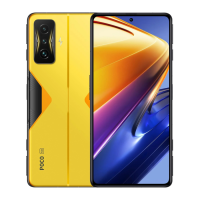
Finally, a Disclaimer clarifies that the user guide is published by Xiaomi or its affiliated company, and improvements or changes may be made without notice due to typographical errors, inaccuracies, or program enhancements. These changes will be incorporated into new online editions of the guide. All illustrations are for reference only and may not precisely depict the actual device. The smartphone is designed with Corning® Gorilla® Glass 5, highlighting its durability.
 General
| Panel type | AMOLED |
|---|---|
| Screen shape | Curved edge screen |
| Display diagonal | 6.67 \ |
| Display brightness | 900 cd/m² |
| Display resolution | 2400 x 1080 pixels |
| Native aspect ratio | 20:9 |
| Maximum refresh rate | 120 Hz |
| Gorilla Glass version | Gorilla Glass 5 |
| Contrast ratio (typical) | 5000000:1 |
| Maximum display brightness (HDR) | 1300 cd/m² |
| High Dynamic Range (HDR) supported | Yes |
| High Dynamic Range (HDR) technology | High Dynamic Range 10+ (HDR10 Plus) |
| Processor cores | 8 |
| Processor model | 870 |
| Processor family | Qualcomm Snapdragon |
| Processor frequency | - GHz |
| Processor boost frequency | 3.2 GHz |
| RAM type | LPDDR5 |
| RAM capacity | 6 GB |
| Compatible memory cards | MicroSD (TransFlash) |
| Internal storage capacity | 128 GB |
| Rear camera type | Triple camera |
| Front camera type | Single camera |
| Maximum frame rate | 60 fps |
| Video recording modes | 1080p |
| Rear camera pixel size | 1.6 µm |
| Rear camera aperture number | 1.79 |
| Resolution at capture speed | 1280x720@30fps, 1920x1080@60fps, 3840x2160@30fps |
| Front camera aperture number | 2.45 |
| Rear camera resolution (numeric) | 48 MP |
| Front camera resolution (numeric) | 20 MP |
| Third rear camera aperture number | 2.4 |
| Second rear camera aperture number | 2.2 |
| Second rear camera resolution (numeric) | 8 MP |
| Second rear camera field of view (FOV) angle | 119 ° |
| 4G standard | LTE-TDD & LTE-FDD |
| 3G standards | WCDMA |
| SIM card type | - |
| Wi-Fi standards | Wi-Fi 6 (802.11ax) |
| Bluetooth version | 5.1 |
| SIM card capability | Dual SIM |
| Mobile network generation | 5G |
| USB connector type | USB Type-C |
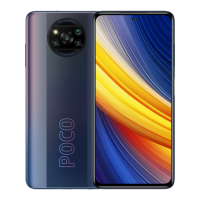
| Color name | Night Black |
| Form factor | Bar |
| Product color | Black |
| Speakers | stereo |
| Audio system | Dolby Atmos |
| Platform | Android |
| Operating system installed | Android 10.0 |
| Gaming time | 10 h |
| Talk time (3G) | - h |
| Battery capacity | 4520 mAh |
| Wireless audio playback time | 149 h |
| Continuous video playback time | 14 h |
| Harmonized System (HS) code | 85171300 |
 Weight and Dimensions
| Depth | 7.8 mm |
|---|---|
| Width | 76.4 mm |
| Height | 163.7 mm |
| Weight | 196 g |


 To Next Page