Need help?
Do you have a question about the Xiaomi Redmi Note 3 and is the answer not in the manual?
This document describes the Redmi Note 3 smartphone, outlining its basic functions, usage features, and information regarding its operating system and security.
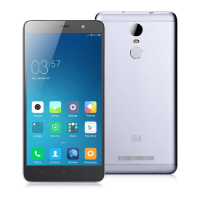
The Redmi Note 3 is a smartphone designed for general use, featuring a main display for user interaction, physical buttons for control, and an integrated camera for photography. Its primary function is to provide a portable computing and communication platform.
To begin using the Redmi Note 3, the user needs to activate the smartphone. This is done by pressing and holding the power button, which is conveniently located on the right side of the device. After activation, the user will be guided through the initial setup instructions on the smartphone's main display. This setup process typically involves configuring essential settings to personalize the device for the user's preferences and needs.
The device's physical layout includes several key components for user interaction. On the right side, in addition to the power button, there are volume buttons, allowing users to adjust audio levels for calls, media, and notifications. The rear of the smartphone features a camera, enabling users to capture photos and videos. Below the camera, a fingerprint scanner is integrated, providing a secure and convenient method for unlocking the device and authenticating certain actions. This biometric security feature enhances user privacy and ease of access.
The main display serves as the primary interface for all applications and features. It shows the current time (e.g., 06:23) and date (e.g., November 24th, Tuesday, as indicated by "11月24日周二" in the image). The display also presents the "Main Display" area where applications and content are shown. At the bottom of the display, there are navigation buttons: "Tasks" (represented by three horizontal lines), "USB port" (represented by a square), and "Back" (represented by a left arrow). These buttons facilitate navigation within the operating system and applications. The "上滑解锁" text on the display suggests a "slide to unlock" gesture, a common method for accessing the phone from a locked state.
The Redmi Note 3 runs on MIUI, an operating system that offers a rich collection of useful applications and features. MIUI is described as having been "created with the millions of fans," suggesting a user-centric development approach that incorporates feedback and preferences from its user base. This implies that the operating system is designed to be intuitive and feature-rich, catering to a wide range of user needs. For more detailed information about MIUI's features, users can visit www.miui.com/features.php.
The device also supports connectivity options, indicated by the "USB port" label, which likely refers to a physical port for charging and data transfer. The presence of a QR code on the document suggests that users can scan it to access additional ROM (Read-Only Memory, often referring to the operating system firmware) and instructions, providing a quick way to get further support or updates. The URL http://xiaomi-mi.com is also provided for general information about the device and its ecosystem.
Regarding maintenance, the document touches upon security and system updates. For updating the phone system, users have a couple of options. They can contact individual official local Mi affiliates for assistance, which suggests a network of authorized service providers or support centers. Alternatively, users can utilize the "self-updating feature of Mi phone," indicating that the device has built-in capabilities to download and install system updates directly, likely over-the-air (OTA). This self-updating feature is crucial for keeping the device secure and ensuring it runs the latest software with bug fixes and new functionalities.
For general information and support, users are directed to visit xiaomi-mi.com. This website serves as a central hub for resources, potentially including FAQs, user manuals, and community forums, which can help users troubleshoot issues or learn more about their device. The emphasis on "More information" and specific URLs for MIUI features and general support highlights the availability of resources for users to maintain and optimize their smartphone experience.
In summary, the Redmi Note 3 is presented as a user-friendly smartphone with standard physical controls, a secure fingerprint scanner, and a feature-rich MIUI operating system. Its activation and setup process is straightforward, and users are provided with multiple avenues for support and system maintenance, including self-updating features and official support channels.
 General
| RAM | 2GB / 3GB |
|---|---|
| Internal Storage | 16GB / 32GB |
| Front Camera | 5 MP |
| Battery | 4050 mAh |
| Dimensions | 150 x 76 x 8.7 mm (5.91 x 2.99 x 0.34 in) |
| Weight | 164 g (5.78 oz) |
| SIM | Hybrid Dual SIM (Micro-SIM/Nano-SIM, dual stand-by) |
| Colors | Silver, Gray, Gold |
| Display | 5.5 inch IPS LCD |
| Processor | Qualcomm MSM8956 Snapdragon 650 |
| Main Camera | 16 MP |
| Operating System | Android 5.1.1 (Lollipop), upgradable to 6.0 (Marshmallow), MIUI 7 |