Rapid Charging
For rapid charging, set the charge current to 1.1 A, and use a high-quality peak-detection charger with automatic shut-off. Do not use higher current; if
rapid charging is done at a higher current, the battery pack may generate too much heat and explode or vent. Never leave the battery pack unattended
while it is charging. If the battery pack becomes too hot (113°F or higher), stop charging immediately.
Recommended Charger
We strongly recommend using a high-quality peak-detection charger with automatic shut-off. The charger should be specifi cally designed for charging
rechargeable nickel metal hydride (NiMH) cells.
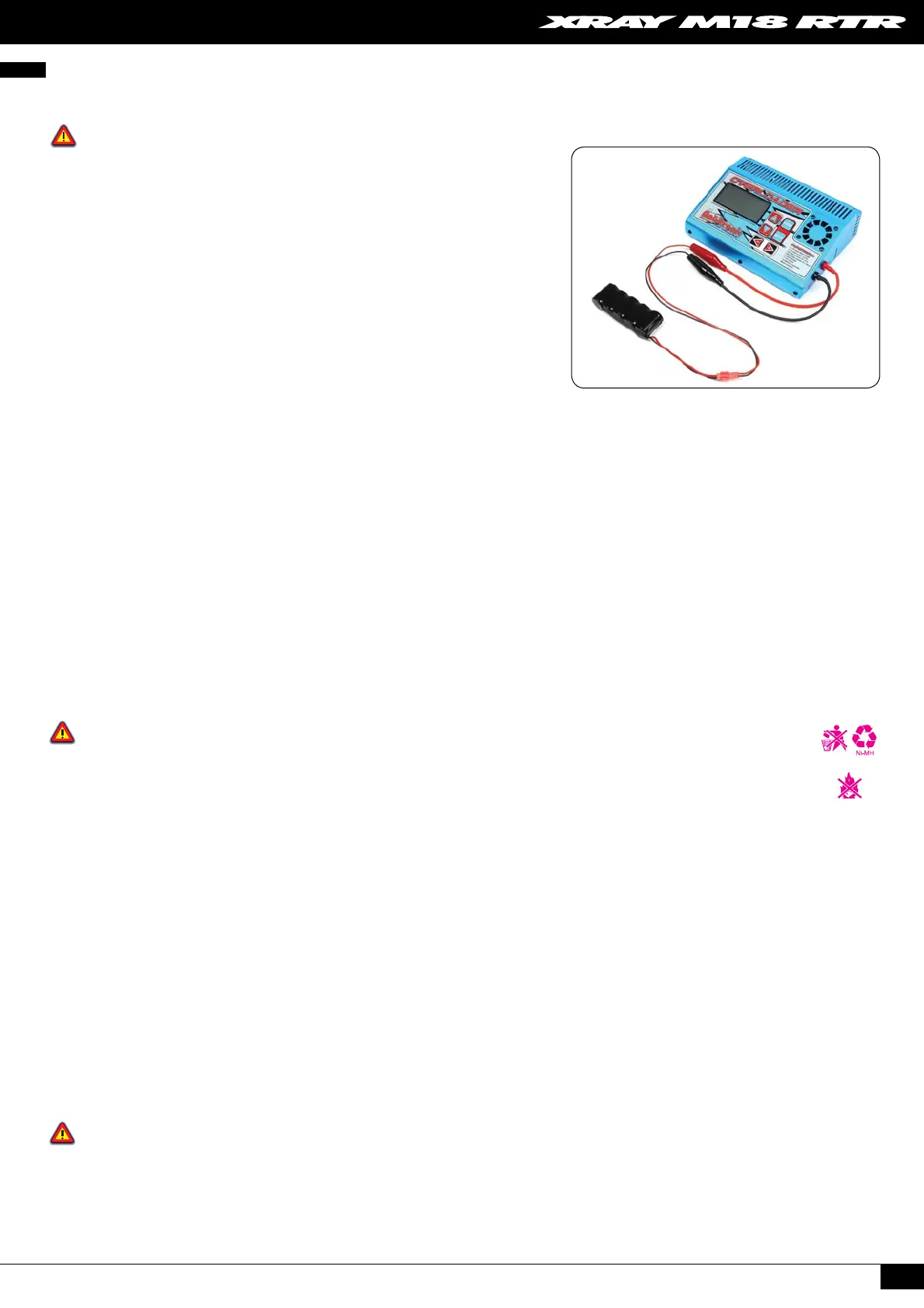
TIP: For charging use the included #389130 charging cable. Make sure to connect the red wire (+) to the positive (+) slot on the charger and connect
the black wire (-) to the negative (-) slot on the charger.
Discharging and Storage
After use, we DO NOT RECOMMEND discharging the pack completely, as this will damage the pack. You can safely recharge the pack immediately after
use without any performance degradation. If you will be storing the pack for longer than a month, partially discharge the pack down to approximately
40% capacity.
IMPORTANT Battery Pack Warnings
• Never disassemble the battery pack or peel away the cover.
• Keep the battery pack away from water.
• Do not touch the battery pack with wet hands or wet objects.
• Do not subject the battery pack to strong impacts and short circuits.
• Keep the battery pack away from fi re and fl ammable objects.
• Disconnect the battery pack when it is not in use.
• Do not put metal objects in the battery pack connector or touch the terminals
• in the connector.
• Do not throw away the battery pack when you no longer need it. Bring it to the shop from which you bought it, or to a shop offering battery recycling
service.
• If leaked battery alkaline electrolyte gets in your eyes or on your skin, fl ush thoroughly with clean water and consult with a doctor immediately.
• Regularly check the wiring for damage. While running the car, vibration or movement may cause damage to the wires which if left unchecked may
result in a short circuit. If any wire insulations becomes damaged, please dispose of the battery pack properly and do not use it, nor try to repair it.
• You are responsible for the proper use of this battery pack and any damage that may occur due to its use or misuse. XRAY is not liable for any injury,
damage, or harm caused to any person or property arising from the use or misuse of their products.
Battery Pack Warranty
A new, unused battery pack is guaranteed against manufacturer‘s defects and workmanship. Any damage due to misuse by the user will be repaired at
the user‘s expense. There is no warranty expressed or implied that covers damage caused by normal use, or covers or implies how long the battery pack
will run (run time), or last before requiring replacement due to normal use and normal cell degradation. XRAY shall not be liable for any damage caused
by overcharging, battery failure, improper charging or discharging, use of non-approved chargers, use of non-approved batteries, and alternations or
modifi cations of any kind to the charger, batteries, switches, or wiring.
Battery Pack Note
When using the battery pack in the micro model cars, some of the battery packs may be slightly longer than others due to the way wiring is made on
individual packs. This may lead to complications when inserting the battery pack on the chassis between the battery holding posts (which hold the battery
strap). If this occurs, we recommend that you trim a small amount of material from the battery holding posts so the battery packs sits properly on the chassis
without problem. We also recommend that you attach a small foam strip to bottom of the battery strap to remove any gap between the strap and the battery
pack. This will help to keep the battery pack in place and prevent it from falling out.
M18 BATTERY PACK INSTRUCTIONS
The M18 RTR comes with a 5-cell NiMH battery pack. Follow these instructions how to charge and install the battery pack.
Cycling – Extremely Important
Cycle the battery pack before using for the fi rst time.
When cycling the battery pack for the fi rst time, carefully follow these instructions:
1. Set the charge current 110 mA (0.11A).
2. Charge the battery pack for 14-16 hours. During charging it may happen that the
charger will stop charging while the battery pack is not fully charged. In such case you
can continue charging until the battery pack is fully charged. This may happen one or
more times during charging and this issue is related to the type of charger or type of
charging used.
3. After 14-16 hours disconnect the battery pack, even if the charger is still charging it.
4. Let the battery pack rest for 1 day.
5. After 1 day discharge the battery pack. Set the discharger to a 1.1A discharge rate,
and set the discharge cut-off voltage to 4.5V for the pack (0.9V per cell).
6. Let the battery pack rest for 6 hours.
Your battery pack has now been cycled and you can use it safely.
RECYCLE THE BATTERY PACK!
DO NOT DISPOSE OF IN FIRE!
6


 To Next Page
 Loading...