
 Need help?
Do you have a question about the Xtreme Power HIGH FREQUENCY Series and is the answer not in the manual?
Covers essential safety measures for installation, operation, and servicing to prevent hazards.
Guidelines for choosing an installation site to ensure performance and longevity.
Ensuring the charger's AC voltage and phase match the available electrical service.
Instructions on performing an equalizing charge to re-balance battery cells.
Explains the meaning of various display icons and indicators used by the control system.
Details module-specific fault codes (M1-M7) and their potential causes.
Lists common symptoms and their potential causes for charger malfunctions.
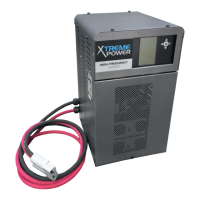
This document is an installation and operation manual for a High Frequency Battery Charger, specifically the XTREME POWER series from Ferro Magnetics Corporation. The manual provides comprehensive instructions for the safe and effective use and maintenance of the charger.
The primary function of this device is to charge industrial batteries. It is designed to be fully automatic, detecting the presence of a battery and initiating a charge cycle without manual intervention. The charger supports various battery chemistries, including standard flooded, gel-cell, sealed lead-acid, nickel-cadmium, and lithium-ion batteries. Each battery type has a specific charging profile, or algorithm, that controls the output current and voltage to ensure optimal charging based on the battery manufacturer's recommendations. This intelligent control system aims to maximize battery life and efficiency.
Key usage features revolve around its user-friendly interface and advanced charging capabilities. The charger is equipped with a keypad featuring four directional buttons (UP, DOWN, LEFT, RIGHT) and a central On/Off (I/O) button. This keypad allows users to terminate a charge cycle, select or unselect an equalize cycle, and view various charge data and history. During a charge cycle, pressing the RIGHT (info) button displays additional charge data, such as charging amps, and subsequent presses reveal more parameters. The UP and DOWN buttons allow users to review past charge cycles, with data for up to 100 previous cycles stored.
The charger also provides clear status indications through a multi-color LED backlight integrated into the I/O button. Different LED colors signify various states: flashing green for "Charger ready for battery," solid green for "Charge complete," flashing amber for "Charging," solid amber for "Battery connected, Charger OFF," and solid red for "Abnormal charge detected." This visual feedback system makes it easy for operators to quickly assess the charger's status.
An important feature is the "Equalize Charge" function, designed to re-balance cell charges within a battery over time, which can otherwise lead to reduced capacity and shortened battery life. Equalization can be performed automatically based on a programmed number of charge cycles or a specific day of the week, or manually initiated via the LEFT (=) button. The manual provides guidelines for when an equalize charge is recommended, such as when specific gravity or on-charge voltage disparities are observed, or after a battery has been stored for 30 days.
The charger incorporates a TOBi® PI (Battery Module) communication feature. When enabled, this allows the charger to communicate with a TOBi® PI module installed on the battery, transferring critical information like battery temperature. This enables temperature compensation during charging, adjusting voltage milestones based on temperature to prevent overheating or undercharging. The charger can also upload and utilize a specific charge algorithm from the TOBi® PI, which is particularly useful in environments with multiple battery types or AH sizes. If communication fails, the charger defaults to its internal algorithm settings.
Safety is a paramount concern, and the manual details several safety instructions. It warns against lethal voltage levels and emphasizes that installation and servicing must be performed by qualified personnel. Proper grounding, adherence to electrical codes, and installation on non-combustible surfaces are mandatory. The charger is designed for indoor use only and should not be exposed to water. Users are cautioned against connecting or disconnecting the battery plug while the charger is on, as this can cause arcing, damage, or even battery explosion. The manual also highlights the dangers of hydrogen gas produced during charging and the caustic nature of sulfuric acid in lead-acid batteries, advising proper ventilation and personal protective equipment.
Maintenance features are straightforward, emphasizing minimal upkeep. The charger requires periodic cleaning with dry compressed air to prevent dirt buildup on components, ensuring connections and terminals remain clean and tight. Users are advised to disconnect both AC and DC power before cleaning and to avoid bumping or moving any adjustments.
The manual also includes a comprehensive troubleshooting guide, listing common symptoms and their possible causes, such as "No charging current," "AC fuse blows," or "Excessive water loss in battery." This section helps users diagnose issues, from blown fuses and incorrect voltage settings to defective control boards or power modules. It also provides guidance on how to clear fault indications, often by correcting the underlying condition and disconnecting the battery. A specific override function for "Low Battery" conditions allows the charger to start even if the battery voltage is below the automatic start threshold, provided the battery is of the correct voltage and merely overly discharged.
Overall, the High Frequency Battery Charger is designed for robust, automatic, and safe operation in industrial settings, with features that promote battery longevity and ease of use, supported by clear operational and maintenance guidelines.
 General
| Input Voltage | 100-240VAC |
|---|---|
| Input Frequency | 50/60Hz |
| Output Voltage | 12V/24V/48V DC |
| Output Current | 10A/20A/30A |
| Equalize Voltage | 14.4V/28.8V/57.6V |
| Operating Temperature | -20°C to 50°C |
| Charging Mode | 3-Stage Charging: Constant Current, Constant Voltage, Float |
| Protection Features | Over Voltage, Over Current, Short Circuit, Reverse Polarity, Over Temperature |
| Cooling Method | Fan Cooled |

 To Next Page