Yak 18T Flight Operations Manual
Page 8 of 82
Disclaimer: This manual is to be used as a reference only, it is based on translated Yak 18T Flight Operations
Manuals and has not been approved by the Yakovlev Design Bureau or any other authority.
influence (air intakes are located on both sides of the fuselage and on the canopy upper
frame). Left windshield is provided with an electric drive windshield wiper. The service
ceiling is 5,520m (16,730 ft). But as oxygen system is not available on-board, it is not
permitted to fly higher than 4,000m (13,120 ft) as it is stated later in this Flying Operations
Manual (FOM).
The power plant consists of the M-14P engine and a variable-pitch propeller V530TA-D35 with
an rpm governor R-2. It is completely identical to the propeller group of the Yak-52s, except
for some little differences in engine mounting. The tricycle-equipped landing gear with the
nose strut is retractable. The front strut wheel is castor. The main landing gear wheels have
block brakes. All landing gears are of telescopic type with a oleo-pneumatic shock-strut
(AMG-10 oil and nitrogen). The double action shock struts are used in the Yak 18T. They
ensure overcoming of the unpaved runway roughness with a smaller loading for frame
construction. The tire pressure is 3 kgpcm² (61lbpsq.ft). A skilled pilot can turn the aircraft
around practically on one wheel. The turning radius equals the landing gear tread width. A
parking brake system is provided for the Yak 18T. In the case of the main system failure, the
emergency system can perform all the functions except for the M-14P start. The capacity of a
main air system cylinder is 12l (3.2 gal), the emergency one is 3l (0.8 gal). During the flight
the air system is recharged from the AK-50T compressor, mounted on the engine.
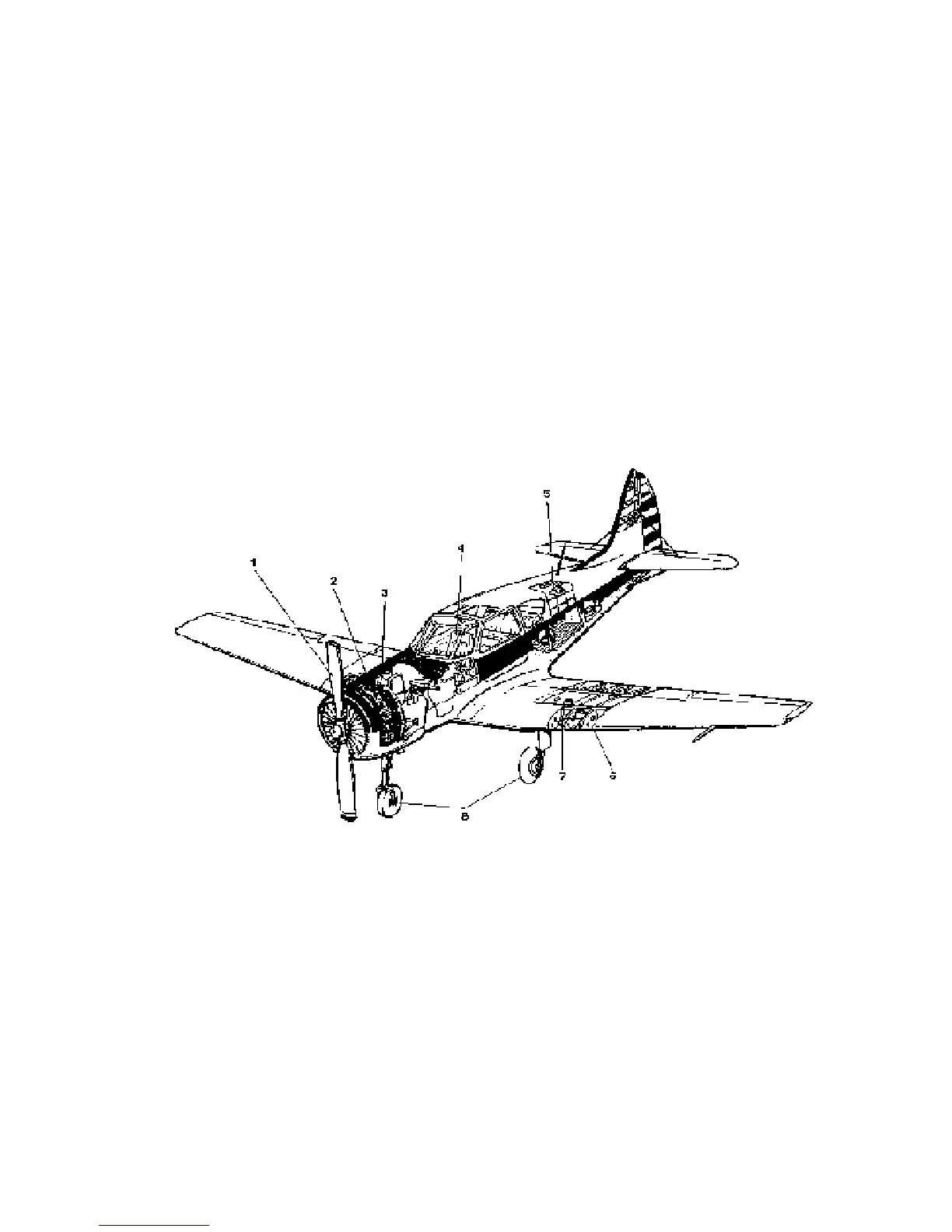
1. Propeller
2. M-14P engine
3. Oil tank
4. Pilot chair
5. Radio equipment
6. Landing light
7. Fuel tank
8. Retractable landing gear
The fuel (standard version) is distributed in two main tanks with the capacity of 95l (25 gal)
each and in the service tank with the capacity of 3.5l (0.9 gal). The fuel is fed by gravity from
the main tanks to a service tank, located in wing panels. The service tank is mounted lower
than the main ones. The fuel is fed from the service tank, mounted on the engine by the
702K rotary pump. Before the engine start-up a fuel priming pump is used for priming its
cylinders and the 702K fuel pump. The fuel to be used is B-91/115 gasoline, GOST (State All-



 To Next Page