2-72-6
A separate throttle lever controls each
engine. In normal operation the throttle
levers are moved together. Moving the
throttle levers forward increases engine
speed. Move both throttles to the idle
position before using the shift lever.
SHIFT LEVER
SEVERE INJURY OR DEATH MAY
RESULT IF YOU IGNORE ANY OF
THE FOLLOWING.
Check throttle, steering, and shift
lever for proper operation before
starting the engines.
Shift into neutral before starting
engines.
Put throttle levers in idle position
before shifting.
Make sure there are no people or
objects behind the boat before
starting or shifting into Reverse.
When operating in Reverse, go
slowly. Do not open the throttle
more than half. Otherwise, the
boat may become unstable,
which could result in loss of con-
trol and an accident.
Do not shift into Reverse while
traveling at planing speeds. Loss
of control, boat swamping, or
damage to the boat could occur.
Do not use control levers as grab
handles because damage can occur.
NOTE: This Sport Boat is equipped
with a mechanical interlock that pre-
vents shift lever movement unless both
throttle levers are put in the idle posi-
tion first. It also has a start-in-gear pro-
tection neutral switch that prevents the
engines from cranking if the shift lever
is not in Neutral.
1 Reverse
2 Neutral
3 Forward
The shift lever controls the direction of
travel.
The drive line on the Sport Boat is
direct drive, so jet thrust is always
being produced while the engines are
running. The direction of the boat is
controlled by jet pump gates which
direct the flow of the jet thrust as fol-
lows:
Forward
The jet pump gates are lifted all the way
up. All jet thrust is to the rear, which
FEATURES & FUNCTIONS 2
3
2
1
Always attach the engine shut-off
cord to your personal flotation
device (PFD) BEFORE starting
the engine. Failure to attach the
cord could result in a runaway
boat if the operator is ejected.
Do not attach the cord to clothing
that could tear loose. Do not route
the cord in such a way that it
could become entangled, pre-
venting it from functioning.
Avoid accidentally pulling the
cord during normal operation.
Once the engine has stopped you
have no steering control of the
boat which could result in an
accident. Also, without engine
power, the boat could slow rapid-
ly from planing speed. This could
cause people and objects in the
boat to be thrown forward, which
could cause injury.
MAIN SWITCHES
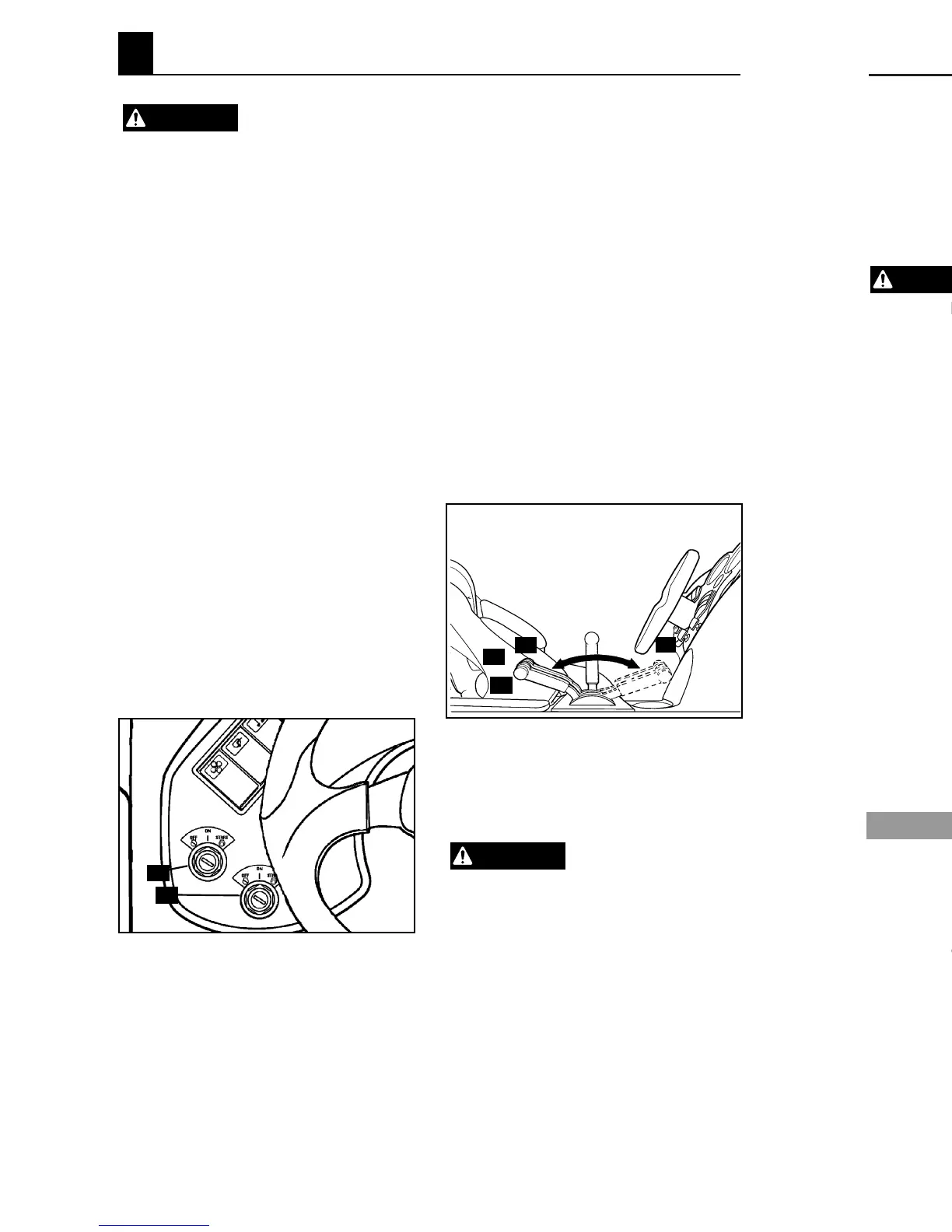
There is a main switch for each engine.
The main switches control the ignition
and electrical circuits as follows:
1 Port (left) engine
2 Starboard (right) engine
OFF:
Ignition circuits are switched off. The
engine cannot be started but other
switches will operate. (The key can be
removed.)
ON:
Ignition circuits are switched on. (The
key cannot be removed).
START:
The starter motor will turn to start the
engine. (When the key is released, it
returns automatically to “ON.”)
NOTE: The engine will not start when
the engine shut-off cord clip is removed
from the engine stop switch. The starter
motor will turn over without the cord
attached.
THROTTLE LEVERS
1 Throttle lever, port (left) engine
2 Throttle lever, starboard (right) engine
3 Idle
4 Full speed
Before starting the engine, always
check the operation of each throttle
lever. It should move smoothly
through its full range of operation.
Otherwise, there could be loss of
control and an accident.
2 FEATURES & FUNCTIONS



 To Next Page