4-34-2
Be sure to replace the cap secure-
ly after fogging the engine.
Otherwise water could enter the
engine and cause damage.
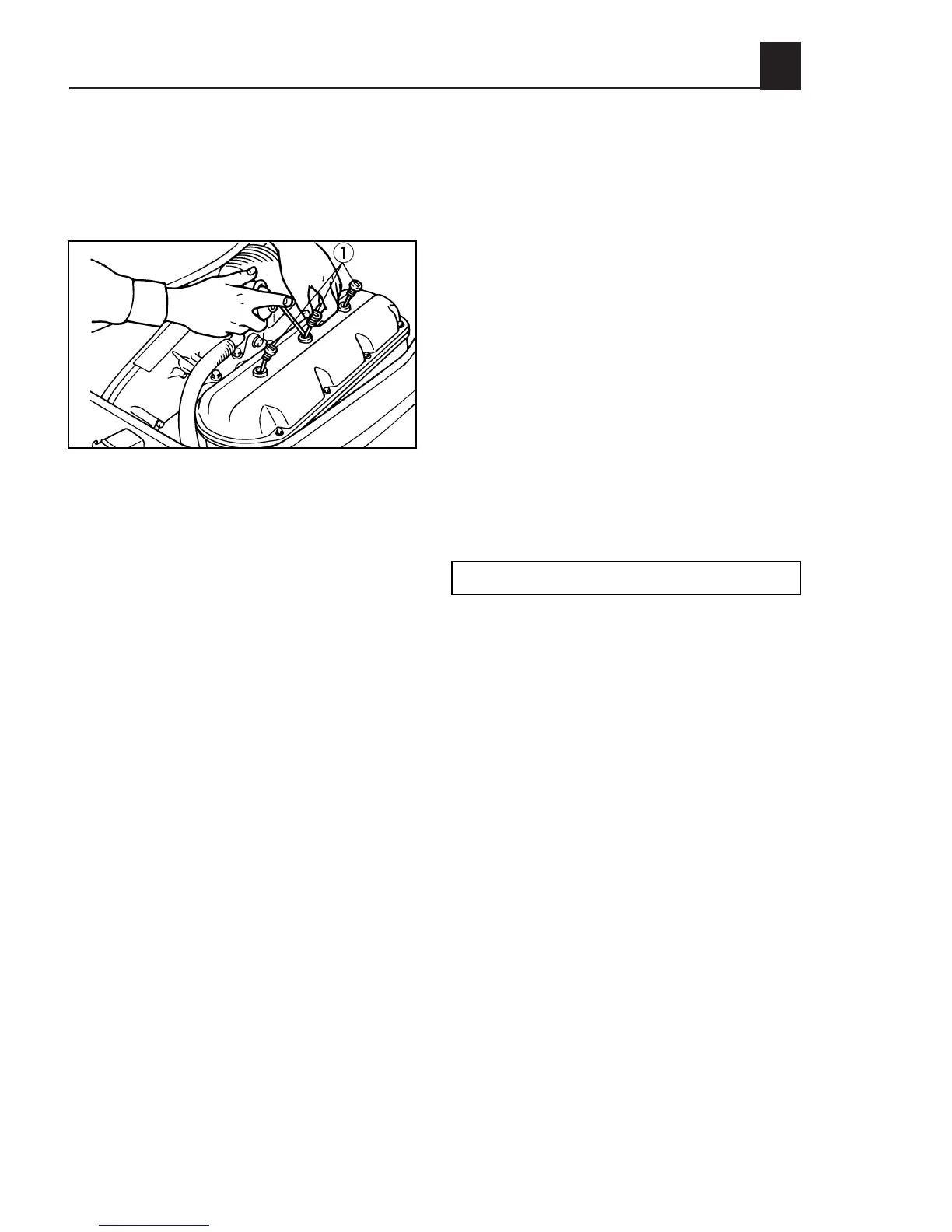
1) Open the cap ➀ on the carburetor
silencer cover of each engine.
2) With the Sport Boat in a well-venti-
lated area, start each engine. With
the engine running at a fast idle,
quickly spray as much Yamaha
Stor-Rite Fogging Oil or an equivalent,
as possible alternately into each
carburetor through the holes in the
silencer cover. Keep spraying until the
engine stalls (or a maximum of 15
seconds). Reinstall the cap secure-
ly.
3) Remove the spark plugs and pour
approximately one tablespoon of oil
into each cylinder.
4) Grease the spark plug threads and
reinstall the spark plugs.
5) Lubricate all cables such as the
throttle choke, and steering cables.
6) Grease the areas of the Sport Boat
specified in “Grease Points” in the
Adjustment And Maintenance sec-
tion.
BATTERY
1) When the Sport Boat is not to be
used for a month or more, remove
the battery and store it in a cool,
dark place. Clean the battery's cas-
ing and terminals using a mixture of
baking soda and water (one tbsp. of
baking soda to one cup of water).
Apply dielectric grease or petroleum
jelly to the battery terminals and to
all exposed connectors.
2) If the battery will be stored for a
longer period, check the specific
gravity of the fluid at least once a
month and recharge the battery if it
gets too low.
MAINTENANCE & CARE 4
Specific gravity: 1.28 at 20°C (68°F)
stopped.
3) Get out of the boat and pull the bow
up on the beach.
4) When leaving the beach, push the
boat out into water that is at least
3 ft (90 cm) deep before starting the
engines.
● Small pebbles, sand, seaweed,
and other debris can be ingested
into the jet intake and impair or
damage the impeller. Always stop
the engines before beaching the
boat. Be sure the boat is in water
3 ft (90 cm) deep
before starting the
engines again.
● Do not beach the boat on rocky
beaches. The hull gelcoat and
exposed pump housings can be
damaged.
● Pay attention to shifts in tides.
Beaching at high tide may make
it impossible to re-launch the
boat if the tide recedes.
ANCHORING
Always anchor from the bow.
Anchoring from the stern will make
the boat unsteady. A strong current
can pull a stern-
anchored boat
underwater.
Select an anchor appropriate for your
boat and water conditions. A “danforth”
(or fluke) type anchor is suitable for
most applications; your dealer can help
you choose an anchor.
1) Make sure the anchor line is
securely tied to the anchor and to
the bow eye.
2) Move the boat to the spot where
you want to lower the anchor, head-
ing the boat into the wind or current.
Stop the boat, then lower the
anchor until it hits bottom.
3) While keeping tension on the line,
slowly back up the
boat until you have let
out line that is 4 to 6
times the depth of the water. For
example, if you are anchoring in 10
feet of water, let out 40 to 60 feet of
line. Secure the line.


 To Next Page