Checking the Spark Plug
The spark plug in your machine can tell you a great deal as to how the
engine
is
operating
when
you
know how to
11
read" the plug.
If
the engine is
operating correctly,
and
if
it
is being ridden correctly, then the tip
of
the
white insulator in the spark plug will
be
a light tan color (standard plug is
NGK
B-8ES).
If,
when
you
remove the spark plug,
it
is
very dark brown or
black,
then
a plug with a hotter
heat
range might
be
needed. The situation
is quite common during the engine break-in period. If the insulator tip shows
a very light tan color, or
is
actually white, or
if
the electrodes begin to melt,
then a spark plug with a colder heat
range
is
required. Again,
if
the spark
plug insulator tip does not have a light tan color, have your dealer install a
spark plug with a different heat
range
to correct the situation.
Do
not attempt
to experiment with different heat
range
spark plugs yourself, as
it
takes
an
experienced
eye
to
gauge
which spark plug to
use,
and
to
gauge
if
the spark
plug
is actually at fault. It is all right
though
for
you
to replace the standard
plug.
Engine conditions
can
cause
any
spark plug to slowly break down.
If
deposits
begin
to build
up,
or
if
the
electrodes finally
become
too
worn,
or
if
for
any
reason
you
believe
the
spark
plug
to not
be
functioning correctly,
replace it.
Be
sure,
when
replacing
the
plug,
that
you
always clean the gasket
surface, that
you
use
a
new
gasket,
and
that the spark plug
is
torqued to
19-21 ft/lbs. Also
wipe
off
any
grime that might
be
present
on
the surface
of the spark
plug.
The
plug
roan
be
taken out to
be
cleaned
and
gapped.
As
long
as deposit build-up
on
the insulator is not extreme,
you
can
use a
spark plug cleaner to quickly
remove
the deposits.
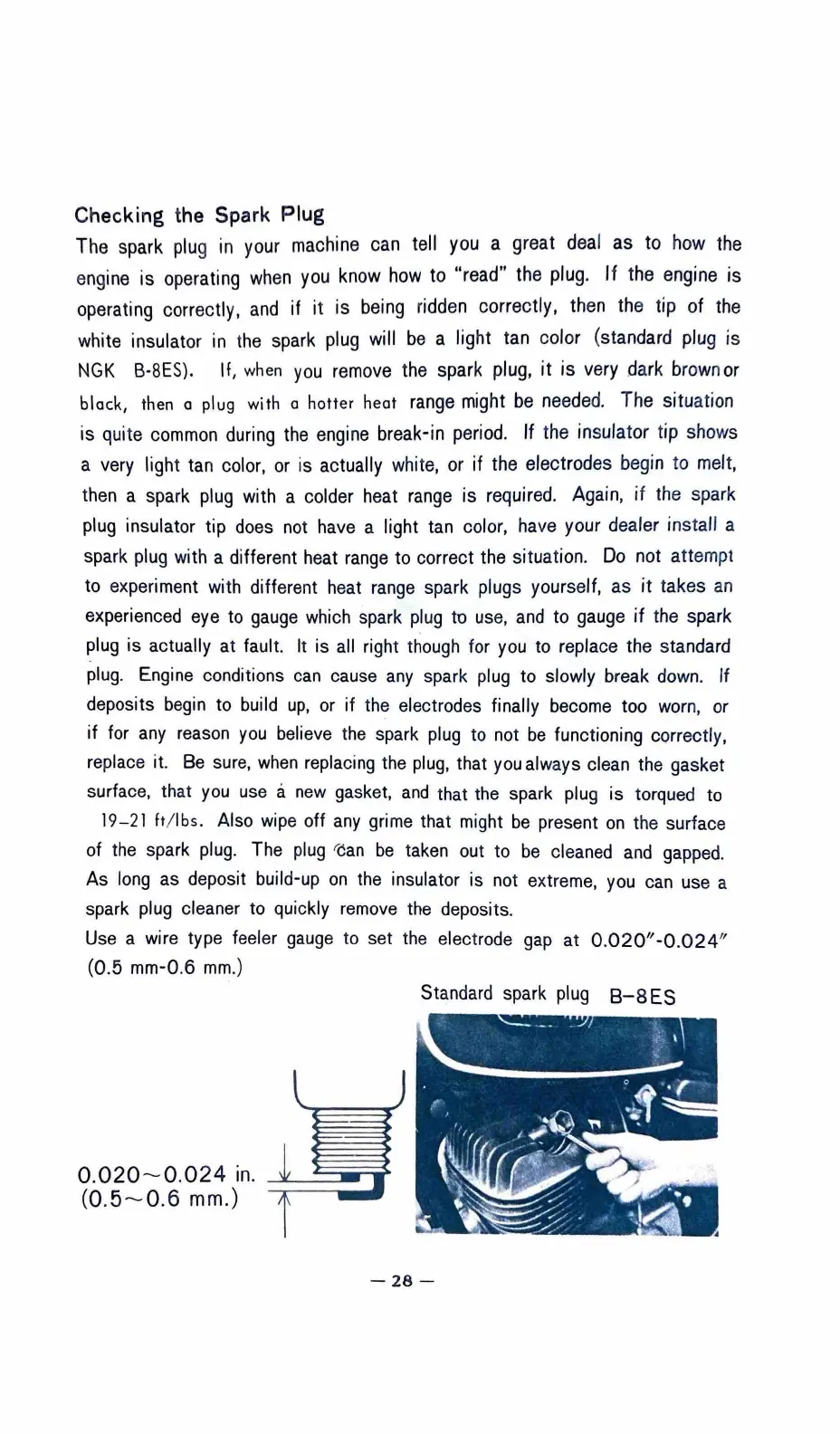
Use
a wire type feeler
gauge
to set
the
electrode
gap
at
0.020"
-0.024"
(0.5 mm-0.6
mm.)
0.020----0.024
in.
(0.5----0.6
mm.)
Standard spark
plug
B-8
ES
-28-



 To Next Page