This document is the Owner's Service Manual for the Yamaha WR250F(Y) model, specifically for the 2009 edition, with the publication number 5UM-28199-56-E0. It provides comprehensive information on the operation, inspection, basic maintenance, and tuning of the vehicle.
Function Description:
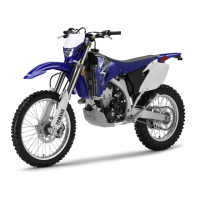
The Yamaha WR250F(Y) is a competition-designed off-road motorcycle, intended for experienced riders on closed courses. It is not legal for operation on public streets, roads, or highways. The manual emphasizes that the machine should not be operated at maximum power until the rider is fully familiar with its characteristics and that it is designed for a single operator, with no passengers.
Important Technical Specifications:
The manual details general specifications for various regions (USA, CDN, AUS, NZ, EUROPE, ZA).
- Model Name: WR250FY (USA, CDN, AUS, NZ), WR250F (EUROPE, ZA)
- Model Code Number: 5UMN (USA), 5UMP (CDN), 5UMR (EUROPE), 5UMS (AUS, NZ, ZA)
- Dimensions:
- Overall length: 2,165 mm (85.24 in) for USA, CDN, ZA; 2,180 mm (85.83 in) for AUS, NZ; 2,190 mm (86.22 in) for EUROPE.
- Overall width: 825 mm (32.48 in) for all regions.
- Overall height: 1,300 mm (51.18 in) for USA, CDN, ZA; 1,305 mm (51.38 in) for AUS, NZ, EUROPE.
- Seat height: 980 mm (38.58 in) for USA, CDN, ZA; 990 mm (38.98 in) for AUS, NZ, EUROPE.
- Wheelbase: 1,480 mm (58.27 in) for USA, CDN, ZA, AUS, NZ; 1,485 mm (58.46 in) for EUROPE.
- Minimum ground clearance: 365 mm (14.37 in) for USA, CDN, ZA; 370 mm (14.57 in) for AUS, NZ; 375 mm (14.76 in) for EUROPE.
- Dry Weight (without oil and fuel): 106.0 kg (233.7 lb).
- Engine: Liquid-cooled 4-stroke, DOHC, single cylinder, forward inclined.
- Displacement: 249 cm³ (8.76 Imp oz, 8.42 US oz).
- Bore × stroke: 77.0 × 53.6 mm (3.03 × 2.11 in).
- Compression ratio: 12.5 : 1.
- Starting system: Kick and electric starter.
- Lubrication system: Dry sump.
- Engine oil capacity: Periodic oil change: 1.1 L (0.97 Imp qt, 1.16 US qt); With oil filter replacement: 1.2 L (1.06 Imp qt, 1.27 US qt); Total amount: 1.4 L (1.23 Imp qt, 1.48 US qt).
- Coolant capacity: 0.99 L (0.87 Imp qt, 1.05 US qt).
- Recommended fuel: Premium unleaded gasoline only with a research octane number of 95 or higher.
- Fuel tank capacity: 8.0 L (1.76 Imp gal, 2.11 US gal); Reserve: 1.1 L (0.24 Imp gal, 0.29 US gal).
- Carburetor: FCR-MX37/KEIHIN.
- Spark Plug: CR9E/NGK (resistance type), gap: 0.7–0.8 mm (0.028–0.031 in).
- Transmission: Constant mesh, 5-speed, wet, multiple-disc clutch.
- Chassis: Semi-double cradle frame.
- Front fork travel: 300 mm (11.8 in).
- Rear wheel travel: 310 mm (12.2 in).
- Brakes: Single disc brake (front and rear).
- Electrical: CDI ignition, AC magneto generator, 12V/6 AH battery.
Usage Features:
The manual outlines various control functions and a multi-function display.
- Controls: Clutch lever, hot starter lever, engine stop switch, main switch, start switch, front brake lever, throttle grip, rear brake pedal, fuel cock (OFF, ON, RES positions), shift pedal, kickstarter crank, cold starter knob.
- Multi-function Display: Features BASIC MODE (speedometer, clock, two tripmeters) and RACE MODE (timer, tripmeter, change tripmeter digits). The display allows changing speedometer units (MPH/km/h) and setting the time. RACE MODE includes manual and auto start options for timer measurement.
- Starting Procedures: Detailed instructions for starting a cold engine (inspect coolant, turn fuel cock ON, main switch ON, shift to neutral, pull cold starter knob, start engine, return cold starter knob) and a warm engine (pull hot starter lever, start engine, release hot starter lever).
- Break-in Procedures: Emphasizes pre-operation checks, warming up the engine, operating in lower gears at moderate throttle openings for 5-8 minutes, then checking full operating range for 10-15 minutes.
Maintenance Features:
The manual provides extensive maintenance schedules and procedures.
- General Maintenance and Lubrication Chart (For Canada): Includes periodic checks and maintenance jobs for clutch, cooling system, spark arrester, brakes, brake hoses, wheels, tires, wheel bearings, swingarm pivot bearings, drive chain, steering bearings, and lever pivot shafts. Intervals range from initial (600 mi/1 month) to 3,000 mi/6 months, with some items requiring yearly or every 4 years service.
- Maintenance Intervals for Competition Use: A more frequent schedule for competition, with checks after break-in, every race, every third (500 km), every fifth (1,000 km), or as required. This covers engine oil, valves, valve springs, valve lifters, camshafts, piston, piston ring, piston pin, cylinder head, cylinder, clutch, transmission, shift fork, rotor nut, muffler, crank, carburetor, air induction system, spark plug, drive chain, cooling system, outside nuts and bolts, air filter, oil filter, engine guard, frame, fuel tank/cock, brakes, front forks, front fork oil/dust seals, protector guide, rear shock absorber, relay arm, connecting rod, sidestand, steering head, tire/wheels, throttle/control cable, hot starter/clutch lever, and battery.
- Pre-operation Inspection and Maintenance: A checklist of items to inspect before each ride, including coolant, fuel, engine oil, gear shifter/clutch, throttle grip, brakes, drive chain, wheels, steering, front forks/rear shock absorber, cables, exhaust pipe, rear wheel sprocket, lubrication, bolts/nuts, lead connectors, and settings.
- Special Tools: A comprehensive list of specialized tools required for tune-up and assembly, including crankcase separating tool, dial gauge and stand, crankshaft installing tool, piston pin puller set, radiator cap tester, steering nut wrench, damper rod holder, fork seal driver, spoke nipple wrench, sheave holder, pocket tester, timing light, valve spring compressor, clutch holding tool, valve guide removers/installers/reamers, rotor puller, dynamic spark tester, vacuum/pressure pump gauge set, and Yamaha Bond No. 1215 sealant.
- Detailed Procedures: Step-by-step instructions for tasks such as removing/installing the seat, fuel tank, side covers, exhaust pipe, silencer, checking/changing coolant, adjusting throttle cable free play, cleaning air filter, checking engine oil level, changing engine oil, adjusting pilot screw, adjusting engine idling speed, adjusting valve clearance, cleaning spark arrester, bleeding hydraulic brake system, adjusting front/rear brake, checking/replacing brake pads, checking/replacing wheel axle/bearings/brake disc, installing front/rear wheel, checking/adjusting drive chain, cleaning front fork oil/dust seal, relieving front fork internal pressure, adjusting front fork damping/spring preload, checking/tightening spokes, checking wheels, lubricating components, checking/charging battery, replacing headlight bulbs, adjusting headlight beams, checking ignition timing, checking engine stop switch/main switch/ignition coil/AC magneto/neutral switch, checking starter motor/starting circuit cut-off relay/clutch switch/diode/start switch, checking charging voltage/charging coil resistance, and checking throttle position sensor.
- Torque Specifications: Detailed tables for tightening torques for engine and chassis components, including thread size, quantity, and torque values in Nm, m•kg, and ft•lb.
- Cable Routing Diagrams: Illustrations and detailed instructions for proper routing of various cables and hoses to prevent interference and ensure correct operation.

 Need help?
 General

 To Next Page