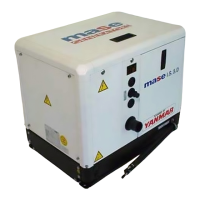
This document provides an installation guide for PowerHouse Generators, specifically focusing on models equipped with Yanmar industrial diesel engines. The generator unit is a robust, skid-mounted system designed for reliable power generation.
Function Description:
The PowerHouse Generator is designed to provide electrical power, likely for off-grid, backup, or remote applications. It utilizes a Yanmar industrial diesel engine as its prime mover, coupled with a Sincro generator. The system incorporates a sophisticated controller (TEM6-DE and PDM1) for engine management, protection, and user interface, allowing for both manual and remote starting capabilities. The generator is built for durability, featuring a heavy-duty skid frame with provisions for forklift handling and a central lifting point.
Important Technical Specifications:
The manual lists several Yanmar engine models and their corresponding KVA ratings:
- 3TNV70: 6.5 KVA
- 3TNV76: 8 KVA
- 3TNV82: 10 KVA
- 3TNV88: 13 KVA
The controller, TEM6-DE, operates with a mains supply of 7 to 30 V DC and offers a 12V positive output and a dry contact for two-wire start inverters. It has a working temperature range of -20 to +60 degrees Celsius. The battery recommended is an ULTIMATE AUTOMOTIVE AGM DEEP CYCLE UL60 BCI Group: BD, 12V 60Ahc20, 456CCA, 309CCA-SAE, RC88, and 62Ahc100.
Usage Features:
- Controller (TEM6-DE): This is a versatile controller with programmable interfaces. It consists of two main parts:
- TEM 3 (User Interface): A measurement instrument displaying Volts (V), Amps (A), Frequency (HZ), and Working Hours (H). It features a single-button interface ("Select Mis") to cycle through measurements manually or automatically (3-second scanning). Users can switch between manual and automatic modes by pressing the "Select Mis" key for 3 seconds.
- PDM 1 (Engine Management): This component protects the engine from operating outside normal parameters. It uses a series of LEDs to indicate various operational statuses and alarms, such as under/over speed, over temperature, fuel switched off, low oil pressure, alternator failure, glow plug pre-heat, and supply status. It also includes P1 & P2 programming buttons.
- Starting: The generator can be started manually via a key switch on the front of the unit. It also supports remote start-stop functionality. The manual emphasizes ensuring the emergency stop button is disengaged before starting.
- Emergency Stop: A large red button on the top right of the controller instantly stops the generator and prevents restarting while depressed.
- Audible Alarm: The controller includes an audible alarm that sounds under fault conditions.
- Fuel System: The system requires priming by pushing down on the fuel pump handle (located near the fuel inlet and dipstick) until sufficient fuel is in the filter and the system is pressured (approximately 10 depressions).
- Ventilation: Proper ventilation is crucial for operation. The manual recommends cross-ventilation and ensuring the generator room is clean and free from heavy dirt and dust.
- Load Management: The generator should not be run on light loads for prolonged periods; it requires at least 50% loading to prevent damage.
Maintenance Features:
The manual provides a detailed periodic inspection interval table for various system components, categorized by daily, 50 hours, 250 hours, 500 hours, 1000 hours, and 2000 hours or yearly intervals. Key maintenance tasks include:
- Fuel System: Daily checks and refills of the fuel tank, draining from the fuel tank, draining from the oil/water separator, cleaning the oil/water separator, and replacement of the fuel filter element (every 500 hours).
- Engine Oil: Daily checks of the engine oil level, replacement of engine oil (every 250 hours), and replacement of the engine oil filter (1st time at 50 hours, then every 250 hours). Recommended oil is Castrol 10W-40 grade.
- Cooling System: Daily checks and additions of cooling water, radiator fin checking and cleaning, cooling fan V-belt checking and adjusting (1st time at 50 hours, then every 250 hours), cooling water replacement (every 1000 hours or yearly), and cooling water path flushing and maintenance (every 1000 hours or yearly). Recommended coolant is Castrol Coolant.
- Rubber Hoses: Fuel and cooling pipe replacement (every 2000 hours or every 2 years).
- Operating System: Governor lever and accelerator check and adjustment (every 250 hours).
- Intake & Exhaust: Air cleaner element cleaning and replacement (every 250 hours).
- Electrical Equipment: Alarm operation check (daily), battery electrolyte check and recharging (every 50 hours).
- Cylinder Head: Adjustment of intake/exhaust valve clearances (every 500 hours), lapping of intake/exhaust valve seats (every 1000 hours).
- Fuel Valve Pump: Check and adjustment of fuel injection valve pressure (every 1000 hours), check and adjustment of fuel injection pump (every 2000 hours).
Spare Parts:
A list of spare parts is provided for various engine models, including:
- Air Filter: 119655-12560 (common for all listed models)
- Fuel Filter: 119810-55650 (for 3TNV70, 3TNV76), 119810-55800 (for 3TNV82, 3TNV88)
- Oil Filter: 119305-35151 (for 3TNV70, 3TNV76), 129150-35152 (for 3TNV82, 3TNV88)
- Fan Belt: 25132-003600 (for 3TNV70, 3TNV76), 25132-003700 (for 3TNV82), 119865-42290 (for 3TNV88)
Safety Guidelines:
The manual emphasizes critical safety practices:
- Location: Keep the generator outdoors unless properly installed inside a building.
- Carbon Monoxide: Install a battery-operated carbon monoxide alarm.
- Moisture: Keep the generator dry and do not use it in wet conditions.
- Electrical Connections: Never "backfeed" power into house wiring by plugging the generator into a wall outlet. If connecting to house wiring, use a licensed electrical contractor in accordance with Australian Standards AS/NZS 3000.
- Fuel Handling: Store fuel in properly labeled non-glass safety containers, away from heat sources. Turn off and cool down the generator before refueling.
- Service Work: Ensure the emergency stop button is pressed when performing service.
- Smoking: Do not smoke in or around the generator.
- Documentation: Familiarize yourself with all provided manuals and paperwork.
The warranty covers defects for 12 months or the first 1000 hours, whichever occurs first. Warranty claims require inspection by the manufacturer or a qualified service agent, with removal and freight costs covered by the owner. The manufacturer covers parts and labor applicable to the scope of supply, backed by manufacturer warranties for their products.

 Need help?
 General

 To Next Page