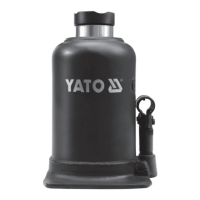
Hydraulic Bottle Jack
This document describes the hydraulic bottle jack, a robust lifting device designed for heavy-duty applications. It is crucial to read and understand this manual thoroughly before operation to ensure safe and efficient use.
Function Description
The hydraulic bottle jack is designed to lift significant weights using hydraulic force. It is important to note that this device is intended solely for lifting and should not be used as a permanent support element. Furthermore, it is strictly prohibited to use the jack to transport lifted loads or to lift people and animals. Proper operation and adherence to safety guidelines are paramount for the device's correct, reliable, and safe functioning.
Important Technical Specifications
The hydraulic bottle jack is available in various models, each with specific lifting capacities and ranges. The following table outlines the key technical specifications for each model:
| Index |
Lifting Capacity [tons] |
Lifting Range [mm] |
Weight [kg] |
| YT-17000 |
2 |
181 - 345 |
2.6 |
| YT-17001 |
3 |
194 - 374 |
3.3 |
| YT-17002 |
5 |
216 - 413 |
4.3 |
| YT-17003 |
8 |
230 - 457 |
5.5 |
| YT-17004 |
10 |
230 - 460 |
6.5 |
| YT-17005 |
12 |
230 - 465 |
7.2 |
| YT-17006 |
15 |
230 - 462 |
8.3 |
| YT-17007 |
20 |
242 - 452 |
10.5 |
| YT-17008 |
32 |
285 - 465 |
22.4 |
| YT-17009 |
50 |
300 - 480 |
32.5 |
The maximum load specified for each model must never be exceeded. The device's lifetime is determined to be 4 years from the date of its first use. After this period, the jack should undergo an inspection at the manufacturer's authorized service center to ensure continued safety.
Usage Features
Safety Recommendations:
Operating the hydraulic bottle jack requires strict adherence to basic safety principles. Always read the operating manual thoroughly before commencing work and keep it for future reference.
- Load Limits: Never exceed the maximum load capacity of the lift.
- Prohibited Use: Do not use the device to lift people or animals. It is designed exclusively for lifting objects, and other uses are forbidden.
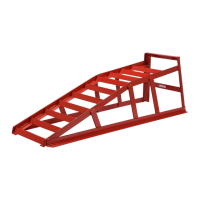
- Support: Always use additional safety devices, such as racks, to support the lifted object before working underneath it.
- Vehicle Safety: When lifting vehicles, block or wedge the wheels and engage the safety brake.
- Supervision: Never leave a lifted load unattended. Keep children and untrained individuals away from the working area.
- Personal Safety: Avoid wearing loose clothing and jewelry; tie back long hair. Always use personal protective equipment.
- Placement: The lift must be placed on an even, flat, hard, and stable surface. Position the lift under the object to be lifted so that the load is centered on the saddle.
- Safety Valve: It is absolutely forbidden to adjust the safety valve.
- Environment: Keep the device away from heat sources and flames, as these can damage the device or impair its function.
- Pre-Lift Checks: Before lifting any load, ensure that the lift will not shift once the load is raised and that the lift itself is undamaged. If repairs are needed, have them performed by an authorized workshop.
- Operator Condition: Do not operate the jack if you are tired or under the influence of medication.
- Modifications: Do not modify any components of the lift that could affect its compliance with safety standards.
- Repairs: All repairs must be carried out by authorized service points using only original spare parts to maintain safety.
Assembly and Operation:
The hydraulic bottle jack is delivered fully assembled and requires no additional assembly or adjustments. Before initial use, perform approximately six full pumping cycles with the release valve open to ensure proper oil distribution throughout the hydraulic system.
Lifting:
- Before starting work, ensure that the lift and the load to be lifted are within the operator's view.
- Close the release valve by turning it clockwise until it stops.
- Position the lift under the load at the designated lifting point (e.g., on a vehicle) so that the load is centered on the saddle.
- If necessary, extend the extension screw on the ram until the saddle contacts the load.
- Insert the operating handle into the socket and pump it up and down to raise the load to the desired height.
- Once the load is lifted, secure it against falling, for example, with support stands.
Lowering:
- Before lowering the load, ensure that no personnel are at risk.
- Slowly turn the release valve counter-clockwise using the narrow end of the operating handle. Do not open the release valve more than necessary for a slow descent. Excessive opening can cause the valve to unscrew completely from its housing.
- Once the load is fully lowered, remove the operating handle and the lift from under the load. In the case of bottle jacks, retract the extension bolt if it was used.
Maintenance Features
General Maintenance:
Regular maintenance is crucial for the longevity and safe operation of the hydraulic bottle jack.
- Lubrication: The lift must be kept clean, and all external moving parts should be lubricated at least every ten working hours.
- Hydraulic System Purging: Periodically, air bubbles can accumulate in the hydraulic system, reducing efficiency. If this occurs, the hydraulic system needs to be purged.
- Position the lift so its ram is vertical.
- Open the release valve and remove the oil filler plug.
- Pump the lift several times vigorously to expel air.
- Close the release valve and replace the oil filler plug.
- Check the lift's operation and repeat the purging procedure if necessary.
- Oil Filling and Lubrication:
- Position the lift so its ram is vertical.
- Lower the pump and ram to their lowest position.
- Remove the oil filler plug.
- Use only hydraulic oil of SAE 10 viscosity. Do not use other liquids.
- Fill the oil tank up to the lower edge of the oil filler opening.
- Purge the lift as described above.
- Close the oil filler plug.
- Check the lift's operation.
- Regularly lubricate the articulated connections and other moving parts of the lift (at least every ten working hours). In the case of bottle jacks, periodically lubricate the extension bolt thread.
Troubleshooting:
The following table outlines common problems and their solutions:
| Problem | Possible Cause | Solution
Hydraulic Bottle Jack
This document describes the hydraulic bottle jack, a robust lifting device designed for heavy-duty applications. It is crucial to read and understand this manual thoroughly before operation to ensure safe and efficient use.
Function Description
The hydraulic bottle jack is designed to lift significant weights using hydraulic force. It is important to note that this device is intended solely for lifting and should not be used as a permanent support element. Furthermore, it is strictly prohibited to use the jack to transport lifted loads or to lift people and animals. Proper operation and adherence to safety guidelines are paramount for the device's correct, reliable, and safe functioning.
Important Technical Specifications
The hydraulic bottle jack is available in various models, each with specific lifting capacities and ranges. The following table outlines the key technical specifications for each model:
| Index |
Lifting Capacity [tons] |
Lifting Range [mm] |
Weight [kg] |
| YT-17000 |
2 |
181 - 345 |
2.6 |
| YT-17001 |
3 |
194 - 374 |
3.3 |
| YT-17002 |
5 |
216 - 413 |
4.3 |
| YT-17003 |
8 |
230 - 457 |
5.5 |
| YT-17004 |
10 |
230 - 460 |
6.5 |
| YT-17005 |
12 |
230 - 465 |
7.2 |
| YT-17006 |
15 |
230 - 462 |
8.3 |
| YT-17007 |
20 |
242 - 452 |
10.5 |
| YT-17008 |
32 |
285 - 465 |
22.4 |
| YT-17009 |
50 |
300 - 480 |
32.5 |
The maximum load specified for each model must never be exceeded. The device's lifetime is determined to be 4 years from the date of its first use. After this period, the jack should undergo an inspection at the manufacturer's authorized service center to ensure continued safety.
Usage Features
Safety Recommendations:
Operating the hydraulic bottle jack requires strict adherence to basic safety principles. Always read the operating manual thoroughly before commencing work and keep it for future reference.
- Load Limits: Never exceed the maximum load capacity of the lift.
- Prohibited Use: Do not use the device to lift people or animals. It is designed exclusively for lifting objects, and other uses are forbidden.
- Support: Always use additional safety devices, such as racks, to support the lifted object before working underneath it.
- Vehicle Safety: When lifting vehicles, block or wedge the wheels and engage the safety brake.
- Supervision: Never leave a lifted load unattended. Keep children and untrained individuals away from the working area.
- Personal Safety: Avoid wearing loose clothing and jewelry; tie back long hair. Always use personal protective equipment.
- Placement: The lift must be placed on an even, flat, hard, and stable surface. Position the lift under the object to be lifted so that the load is centered on the saddle.
- Safety Valve: It is absolutely forbidden to adjust the safety valve.
- Environment: Keep the device away from heat sources and flames, as these can damage the device or impair its function.
- Pre-Lift Checks: Before lifting any load, ensure that the lift will not shift once the load is raised and that the lift itself is undamaged. If repairs are needed, have them performed by an authorized workshop.
- Operator Condition: Do not operate the jack if you are tired or under the influence of medication.
- Modifications: Do not modify any components of the lift that could affect its compliance with safety standards.
- Repairs: All repairs must be carried out by authorized service points using only original spare parts to maintain safety.
Assembly and Operation:
The hydraulic bottle jack is delivered fully assembled and requires no additional assembly or adjustments. Before initial use, perform approximately six full pumping cycles with the release valve open to ensure proper oil distribution throughout the hydraulic system.
Lifting:
- Before starting work, ensure that the lift and the load to be lifted are within the operator's view.
- Close the release valve by turning it clockwise until it stops.
- Position the lift under the load at the designated lifting point (e.g., on a vehicle) so that the load is centered on the saddle.
- If necessary, extend the extension screw on the ram until the saddle contacts the load.
- Insert the operating handle into the socket and pump it up and down to raise the load to the desired height.
- Once the load is lifted, secure it against falling, for example, with support stands.
Lowering:
- Before lowering the load, ensure that no personnel are at risk.
- Slowly turn the release valve counter-clockwise using the narrow end of the operating handle. Do not open the release valve more than necessary for a slow descent. Excessive opening can cause the valve to unscrew completely from its housing.
- Once the load is fully lowered, remove the operating handle and the lift from under the load. In the case of bottle jacks, retract the extension bolt if it was used.
Maintenance Features
General Maintenance:
Regular maintenance is crucial for the longevity and safe operation of the hydraulic bottle jack.
- Lubrication: The lift must be kept clean, and all external moving parts should be lubricated at least every ten working hours.
- Hydraulic System Purging: Periodically, air bubbles can accumulate in the hydraulic system, reducing efficiency. If this occurs, the hydraulic system needs to be purged.
- Position the lift so its ram is vertical.
- Open the release valve and remove the oil filler plug.
- Pump the lift several times vigorously to expel air.
- Close the release valve and replace the oil filler plug.
- Check the lift's operation and repeat the purging procedure if necessary.
- Oil Filling and Lubrication:
- Position the lift so its ram is vertical.
- Lower the pump and ram to their lowest position.
- Remove the oil filler plug.
- Use only hydraulic oil of SAE 10 viscosity. Do not use other liquids.
- Fill the oil tank up to the lower edge of the oil filler opening.
- Purge the lift as described above.
- Close the oil filler plug.
- Check the lift's operation.
- Regularly lubricate the articulated connections and other moving parts of the lift (at least every ten working hours). In the case of bottle jacks, periodically lubricate the extension bolt thread.
Troubleshooting:
The following table outlines common problems and their solutions:
| Problem | Possible Cause | Solution Hydraulic Bottle Jack
This document describes the hydraulic bottle jack, a robust lifting device designed for heavy-duty applications. It is crucial to read and understand this manual thoroughly before operation to ensure safe and efficient use.
Function Description
The hydraulic bottle jack is designed to lift significant weights using hydraulic force. It is important to note that this device is intended solely for lifting and should not be used as a permanent support element. Furthermore, it is strictly prohibited to use the jack to transport lifted loads or to lift people and animals. Proper operation and adherence to safety guidelines are paramount for the device's correct, reliable, and safe functioning.
Important Technical Specifications
The hydraulic bottle jack is available in various models, each with specific lifting capacities and ranges. The following table outlines the key technical specifications for each model:
| Index |
Lifting Capacity [tons] |
Lifting Range [mm] |
Weight [kg] |
| YT-17000 |
2 |
181 - 345 |
2.6 |
| YT-17001 |
3 |
194 - 374 |
3.3 |
| YT-17002 |
5 |
216 - 413 |
4.3 |
| YT-17003 |
8 |
230 - 457 |
5.5 |
| YT-17004 |
10 |
230 - 460 |
6.5 |
| YT-17005 |
12 |
230 - 465 |
7.2 |
| YT-17006 |
15 |
230 - 462 |
8.3 |
| YT-17007 |
20 |
242 - 452 |
10.5 |
| YT-17008 |
32 |
285 - 465 |
22.4 |
| YT-17009 |
50 |
300 - 480 |
32.5 |
The maximum load specified for each model must never be exceeded. The device's lifetime is determined to be 4 years from the date of its first use. After this period, the jack should undergo an inspection at the manufacturer's authorized service center to ensure continued safety.
Usage Features
Safety Recommendations:
Operating the hydraulic bottle jack requires strict adherence to basic safety principles. Always read the operating manual thoroughly before commencing work and keep it for future reference.
- Load Limits: Never exceed the maximum load capacity of the lift.
- Prohibited Use: Do not use the device to lift people or animals. It is designed exclusively for lifting objects, and other uses are forbidden.
- Support: Always use additional safety devices, such as racks, to support the lifted object before working underneath it.
- Vehicle Safety: When lifting vehicles, block or wedge the wheels and engage the safety brake.
- Supervision: Never leave a lifted load unattended. Keep children and untrained individuals away from the working area.
- Personal Safety: Avoid wearing loose clothing and jewelry; tie back long hair. Always use personal protective equipment.
- Placement: The lift must be placed on an even, flat, hard, and stable surface. Position the lift under the object to be lifted so that the load is centered on the saddle.
- Safety Valve: It is absolutely forbidden to adjust the safety valve.
- Environment: Keep the device away from heat sources and flames, as these can damage the device or impair its function.
- Pre-Lift Checks: Before lifting any load, ensure that the lift will not shift once the load is raised and that the lift itself is undamaged. If repairs are needed, have them performed by an authorized workshop.
- Operator Condition: Do not operate the jack if you are tired or under the influence of medication.
- Modifications: Do not modify any components of the lift that could affect its compliance with safety standards.
- Repairs: All repairs must be carried out by authorized service points using only original spare parts to maintain safety.
Assembly and Operation:
The hydraulic bottle jack is delivered fully assembled and requires no additional assembly or adjustments. Before initial use, perform approximately six full pumping cycles with the release valve open to ensure proper oil distribution throughout the hydraulic system.
Lifting:
- Before starting work, ensure that the lift and the load to be lifted are within the operator's view.
- Close the release valve by turning it clockwise until it stops.
- Position the lift under the load at the designated lifting point (e.g., on a vehicle) so that the load is centered on the saddle.
- If necessary, extend the extension screw on the ram until the saddle contacts the load.
- Insert the operating handle into the socket and pump it up and down to raise the load to the desired height.
- Once the load is lifted, secure it against falling, for example, with support stands.
Lowering:
- Before lowering the load, ensure that no personnel are at risk.
- Slowly turn the release valve counter-clockwise using the narrow end of the operating handle. Do not open the release valve more than necessary for a slow descent. Excessive opening can cause the valve to unscrew completely from its housing.
- Once the load is fully lowered, remove the operating handle and the lift from under the load. In the case of bottle jacks, retract the extension bolt if it was used.
Maintenance Features
General Maintenance:
Regular maintenance is crucial for the longevity and safe operation of the hydraulic bottle jack.
- Lubrication: The lift must be kept clean, and all external moving parts should be lubricated at least every ten working hours.
- Hydraulic System Purging: Periodically, air bubbles can accumulate in the hydraulic system, reducing efficiency. If this occurs, the hydraulic system needs to be purged.
- Position the lift so its ram is vertical.
- Open the release valve and remove the oil filler plug.
- Pump the lift several times vigorously to expel air.
- Close the release valve and replace the oil filler plug.
- Check the lift's operation and repeat the purging procedure if necessary.
- Oil Filling and Lubrication:
- Position the lift so its ram is vertical.
- Lower the pump and ram to their lowest position.
- Remove the oil filler plug.
- Use only hydraulic oil of SAE 10 viscosity. Do not use other liquids.
- Fill the oil tank up to the lower edge of the oil filler opening.
- Purge the lift as described above.
- Close the oil filler plug.
- Check the lift's operation.
- Regularly lubricate the articulated connections and other moving parts of the lift (at least every ten working hours). In the case of bottle jacks, periodically lubricate the extension bolt thread.
Troubleshooting:
The following table outlines common problems and their solutions:
| Problem | Possible Cause | Solution
The following table outlines common problems and their solutions:
| Problem | Possible Cause | Solution | Problem | Possible Cause | Solution

 Need help?
 General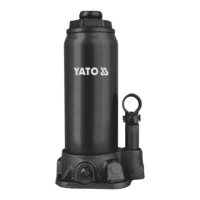

 To Next Page