
 Need help?
Do you have a question about the Yescom Violin and is the answer not in the manual?
Handle the instrument with care to avoid damage from bumps or drops during transport.
Protect the instrument from direct sunlight, extreme temperatures, and high humidity.
Use a soft, dry cloth for cleaning. Avoid harsh chemicals and be aware of potential wood discoloration.
Always loosen the bow hair before storing it in the case after playing.
Plated parts may tarnish but it does not affect performance; clean as needed.
Avoid storing the violin in places with high temperatures or humidity; clean smudges regularly.
Maintain safe distance while playing. Handle the bow carefully; do not swing or throw it.
Be careful not to pinch hands or fingers when closing the violin case.
Sudden temperature/humidity changes can affect wood glue. Acclimate instrument before playing.
Change strings one at a time to prevent bridge collapse and tailpiece detachment.
Avoid over-loosening or over-tightening fine tuners to prevent damage or noise.
List of items included with the violin package, such as rosin, tuner, case, and straps.
Details on the violin's overall length and fingerboard length.
Apply rosin evenly to the bow hair before use. Apply abundantly when new.
Always loosen the bow hair before storing it in the case to maintain its condition.
Ensure the bridge is aligned correctly with four notches for proper string spacing.
Ensure the bridge is at a right angle to the instrument top; adjust if leaning.
Tune strings to E, A, D, G. Use a tuning fork or tuner for accurate pitch.
After tuning, re-check bridge alignment and adjust if necessary.
Set the fine tuner to the middle of its adjustment range before attaching new strings.
Hook the ball end of each string onto the corresponding fine tuner notch at the tailpiece.
Insert string into peg hole and wind onto the tuning peg, applying pressure.
Ensure strings are seated correctly in their corresponding notches on the bridge.
The bridge side facing the tailpiece must remain at a right angle to the instrument body.
Slide out the battery compartment lid to replace the battery if necessary.
Clip the tuner onto the top of the violin.
Turn on the tuner and select 'Violin' mode.
Play string until tuner shows the right turn and no deviation.
Tuning is recommended to be done by a professional or experienced person.
Slide brackets onto both sides of the violin until firmly secured. Do slowly.
Install the two straps on the back of the case to enable carrying it on your back.
Contact information and website for customer support and inquiries.
This document provides a comprehensive user manual for a violin, outlining its parts, setup, tuning, and maintenance procedures. It also includes important safety precautions to ensure the longevity of the instrument and the safety of the user.
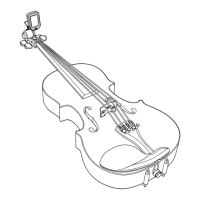
The violin is a string instrument designed for musical performance. It produces sound through the vibration of its strings, which are typically bowed, though they can also be plucked. The instrument is comprised of a body, neck, fingerboard, bridge, tailpiece, and tuning pegs, all working in concert to create its characteristic sound. The bow, an essential accessory, is used to draw across the strings, causing them to vibrate. The manual details the process of installing the bridge, hooking and winding the strings, and tuning the instrument to specific pitches (E, A, D, G for the 1st, 2nd, 3rd, and 4th strings respectively). A tuner is provided to assist in achieving accurate pitch, and a shoulder rest is included for comfortable playing posture. The case is designed for safe transport and storage of the violin and its accessories.
 General
| Category | Violin |
|---|---|
| Top Material | Spruce |
| Back & Sides Material | Maple |
| Fingerboard Material | Ebony |
| Bow Material | Brazilwood |
| Rosin | Included |
| Size | 4/4 |
| Strings | Steel |
| Case | Hard Case |
| Shoulder Rest | Included |
| Bow Hair | Horsehair |

 To Next Page