yt 2120 yt
EN
YOU CAN FIND DETAILLED
INFORMATION ABOUT
YOUR BIKE IN YOUR
„SAFETY FIRST.“
HANDBOOK
ADJUSTING THE SUSPENSION ELEMENTS
(REAR SHOCK AND SUSPENSION FORK)
The suspension elements we use allow for a variety
of adjustments. When making adjustments, please
note the detailed instructions of the suspension
element manufacturer. You can find up-to-date
information on their websites:
FOX: http://www.ridefox.com
RockShox: http://www.sram.com/rockshox
CAUTION! NEVER OPERATE YOUR BICYCLE
WITH INSUFFICIENT OR EXCESS AIR
PRESSURE! THIS COULD RESULT IN DAMAGE
TO THE FORK OR SHOCKS.
BASIC SETTINGS
The weight of the rider and his position on the bi-
cycle determine the adjustment criteria for the rear
shock and suspension fork. When sitting on the bike,
the suspension will compress to a certain degree –
the so-called ″sag″. Sag should be between 20 – 25 %
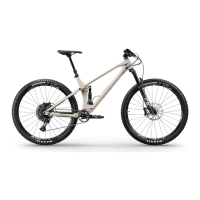
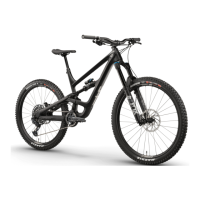
for Trail bikes and All-Mountain bikes, 25 – 30 %
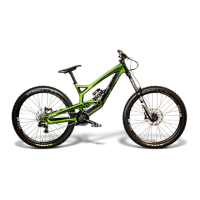
for Enduro bikes, between 30 – 40 % for Downhill
bikes, and between 10 – 20 % for Dirt bikes. The ″sag
value″ that corresponds to your riding style is best
determined with a few test rides. Test rides and per-
sonal preferences will also determine the settings of
the compression and rebound speeds of the suspen-
sion elements.
CAUTION! PLEASE NOTE
Your bike’s handling is influenced by each and every
adjustment to the suspension elements – therefore,
please be careful on your rst test rides to avoid
crashes. Avoid any adjustments that could lead to
the suspension elements frequently bottoming out.
They will thank you with a long service life. If you are
uncertain of anything or have any questions, do not
hesitate to contact us at:
service@yt-industries.com.
GET TO KNOW YOUR BIKE
Familiarize yourself with your new bike. Verify once
again that all screws are tightened to the correct
torque. Our bikes are equipped with modern disc
brake systems with exceptional braking performance.
In addition, the braking performance increases after a
short break-in period. Try to get used to the braking
response and how it differs when riding over various
surfaces. Position the brake levers at your ngertips
so that they can be pulled without excessive effort.
The same applies to the shifters. Shift smoothly and
without applying too much pressure on the pedals.
This will help protect your drive train components.
Please choose a safe and familiar terrain for your ini-
tial test and training rides. You can nd all you need to
know about your bike in our ″SAFETY FIRST.″- manual
as well.
Familiarize yourself with the bike manual before
getting on your bike the rst time.
BEFORE EACH RIDE
By nature, mountain bikes are placed under a lot of
strain. The components of the bike react differently
to stresses, from wear and tear to material fatigue.
Individual components may fail without warning.
Please check your bike regularly for signs of damage
and/or have your bike periodically inspected.
CHECK BEFORE EVERY RIDE
• the seatpost and wheels are rmly secured in
the frame and fork.
• the wheels spin freely.
• the air pressure in the tires, the tension of the
spokes and the hub bearing play.
• the brake function.
• for signs of material fatigue (deformations,
fractures, cracks, signs of impact, etc.).
• all additional components for stability and
operational safety.
• the required torques for all screws.
Do not ride even if only one of the possible defects
is present.
CAUTION! VIBRATIONS THAT OCCUR WHEN
RIDING YOUR MOUNTAIN BIKE CAN LEAD TO
SCREWS LOOSENING (EVEN FOR SCREWS
WITH THREADLOCKER ADHESIVE)!
IN THE EVENT OF A CRASH
Crashes place a lot of strain on your bike’s materi-
al and components. Therefore, before you continue
your ride, check your bike for damage and impaired
functions (see ″Check Before Every Ride″).
Do not continue your ride even if only one of the
possible defects is present. If you are uncertain of
anything or have any questions, do not hesitate to
contact us directly at:
service@yt-industries.com.
RIDING ON PUBLIC ROADS
IN GERMANY
The German Road Trafc Licensing Regulations
(Straßenverkehrs-Zulassungs-Ordnung, StVZO) dic-
tate the following safety devices when operating
bicycles on public roads:
• A braking and lighting system and a bright
sounding bell.
• Furthermore, every cyclist is obligated to maintain
his vehicle in a roadworthy condition and a state
that is safe for riding.
We would like to explicitly point out that our bikes
are not in compliance with the German road trafc
licensing regulations!
Read more about this topic in the ″SAFETY FIRST.″
handbook.
OUTSIDE OF GERMANY
Please inquire about the respective regulations for
each country in which you want to ride your YT Bike
on public roads.
DESIGNATED USE
In addition to the assembly instructions, our moun-
tain bikes are also supplied with the operating
instructions from the manufacturers of the indi-
vidual components. You can nd all information
regarding use, maintenance, and care here. Please
follow these instructions and retain them. Damage
that arises from improper or inappropriate use of
your YT are not covered by our warranty.
These include:
• Improper or inadequate maintenance and care.
• Damage from crashes or overstressing.
• Modication to the frame or fork.
• Modication of components.
• Jumps or other stresses that lead to overstraining.
Please refer to our General Terms and Conditions at
www.yt-industries.com.
IMPORTANT GENERAL INFORMATION
We are not liable for property damage or personal
injury resulting from the operation of the mountain
bike itself, in particular, in the event of failures due to
inadequate maintenance and care.
The abilities of professional mountain bikers may
seem easy to imitate to laypersons. In reality, there
are often years of training and constant practice
behind their skills. For your safety, always wear pro-
tective clothing appropriate for the discipline.
We recommend always wearing a protective helmet.
Things always seem to happen when you least
expect them.
CARE AND SERVICE INTERVALS
Only regular inspections, care and maintenance,
immediate professional repair, and the replacement
of damaged components can guarantee the safe
function of your bike over the long term. If you do
not possess the necessary specialist knowledge or
tools to carry out the required work yourself, a trip
to the workshop is essential. For guidance, we have
prepared some maintenance information:
We recommend an initial inspection, depending on
how hard you ride, after 5 to 15 hours of operation.
This includes:
• Checking the torques on all screws and nuts and
tightening them if necessary.
• Changing the length of the shifter cable by
correcting the tension via adjustment (barrel
adjuster on the shifter).
• Checking the spoke tension on the wheels and that
the wheels are true and adjusting spoke tension if
necessary.
• Checking the headset preload and gently readjust
if necessary.
MONTHLY INSPECTIONS
• Checking the prole height and sidewalls of the
tires. Replacing worn or ″washed out″ tires.
• Measuring the strength of the disc brake pads.
Replacing the brake pads if necessary (please note
the manufacturer specications).
• Checking the braking system for leaks. In the event
of leaks, please visit a specialist workshop.
• Checking bearing play in the bottom bracket, head
set, hubs, and pedals and tightening if necessary.
• Checking the spoke tension on the wheels and that
the wheels are true and adjusting spoke tension if
necessary.
• Checking the torques on screws and nuts. If neces
sary, tightening screws and nuts.
• Cleaning and greasing the drivetrain and derailleur
mechanism.
ANNUAL INSPECTIONS
• Suspension fork service: Please note the
specications of the manufacturer here.
• Remove the bottom bracket, clean it, and regrease
the treads.
• Remove the headset, check the bearings and
regrease them.
• Remove the stem, handlebar, and seatpost and
check them for cracks and damage and replace
them if necessary.
• Check the shifter cable for damage (breaks, kinks,
corrosion, etc.) and exchange them if necessary.
ADJUSTMENTS ADJUSTMENTS
AFTER ASSEMBLY AFTER ASSEMBLY


 To Next Page
 Loading...