This document serves as the owner's manual for Z Grills wood pellet grills, specifically models ZPG-7002B, ZPG-7002BPro, and ZPG-7002E. It provides comprehensive instructions for assembly, initial firing, subsequent start-up, operation, maintenance, troubleshooting, and warranty information. The primary function of these devices is to cook food using wood pellets as fuel, offering a distinct smoky flavor.
Function Description
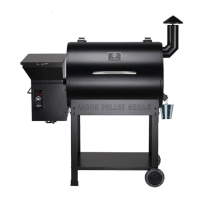
The Z Grills wood pellet grill operates by feeding wood pellets from a hopper into a firepot, where they are ignited by a hot rod. A fan then blows air through the firepot to maintain combustion and circulate heat and smoke throughout the grill chamber. An RTD (Resistance Temperature Detector) temperature probe monitors the internal temperature, which is displayed on a digital control panel. Users can set a desired cooking temperature, and the grill's control system automatically adjusts the pellet feed rate and fan speed to maintain that temperature. This allows for precise temperature control, making it suitable for various cooking methods, including smoking, grilling, baking, roasting, braising, and barbecuing. The grill features a main cooking chamber, a hopper for storing pellets, and a chimney for smoke exhaust.
Usage Features
The manual emphasizes several key usage features to ensure safe and effective operation. For initial use, a specific firing procedure is outlined to properly season the grill and ensure all components are functioning correctly. This involves removing internal components, checking for obstructions, plugging in the power cord, and setting the temperature dial to "SMOKE" to initiate the hot rod and fan. After the pellets ignite and produce smoke, the grill is allowed to cool down, then components are reinstalled, and the grill is preheated at a high temperature for 45 minutes to burn off any foreign matter before cooking food. This preheating step is crucial for optimal performance and food safety.
For subsequent start-ups, if the grill runs out of pellets or the fire goes out, a detailed procedure is provided to prevent hazardous "over-firing." This involves turning off and unplugging the grill, allowing it to cool, removing all food and internal components, and clearing any unburned pellets and ash from the firepot. The grill is then plugged back in, and pellets are allowed to fall into the firepot, with the hot rod heating up to reignite. Once flames are visible, the grill is set to "SHUT DOWN CYCLE" to cool, and then components are reinstalled, and the grill is started on "SMOKE" with the lid open until whitish-gray smoke appears, after which the lid can be closed, and the desired cooking temperature set.
The digital control allows users to select various temperature settings, including "SMOKE," which is a low-temperature setting ideal for infusing food with smoke flavor, and "HIGH" for searing or high-temperature cooking. The "SHUT DOWN CYCLE" feature is designed to safely extinguish the fire by allowing the fan to run for 10 minutes to burn off residual pellets in the firepot before powering down. This prevents pellet accumulation and potential fire hazards.
Operating tips include recommendations to shelter the grill from wind to improve temperature output and heat retention, avoid frequent lid opening to maintain cooking temperature, and preheat the grill for 10 minutes before adding food for faster heating. A critical safety warning advises against adding pellets directly to the firepot, as this is dangerous. The manual also suggests wrapping the grease drain pan with heavy-duty aluminum foil for easier cleaning and to prevent grease fires.
Maintenance Features
Regular maintenance is crucial for the longevity and safe operation of the Z Grills wood pellet grill. The manual provides detailed instructions for cleaning various components. Before any maintenance, the grill must be turned off, unplugged, and completely cold to prevent injury.
Grease management is a primary focus. Regular use leads to grease accumulation on the flue lining, grease drain tube, V-shaped grease drain, and grease drain pan. These areas must be kept clean to reduce the risk of fire. It's easier to remove grease when the grill is still warm (but not hot), and heat-resistant gloves are recommended. Accumulated grease can be scraped off using a stiff, nonmetallic tool and pushed into the grease bucket. Any remaining residue should be wiped with paper towels or disposable rags. Failure to clean these areas can lead to grease fires.
The flue pipe (smoke stack) also requires cleaning. The chimney cap assembly should be removed and cleaned with warm soapy water. Creosote and grease accumulation inside the vertical and horizontal sections of the flue pipe can be scraped with a nonmetallic tool like a wooden paint stir stick. Water or other liquid cleaners should not be sprayed inside the grill.
For outside surfaces, warm soapy water is recommended for cleaning grease. Abrasive cleansers or oven cleaner should be avoided. Using a Z Grills cover is suggested to protect the grill, and a high-quality car wax can be applied to maintain the finish.
Internal components also need attention. The porcelain-coated grill grates should be cleaned after each use, preferably with a long-handled cleaning brush designed for such surfaces. The inner RTD temperature probe should also be cleaned after each use to ensure accurate temperature readings.
Ash removal is another important maintenance task. Excessive ash in the firepot can cause the fire to go out, especially on the "SMOKE" setting. A shop vac is an excellent tool for removing ash, but it is crucial to ensure the grill fire is out, the unit is off, unplugged, and cold before attempting to clean ash from the grill.
Troubleshooting guidance is provided for common issues, such as the grill not working, fire going out, or difficulties starting. Solutions range from checking power connections and fuses to replacing specific components like the hot rod or auger drive motor. Error codes displayed on the LED screen (LEr for low temperature, HEr for high temperature, Er 1 for probe connection, Er 2 for dial security alarm) are explained with corresponding solutions. A critical warning reiterates not to turn off the main switch during the "SHUT DOWN CYCLE" to prevent fire in the hopper chamber.


 To Next Page
 General