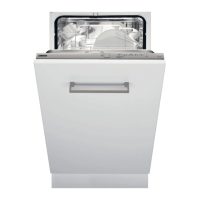
This document serves as a user manual for a Zanussi dishwasher, model ZDTS 101, providing comprehensive instructions for its operation, maintenance, and installation. The appliance is designed for washing household utensils suitable for machine washing.
Function Description
The dishwasher operates through a series of washing programmes tailored to different degrees of soil and types of load. These programmes include:
- Intensive 65°: For heavy soil, suitable for crockery, cutlery, pots, and pans. It involves a prewash, main wash, two intermediate rinses, a final rinse, and drying.
- Normal 65°: For normal soil, also suitable for crockery, cutlery, pots, and pans, with a similar cycle to the Intensive programme.
- 65° A 30': For light soil, designed for crockery and cutlery, featuring a main wash and a final rinse. This programme is ideal for partially loaded dishwashers, meeting the daily needs of a family of four for breakfast and dinner crockery and cutlery.
- 50°: For normal soil, suitable for crockery and cutlery, including a prewash, main wash, one intermediate rinse, a final rinse, and drying. This is also designated as a test programme for test institutes.
- Rinse and Hold: For any soil level and partial loads (to be completed later in the day). This programme performs one cold rinse to prevent food scraps from sticking together and does not require detergent.
The dishwasher features a water softener system to remove minerals and salts from the water supply, which can be adjusted manually and electronically based on the local water hardness. It also includes a rinse aid dispenser to improve drying results and prevent water spots.
Usage Features
The dishwasher's control panel includes an On-Off button, a Programme selection/cancel button, indicator lights, and programme lights.
- Setting Mode: The appliance enters setting mode when all programme lights are off and the "End of programme" light flashes. This mode is used for selecting washing programmes, setting the water softener, and activating/deactivating audible signals.
- Starting a Programme: To start a programme, press the On-Off button, then the Programme selection/cancel button to illuminate the last performed programme. Press the Programme selection/cancel button repeatedly to select the desired programme, then close the door.
- Cancelling a Programme: If a programme needs to be changed after starting, open the door, press and hold the Programme selection/cancel button until the running programme light turns off and the "End of programme" light flashes, then release the button. The machine can then be switched off or a new programme selected.
- Audible Signals: The dishwasher provides audible signals to indicate the end of a washing programme or a malfunction. These signals can be activated or deactivated through the setting mode.
- Detergent Use: Only detergents suitable for dishwashers should be used. For programmes with prewash, an additional detergent dose is added to a separate compartment. When using detergent tablets, they are placed in the main detergent compartment. The manual advises using long washing programmes with tablets to ensure complete dissolution.
- Loading Dishes: Dishes and cutlery should be loaded to allow free rotation of the spray arms. Hollow items should be placed face down to prevent water collection. Items should not overlap. Specific items like wooden, horn, or lead crystal cutlery are not suitable for machine washing, while stoneware, glazed patterns, and silver/aluminium parts have limited suitability.
- Adjusting Upper Basket: The upper basket's height can be adjusted to accommodate larger items in the lower basket. This involves moving front runner stops and sliding the basket to the desired position. Note that cup racks may not be usable when the basket is in the higher position.
- Unloading Dishes: Hot dishes are sensitive to knocks, so they should be allowed to cool before removal. The lower basket should be emptied first, followed by the upper basket, to prevent water dripping onto clean dishes.
Maintenance Features
Regular maintenance is crucial for the dishwasher's performance and longevity:
- Filter Cleaning: The dishwasher should never be used without filters. Filters A, B, and C must be cleaned thoroughly under running water. Filter A is removed from the base of the washing compartment, and filters B and C are removed by turning a handle anticlockwise. After cleaning, the filters are replaced and locked by turning clockwise.
- Spray Arm Cleaning: If soil residues clog the holes in the spray arms, they can be cleared with a cocktail stick. The spray arms should not be removed.
- External Cleaning: The external surfaces and control panel should be cleaned with a damp, soft cloth and neutral detergents. Abrasive products, scouring pads, or solvents should not be used.
- Internal Cleaning: The seals around the door and the detergent/rinse aid dispensers should be cleaned regularly with a damp cloth. It is recommended to run a wash programme for heavily soiled dishes with detergent but without dishes every three months.
- Prolonged Periods of Non-Operation: If the machine will not be used for an extended period, it should be unplugged, the water supply turned off, and the door left ajar to prevent unpleasant smells.
- Frost Precautions: To prevent damage from frost, the machine should not be placed in locations below 0°C. If unavoidable, the machine should be emptied, the door closed, and the water inlet pipe disconnected and emptied.

 Need help?
 General

 To Next Page