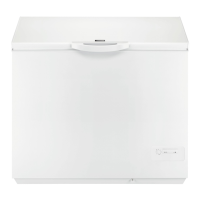
Need help?
Do you have a question about the Zanussi ZFC620WAP and is the answer not in the manual?
Safety guidelines for children and vulnerable individuals using the appliance, including supervision and packaging hazards.
General safety precautions for operating the appliance, including ventilation, prohibited uses, and refrigerant handling.
Ensures electrical components are handled by certified agents to prevent hazards, detailing power cord and plug safety.
Guidance on unpacking, checking for damage, and initial connection procedures, including waiting periods.
Safety warning about discarding old appliances and guidelines for optimal installation location based on climate class.
Cautionary notes on electrical work, emphasizing qualified personnel and the requirement for earthing the appliance.
Detailed instructions on connecting mains lead wires to the plug terminals according to colour coding and safety standards.
Details the high temperature alarm light, its indicator for power failure, and actions during alarm phases.
Procedure for defrosting the freezer when frost accumulates, including steps for removing frost and water.
Details causes for the high temperature alarm, including room temperature and internal freezer conditions.
Troubleshooting for complete appliance failure, checking plug connection, power supply, and if the appliance is switched on.
Troubleshooting the absence of power, advising to test the socket with another appliance and call an electrician.
This document is a user manual for a Zanussi chest freezer, model ZFC620WAP, providing comprehensive instructions for its safe operation, maintenance, and troubleshooting.
The Zanussi chest freezer is designed for freezing fresh food and storing frozen and deep-frozen food for extended periods. It operates by maintaining a low temperature within its compartment, controlled by a temperature regulator. The appliance uses isobutane (R600a) as a refrigerant, a natural gas with high environmental compatibility. It is intended for use in normal household settings and similar applications such as staff kitchen areas, farmhouses, hotels, motels, bed and breakfast environments, and catering services. The freezer is equipped with a high temperature alarm light to indicate an increase in internal temperature, for example, due to a power failure.
Switching On and Temperature Regulation: To switch on the appliance, the plug is inserted into a wall socket. The temperature regulator should be turned to the "Full Loaded" position, and the freezer allowed to run for 24 hours to reach the correct temperature before food is placed inside. The temperature within the appliance is controlled by a regulator on the control panel. Lower settings provide minimum coldness, while higher settings provide maximum coldness. For freezing smaller food volumes, the "Half Loaded" setting is recommended, and for larger volumes, the "Full Loaded" setting is most suitable.
Switching Off: To turn off the appliance, the temperature regulator is simply turned to the "OFF" position.
Freezing Fresh Food: The freezer compartment is suitable for freezing fresh food. The maximum amount of food that can be frozen in 24 hours is specified on the rating plate. The freezing process takes 24 hours, during which no additional food should be added.
Storage of Frozen Food: When starting up or after a period of disuse, the appliance should run for 24 hours with the temperature regulator set to the "Full Loaded" position before products are placed inside. In case of accidental defrosting (e.g., due to a power failure exceeding the "rising time" value), defrosted food must be consumed quickly or cooked immediately and then re-frozen after cooling.
Opening and Closing the Lid: The lid is equipped with a tightly closing seal, which may make it difficult to reopen immediately after closing due to vacuum formation. Users should wait a few minutes before attempting to reopen the appliance, as a vacuum valve will assist in opening the lid. It is important not to pull the handle with immense force.
Storage Baskets: The freezer includes storage baskets that can be hung on the upper edge of the freezer or placed inside. The handles can be turned and fixed for these two positions. Additional baskets can be purchased from a service center.
Hints for Freezing: To optimize the freezing process, it is advised to freeze only top-quality, fresh, and thoroughly cleaned foodstuffs. Food should be prepared in small portions for rapid and complete freezing, allowing only the required quantity to be thawed later. Food should be wrapped in aluminum foil or polythene, ensuring airtight packages. Fresh, unfrozen food should not touch already frozen food to prevent temperature rise. Lean foods store better and longer than fatty ones, while salt reduces storage life. Water ices, if consumed immediately from the freezer, can cause freeze burns. The freezing date should be marked on each pack to track storage time.
Hints for Storage of Frozen Food: For best performance, commercially frozen foodstuffs should be adequately stored by the retailer and transferred to the freezer as quickly as possible. The lid should not be opened frequently or left open longer than necessary. Once defrosted, food deteriorates rapidly and should not be re-frozen. The storage period indicated by the food manufacturer should not be exceeded.
Cleaning the Interior: Before first use, the interior and all internal accessories should be washed with lukewarm water and a neutral soap to remove any new product smell, then thoroughly dried. Detergents or abrasive powders should not be used as they can damage the finish.
Periodic Cleaning: The appliance should be switched off and disconnected from the mains socket before cleaning. Regular cleaning of the appliance and accessories should be done with warm water and neutral soap, paying careful attention to the lid seal. After cleaning, the appliance must be fully dried before reconnecting to the mains and switching on. Harsh detergents, abrasive products, highly perfumed cleaning products, or wax polishes should not be used on the inner side of the appliance to prevent damage to the cooling system. The compressor area does not require cleaning.
Defrosting the Freezer: The freezer should be defrosted when the frost layer reaches a thickness of about 10-15 mm. The best time to defrost is when the freezer contains little or no food. To defrost, the appliance should be switched off, and all stored food removed, wrapped in newspaper, and placed in a cool location. The lid should be left open, and the plug from the defrost water drain removed to collect defrost water on a tray. A plastic scraper can be used to quickly remove ice. Sharp metal tools or artificial means to speed up thawing should not be used, as they can damage the appliance and shorten the safe storage life of frozen food. After defrosting, the interior should be thoroughly dried, the plug refitted, and the appliance switched on. The temperature regulator should be set to maximum coldness for two to three hours before reloading food.
Replacing the Lamp: To replace the lamp, the mains plug must first be disconnected from the socket. The lamp should be replaced with one of the same power, specifically designed for household appliances (maximum power indicated on the lamp cover). After replacement, the mains plug is reconnected, and the lid opened to ensure the lamp comes on.
Troubleshooting: Before troubleshooting, the power supply must be disconnected. Only a qualified electrician or competent person should perform troubleshooting not covered in the manual. The manual provides solutions for common issues such as noisy operation, continuous compressor operation, high temperature alarm, excessive frost, lid not closing properly, difficulty opening the lid, and the lamp not working.
Environmental Protection: The appliance does not contain gases that damage the ozone layer. It should not be discarded with urban refuse. The insulation foam contains flammable gases, and the appliance should be disposed of according to local regulations. The cooling unit should not be damaged, especially near the heat exchanger at the rear. Materials used in the appliance are recyclable. Users are encouraged to recycle packaging materials and dispose of the appliance at local recycling facilities or municipal offices at the end of its life.
 General
| Type | Chest freezer |
|---|---|
| Colour | White |
| Energy Efficiency Class | F |
| Height | 85 cm |
| Weight | 45 kg |
| Defrost Type | Manual |
| Climate class | SN-T |

 To Next Page