EasyManua.ls Logo

Zenith D952X - Page 19

Zenith D952X
56 pages
Print Icon
To Next Page IconTo Next Page
To Previous Page IconTo Previous Page
Loading...
SECTION
THREE
MULTIPLEX
ALIGNMENT
PROCEDURE
Before
any
attempt
is
made
to
align,
or
service,
FM
Multiplex
circuitry,
the
technician
must
be
certain
that
the
RF,
IF,
and
Ratio
Detector
alignment
is
correct,
and
that
the
receiver
functions
normally
on
monaural
signals.
Because
of
the
wide
band
pass
required
in
a
FM
multiplex
receiver,
it
is
desirable
to
use
a
FM
signal
generator
having
a
deviation
of
at
least
200
KHz
with
a
sweep
rate
of
60
Hertz,
as
well
as
an
oscilloscope.
During
the
IF
and
Ratio
Detector
alignment
it
is
not
only
necessary
to
obtain
maximum
gain,
but
also
extremely
important
to
maintain
symmetry.
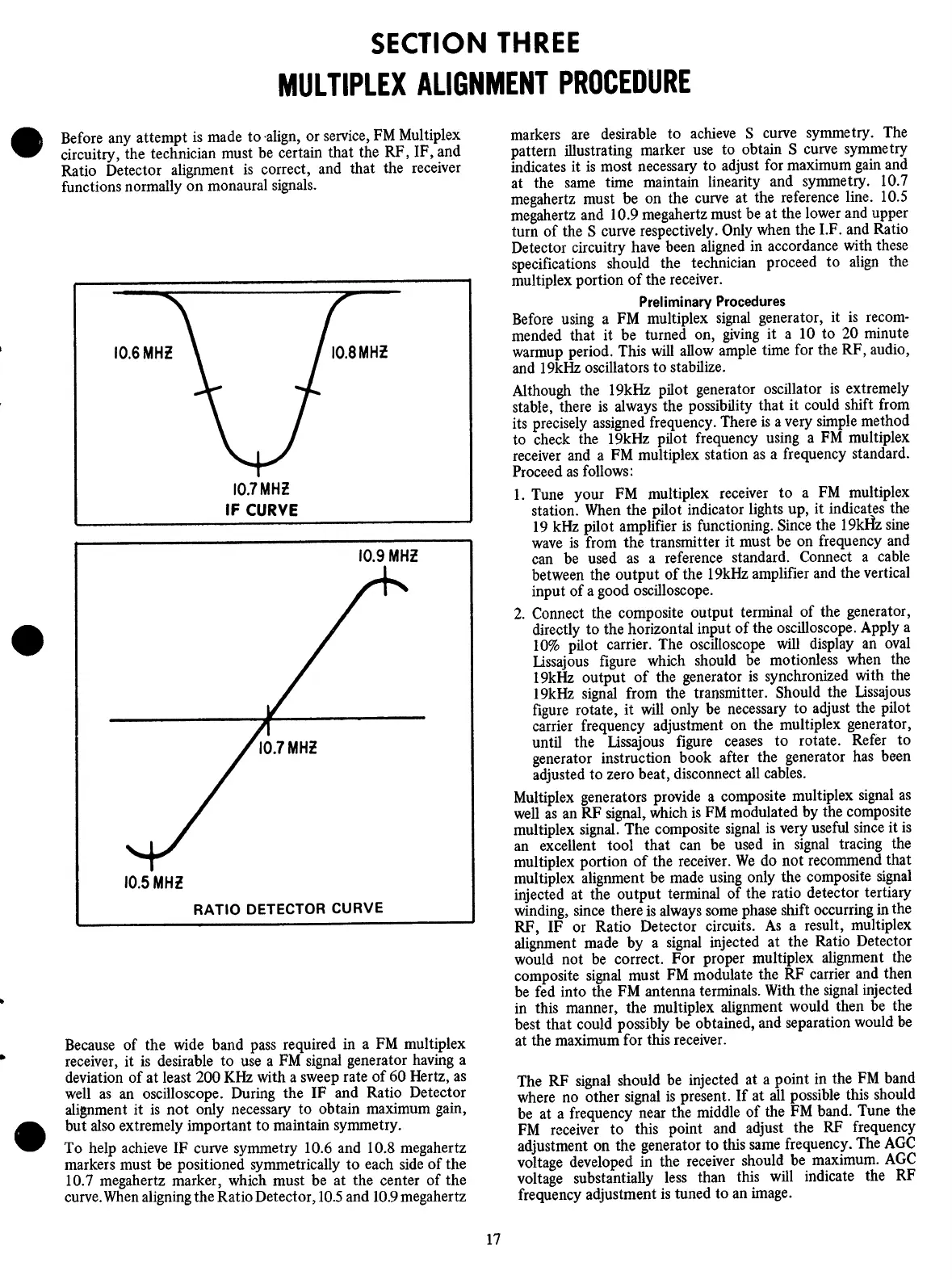
To
help
achieve
IF
curve
symmetry
10.6
and
10.8
megahertz
markers
must
be
positioned
symmetrically
to
each
side
of
the
10.7
megahertz
marker,
which
must
be
at
the
center
of
the
curve.
When
aligning
the
Ratio
Detector,
10.5
and
10.9
megahertz
17
markers
are
desirable
to
achieve
S
curve
symmetry.
The
pattern
illustrating
marker
use
to
obtain
S
curve
symmetry
indicates
it
is
most
necessary
to
adjust
for
maximum
gain
and
at
the
same
time
maintain
linearity
and
symmetry.
10.7
megahertz
must
be
on
the
curve
at
the
reference
line.
10.5
megahertz
and
10.9
megahertz
must
be
at
the
lower
and
upper
turn
of
the
S
curve
respectively.
Only
when
the
I.F.
and
Ratio
Detector
circuitry
have
been
aligned
in
accordance
with
these
specifications
should
the
technician
proceed
to
align
the
multiplex
portion
of
the
receiver.
Preliminary
Procedures
Before
using
a
FM
multiplex
signal
generator,
it
is
recom
mended
that
it
be
turned
on,
giving
it
a
10
to
20
minute
warmup
period.
This
will
allow
ample
time
for
the
RF,
audio,
and
19kHz
oscillators
to
stabilize.
Although
the
19kHz
pilot
generator
oscillator
is
extremely
stable,
there
is
always
the
possibility
that
it
could
shift
from
its
precisely
assigned
frequency.
There
is
a
very
simple
method
to
check
the
19kHz
pilot
frequency
using
a
FM
multiplex
receiver
and
a
FM
multiplex
station
as
a
frequency
standard.
Proceed
as
follows:
1.
Tune
your
FM
multiplex
receiver
to
a
FM
multiplex
station.
When
the
pilot
indicator
lights
up,
it
indicates
the
19
kHz
pilot
amplifier
is
functioning.
Since
the
19kllz
sine
wave
is
from
the
transmitter
it
must
be
on
frequency
and
can
be
used
as
a
reference
standard.
Connect
a
cable
between
the
output
of
the
19kHz
amplifier
and
the
vertical
input
of
a
good
oscilloscope.
2.
Connect
the
composite
output
terminal
of
the
generator,
directly
to
the
horizontal
input
of
the
oscilloscope.
Apply
a
10%
pilot
carrier.
The
oscilloscope
will
display
an
oval
Lissajous
figure
which
should
be
motionless
when
the
19kHz
output
of
the
generator
is
synchronized
with
the
19kHz
signal
from
the
transmitter.
Should
the
Lissajous
figure
rotate,
it
will
only
be
necessary
to
adjust
the
pilot
carrier
frequency
adjustment
on
the
multiplex
generator,
until
the
Lissajous
figure
ceases
to
rotate.
Refer
to
generator
instruction
book
after
the
generator
has
been
adjusted
to
zero
beat,
disconnect
all
cables.
Multiplex
generators
provide
a
composite
multiplex
signal
as
well
as
an
RF
signal,
which
is
FM
modulated
by
the
composite
multiplex
signal.
The
composite
signal
is
very
useful
since
it
is
an
excellent
tool
that
can
be
used
in
signal
tracing
the
multiplex
portion
of
the
receiver.
We
do
not
recommend
that
multiplex
alignment
be
made
using
only
the
composite
signal
injected
at
the
output
terminal
of
the
ratio
detector
tertiary
winding,
since
there
is
always
some
phase
shift
occurring
in
the
RF,
IF
or
Ratio
Detector
circuits.
As
a
result,
multiplex
alignment
made
by
a
signal
injected
at
the
Ratio
Detector
would
not
be
correct.
For
proper
multiplex
alignment
the
composite
signal
must
FM
modulate
the
RF
carrier
and
then
be
fed
into
the
FM
antenna
terminals.
With
the
signal
injected
in
this
manner,
the
multiplex
alignment
would
then
be
the
best
that
could
possibly
be
obtained,
and
separation
would
be
at
the
maximum
for
this
receiver.
The
RF
signal
should
be
injected
at
a
point
in
the
FM
band
where
no
other
signal
is
present.
If
at
all
possible
this
should
be
at
a
frequency
near
the
middle
of
the
FM
band.
Tune
the
FM
receiver
to
this
point
and
adjust
the
RF
frequency
adjustment
on
the
generator
to
this
same
frequency.
The
AGC
voltage
developed
in
the
receiver
should
be
maximum.
AGC
voltage
substantially
less
than
this
will
indicate
the
RF
frequency
adjustment
is
tuned
to
an
image.

Related product manuals