EasyManua.ls Logo

Zenith D952X - Page 20

Zenith D952X
56 pages
Print Icon
To Next Page IconTo Next Page
To Previous Page IconTo Previous Page
Loading...
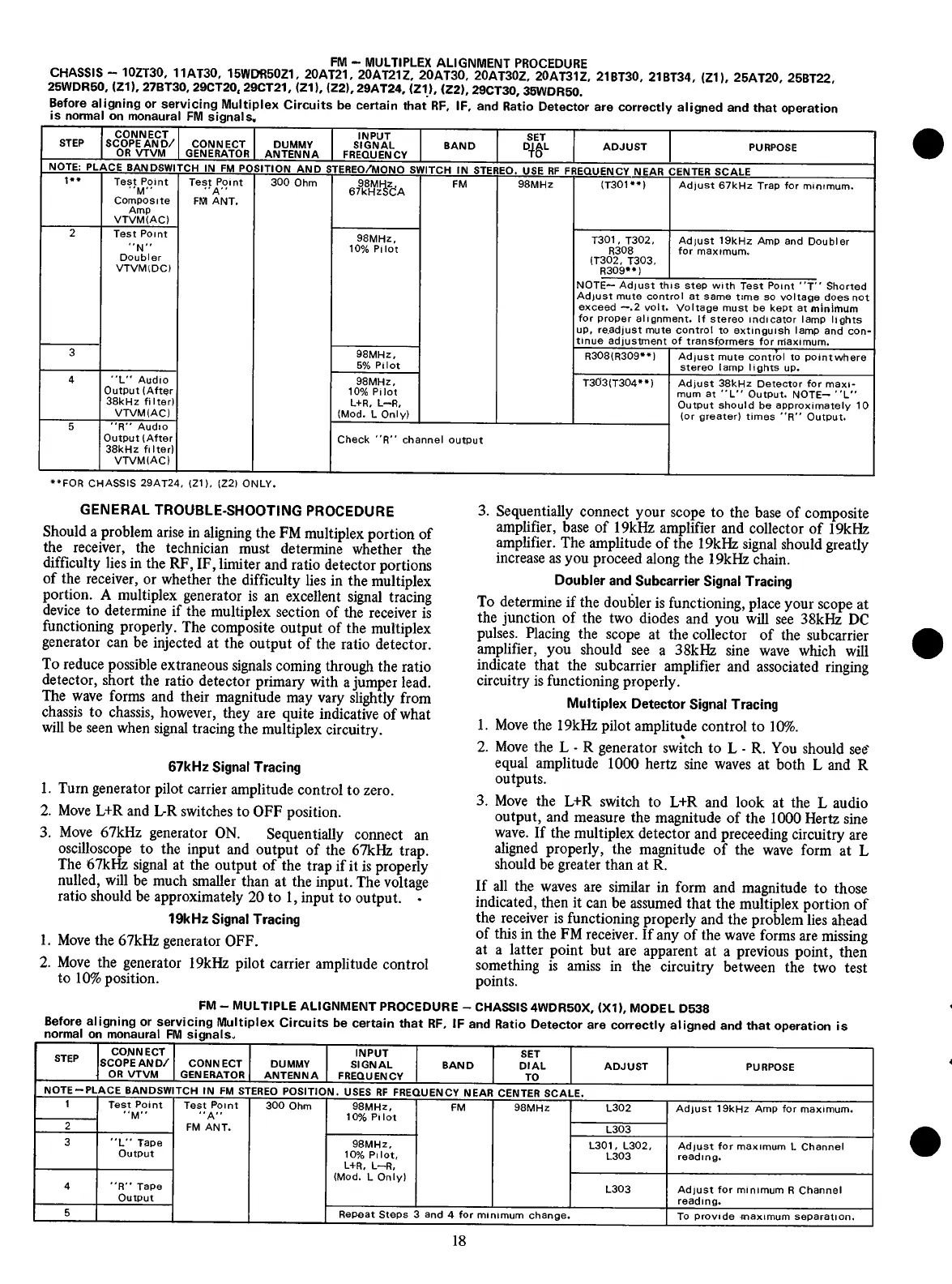
Before
aligning
or
servicing
Multiplex
Circuits
be
certain
that
RF,
IF,
and
Ratio
Detector
are
correctly
aligned
and
that
operation
is
normal
on
monaural
FM
signals.
^
1IA
_
zx
FM-MULTIPLEX
ALIGNMENT
PROCEDURE
CHASSIS
-
10ZT30,
11AT30,
15WDR50Z1,
20AT21,
20AT21Z,
20AT30,
20AT30Z,
20AT31Z,
21BT30,
21BT34,
(Z1
),
25AT20
25BT22
25WDR50,
(Z
1),
27BT30,
29CT20,
29CT21
,
(Z
1),
(Z2),
29AT24,
(Z1
),
(Z2),
29CT30,
35WDR50.
STEP
CONNECT
SCOPE
AND/
OR
VTVM
CONNECT
GENERATOR
DUMMY
ANTENNA
INPUT
SIGNAL
FREQUEN
CY
BAND
SET
D
^
L
ADJUST
PURPOSE
NOTE:
PL
ACE
BANDSWI
TCH
IN
FM
POSITION
AND
STEREO/MONO
SWITCH
IN
STEF
EO.
USE
RF
FREQUENCY
NEAR
CENTER
SCALE
1
**
Test
Point
"M"
Composite
Amp
VTVM(AC)
Test
Point
"A"
FM
ANT.
300
Ohm
98MHz,
67kHz$CA
FM
98MHz
(T301**)
Adjust
67kHz
Trap
for
minimum.
2
Test
Point
"N"
Doubler
VTVM(DC)
98MHz,
10%
Pilot
T301
,
T302,
R308
(T302,
T303,
R309**)
Adjust
19kHz
Amp
and
Doubler
for
maximum.
NOTE
Adjust
this
step
with
Test
Point
"T"
Shorted
Adjust
mute
control
at
same
time
so
voltage
doesnot
exceed
.2
volt.
Voltage
must
be
kept
at
minirtidrn
for
proper
alignment.
If
stereo
indicator
lamp
lights
up,
readjust
mute
control
to
extinguish
lamp
and
con
tinue
adjustment
of
transf.ormers
for
maximum.
3
98MHz,
5%
Pilot
R308(R309**)
Adjust
mute
control
to
pointwhere
stereo
lamp
lights
up.
4
"L"
Audio
Output
(Aft^r
38kHz
filter)
VTVM
(AC)
98MHz,
10%
Pilot
L+R,
L-R,
(Mod.
L
Only)
T303(T304**)
Adjust
38kHz
Detector
for
maxi
mum
at
"L"
Output.
NOTE
"L"
Output
should
be
approximately
10
(or
greater)
times
"R"
Output.
5
"R"
Audio
Output
(After
38kHz
filter)
VTVM(AC)
Check
"R"
channel
output
**FOR
CHASSIS
29AT24,
(Z1
),
(Z2)
ONLY.
3.
Sequentially
connect
your
scope
to
the
base
of
composite
amplifier,
base
of
19kHz
amplifier
and
collector
of
19kHz
amplifier.
The
amplitude
of
the
19kHz
signal
should
greatly
increase
as
you
proceed
along
the
19kHz
chain.
Doubler
and
Subcarrier
Signal
Tracing
To
determine
if
the
doubler
is
functioning,
place
your
scope
at
the
junction
of
the
two
diodes
and
you
will
see
38kHz
DC
pulses.
Placing
the
scope
at
the
collector
of
the
subcarrier
amplifier,
you
should
see
a
38kHz
sine
wave
which
will
indicate
that
the
subcarrier
amplifier
and
associated
ringing
circuitry
is
functioning
properly.
Multiplex
Detector
Signal
Tracing
1.
Move
the
19kHz
pilot
amplitude
control
to
10%.
*
2.
Move
the
L
-
R
generator
switch
to
L
-
R.
You
should
see'
equal
amplitude
1000
hertz
sine
waves
at
both
L
and
R
outputs.
3.
Move
the
L+R
switch
to
L+R
and
look
at
the
L
audio
output,
and
measure
the
magnitude
of
the
1000
Hertz
sine
wave.
If
the
multiplex
detector
and
preceeding
circuitry
are
aligned
properly,
the
magnitude
of
the
wave
form
at
L
should
be
greater
than
at
R.
If
all
the
waves
are
similar
in
form
and
magnitude
to
those
indicated,
then
it
can
be
assumed
that
the
multiplex
portion
of
the
receiver
is
functioning
properly
and
the
problem
lies
ahead
of
this
in
the
FM
receiver.
If
any
of
the
wave
forms
are
missing
at
a
latter
point
but
are
apparent
at
a
previous
point,
then
something
is
amiss
in
the
circuitry
between
the
two
test
points.
GENERAL
TROUBLE-SHOOTING
PROCEDURE
Should
a
problem
arise
in
aligning
the
FM
multiplex
portion
of
the
receiver,
the
technician
must
determine
whether
the
difficulty
lies
in
the
RF,
IF,
limiter
and
ratio
detector
portions
of
the
receiver,
or
whether
the
difficulty
lies
in
the
multiplex
portion.
A
multiplex
generator
is
an
excellent
signal
tracing
device
to
determine
if
the
multiplex
section
of
the
receiver
is
functioning
properly.
The
composite
output
of
the
multiplex
generator
can
be
injected
at
the
output
of
the
ratio
detector.
To
reduce
possible
extraneous
signals
coming
through
the
ratio
detector,
short
the
ratio
detector
primary
with
a
jumper
lead.
The
wave
forms
and
their
magnitude
may
vary
slightly
from
chassis
to
chassis,
however,
they
are
quite
indicative
of
what
will
be
seen
when
signal
tracing
the
multiplex
circuitry.
67kHz
Signal
Tracing
1.
Turn
generator
pilot
carrier
amplitude
control
to
zero.
2.
Move
L+R
and
L-R
switches
to
OFF
position.
3.
Move
67kHz
generator
ON.
Sequentially
connect
an
oscilloscope
to
the
input
and
output
of
the
67kHz
trap.
The
67kHz
signal
at
the
output
of
the
trap
if
it
is
properly
nulled,
will
be
much
smaller
than
at
the
input.
The
voltage
ratio
should
be
approximately
20
to
1,
input
to
output.
19kHz
Signal
Tracing
1.
Move
the
67kHz
generator
OFF.
2.
Move
the
generator
19kHz
pilot
carrier
amplitude
control
to
10%
position.
FM
-
MULTIPLE
ALIGNMENT
PROCEDURE
-
CHASSIS
4WDR50X,
(XI),
MODEL
D538
Before
aligning
or
servicing
Multiplex
Circuits
be
certain
that
RF,
IF
and
Ratio
Detector
are
correctly
aligned
and
that
operation
is
normal
on
monaural
FM
signals.
18
STEP
CONNECT
SCOPE
AND/
OR
VTVM
CONNECT
GENERATOR
DUMMY
ANTENNA
INPUT
SIGNAL
FREQUENCY
BAND
SET
DIAL
TO
ADJUST
PURPOSE
NOTE-PL
ACE
BANDSWITCH
IN
FM
STEREO
POSITION.
USES
RF
FREQUENCY
NEAR
CENTER
SCALE.
1
2
Test
Point
"M"
Test
Point
"A"
FM
ANT.
300
Ohm
98MHz,
10%
Pilot
FM
98MHz
L302
L303
Adjust
19kHz
Amp
for
maximum.
3
"L"
Tape
Output
98MHz,
10%
Pilot,
L+R,
L-R,
(Mod.
L
Only)
L301,
L302,
L303
Adjust
for
maximum
L
Channel
reading.
4
"R
Tape
Output
L303
Adjust
for
minimum
R
Channel
reading.
5
Repeat
Steps
3
and
4
for
minimum
change.
To
provide
maximum
separation.

Related product manuals