EasyManua.ls Logo

Zenith D952X - Page 22

Zenith D952X
56 pages
Print Icon
To Next Page IconTo Next Page
To Previous Page IconTo Previous Page
Loading...
SECTION
FOUR
THEORY
AND
APPLICATION
ALLEGRO
SPEAKER
SYSTEM
-
MODEL
D9013W
Speaker
system,
Model
D9013,
is
of
the
bass
reflex
type.
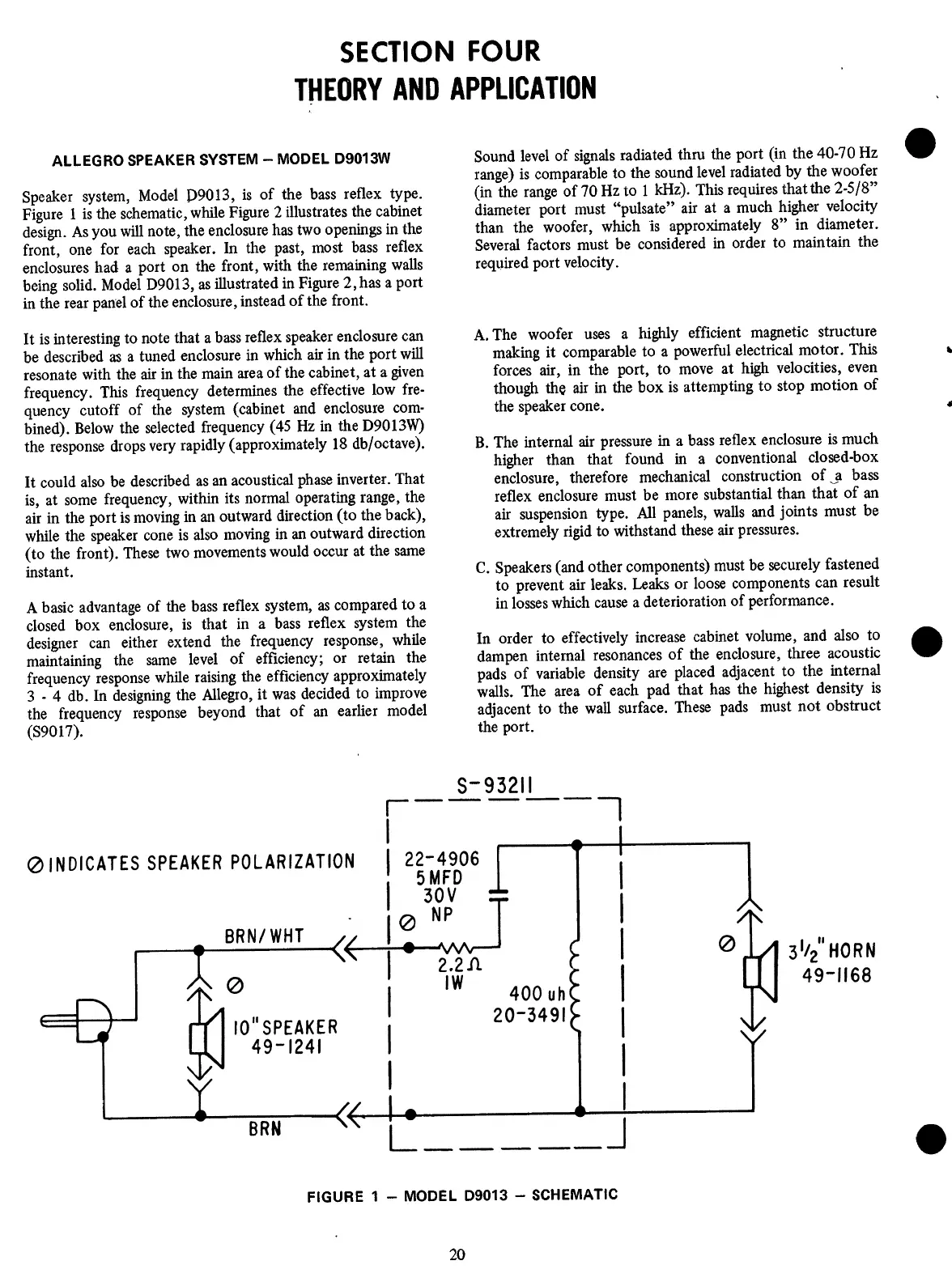
Figure
1
is
the
schematic,
while
Figure
2
illustrates
the
cabinet
design.
As
you
will
note,
the
enclosure
has
two
openings
in
the
front,
one
for
each
speaker.
In
the
past,
most
bass
reflex
enclosures
had
a
port
on
the
front,
with
the
remaining
walls
being
solid.
Model
D9013,
as
illustrated
in
Figure
2,
has
a
port
in
the
rear
panel
of
the
enclosure,
instead
of
the
front.
It
is
interesting
to
note
that
a
bass
reflex
speaker
enclosure
can
be
described
as
a
tuned
enclosure
in
which
air
in
the
port
will
resonate
with
the
air
in
the
main
area
of
the
cabinet,
at
a
given
frequency.
This
frequency
determines
the
effective
low
fre
quency
cutoff
of
the
system
(cabinet
and
enclosure
com
bined).
Below
the
selected
frequency
(45
Hz
in
the
D9013W)
the
response
drops
very
rapidly
(approximately
18
db/octave).
It
could
also
be
described
as
an
acoustical
phase
inverter.
That
is,
at
some
frequency,
within
its
normal
operating
range,
the
air
in
the
port
is
moving
in
an
outward
direction
(to
the
back),
while
the
speaker
cone
is
also
moving
in
an
outward
direction
(to
the
front).
These
two
movements
would
occur
at
the
same
instant.
A
basic
advantage
of
the
bass
reflex
system,
as
compared
to
a
closed
box
enclosure,
is
that
in
a
bass
reflex
system
the
designer
can
either
extend
the
frequency
response,
while
maintaining
the
same
level
of
efficiency;
or
retain
the
frequency
response
while
raising
the
efficiency
approximately
3
-
4
db.
In
designing
the
Allegro,
it
was
decided
to
improve
the
frequency
response
beyond
that
of
an
earlier
model
(S9017).
Sound
level
of
signals
radiated
thru
the
port
(in
the
40-70
Hz
range)
is
comparable
to
the
sound
level
radiated
by
the
woofer
(in
the
range
of
70
Hz
to
1
kHz).
This
requires
that
the
2-5/8
diameter
port
must
pulsate
air
at
a
much
higher
velocity
than
the
woofer,
which
is
approximately
8
in
diameter.
Several
factors
must
be
considered
in
order
to
maintain
the
required
port
velocity.
A.
The
woofer
uses
a
highly
efficient
magnetic
structure
making
it
comparable
to
a
powerful
electrical
motor.
This
forces
air,
in
the
port,
to
move
at
high
velocities,
even
though
the
air
in
the
box
is
attempting
to
stop
motion
of
the
speaker
cone.
B.
The
internal
air
pressure
in
a
bass
reflex
enclosure
is
much
higher
than
that
found
in
a
conventional
closed-box
enclosure,
therefore
mechanical
construction
of
a
bass
reflex
enclosure
must
be
more
substantial
than
that
of
an
air
suspension
type.
All
panels,
walls
and
joints
must
be
extremely
rigid
to
withstand
these
air
pressures.
C.
Speakers
(and
other
components)
must
be
securely
fastened
to
prevent
air
leaks.
Leaks
or
loose
components
can
result
in
losses
which
cause
a
deterioration
of
performance.
In
order
to
effectively
increase
cabinet
volume,
and
also
to
dampen
internal
resonances
of
the
enclosure,
three
acoustic
pads
of
variable
density
are
placed
adjacent
to
the
internal
walls.
The
area
of
each
pad
that
has
the
highest
density
is
adjacent
to
the
wall
surface.
These
pads
must
not
obstruct
the
port.
20
FIGURE
1
-
MODEL
D9013
-
SCHEMATIC

Related product manuals