EasyManua.ls Logo

Zenith J584W - Page 30

Zenith J584W
80 pages
Print Icon
To Next Page IconTo Next Page
To Previous Page IconTo Previous Page
Loading...
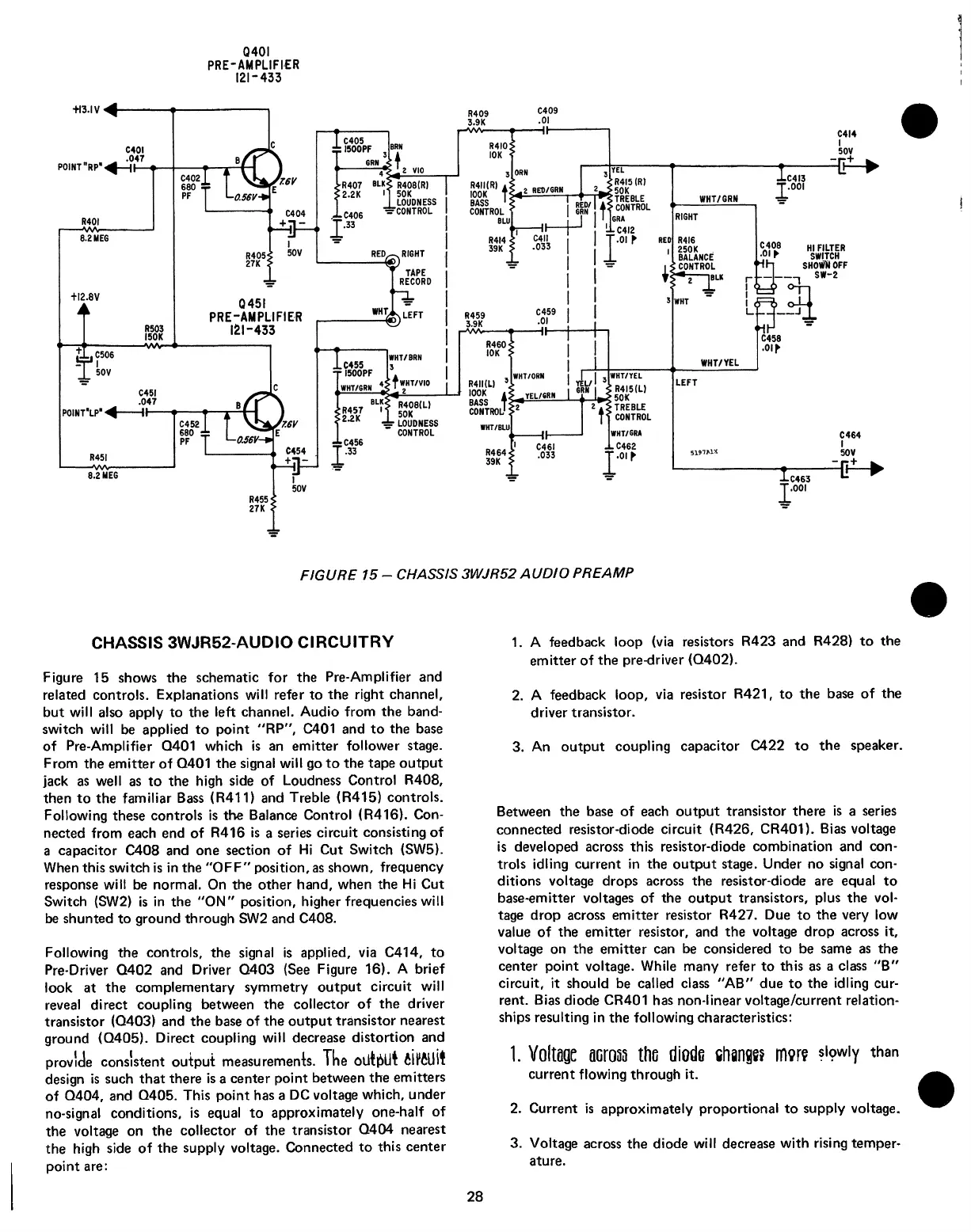
FIGURE
15
-
CHASSIS
3WJR52
AUDIO
PREAMP
28
CHASSIS
3WJR52-AUDIO
CIRCUITRY
Figure
15
shows
the
schematic
for
the
Pre-Amplifier
and
related
controls.
Explanations
will
refer
to
the
right
channel,
but
will
also
apply
to
the
left
channel.
Audio
from
the
band
switch
will
be
applied
to
point
"RP",
C401
and
to
the
base
of
Pre-Amplifier
Q401
which
is
an
emitter
follower
stage.
From
the
emitter
of
Q401
the
signal
will
go
to
the
tape
output
jack
as
well
as
to
the
high
side
of
Loudness
Control
R408,
then
to
the
familiar
Bass
(R41
1)
and
Treble
(R415)
controls.
Following
these
controls
is
the
Balance
Control
(R416).
Con
nected
from
each
end
of
R416
is
a
series
circuit
consisting
of
a
capacitor
C408
and
one
section
of
Hi
Cut
Switch
(SW5).
When
this
switch
is
in
the
"OFF"
position,
as
shown,
frequency
response
will
be
normal.
On
the
other
hand,
when
the
Hi
Cut
Switch
(SW2)
is
in
the
"ON"
position,
higher
frequencies
will
be
shunted
to
ground
through
SW2
and
C408.
Following
the
controls,
the
signal
is
applied,
via
C414,
to
Pre-Driver
Q402
and
Driver
Q403
(See
Figure
16).
A
brief
look
at
the
complementary
symmetry
output
circuit
will
reveal
direct
coupling
between
the
collector
of
the
driver
transistor
(Q403)
and
the
base
of
the
output
transistor
nearest
ground
(Q405).
Direct
coupling
will
decrease
distortion
and
provide
consistent
output
measurements.
The
oiitfillt
design
is
such
that
there
is
a
center
point
between
the
emitters
of
Q404,
and
Q405.
This
point
has
a
DC
voltage
which,
under
no-signal
conditions,
is
equal
to
approximately
one-half
of
the
voltage
on
the
collector
of
the
transistor
Q404
nearest
the
high
side
of
the
supply
voltage.
Connected
to
this
center
point
are:
1.
A
feedback
loop
(via
resistors
R423
and
R428)
to
the
emitter
of
the
pre-driver
(Q402).
2.
A
feedback
loop,
via
resistor
R421,
to
the
base
of
the
driver
transistor.
3.
An
output
coupling
capacitor
C422
to
the
speaker.
Between
the
base
of
each
output
transistor
there
is
a
series
connected
resistor-diode
circuit
(R426,
CR401).
Bias
voltage
is
developed
across
this
resistor-diode
combination
and
con
trols
idling
current
in
the
output
stage.
Under
no
signal
con
ditions
voltage
drops
across
the
resistor-diode
are
equal
to
base-emitter
voltages
of
the
output
transistors,
plus
the
vol
tage
drop
across
emitter
resistor
R427.
Due
to
the
very
low
value
of
the
emitter
resistor,
and
the
voltage
drop
across
it,
voltage
on
the
emitter
can
be
considered
to
be
same
as
the
center
point
voltage.
While
many
refer
to
this
as
a
class
"B"
circuit,
it
should
be
called
class
"AB"
due
to
the
idling
cur
rent.
Bias
diode
CR401
has
non-linear
voltage/current
relation
ships
resulting
in
the
following
characteristics:
1.
Voltage
across
the
diode
changes
mere
?'?
w|
y
than
current
flowing
through
it.
2.
Current
is
approximately
proportional
to
supply
voltage.
3.
Voltage
across
the
diode
will
decrease
with
rising
temper
ature.