EasyManua.ls Logo

Zenith J584W - Page 31

Zenith J584W
80 pages
Print Icon
To Next Page IconTo Next Page
To Previous Page IconTo Previous Page
Loading...
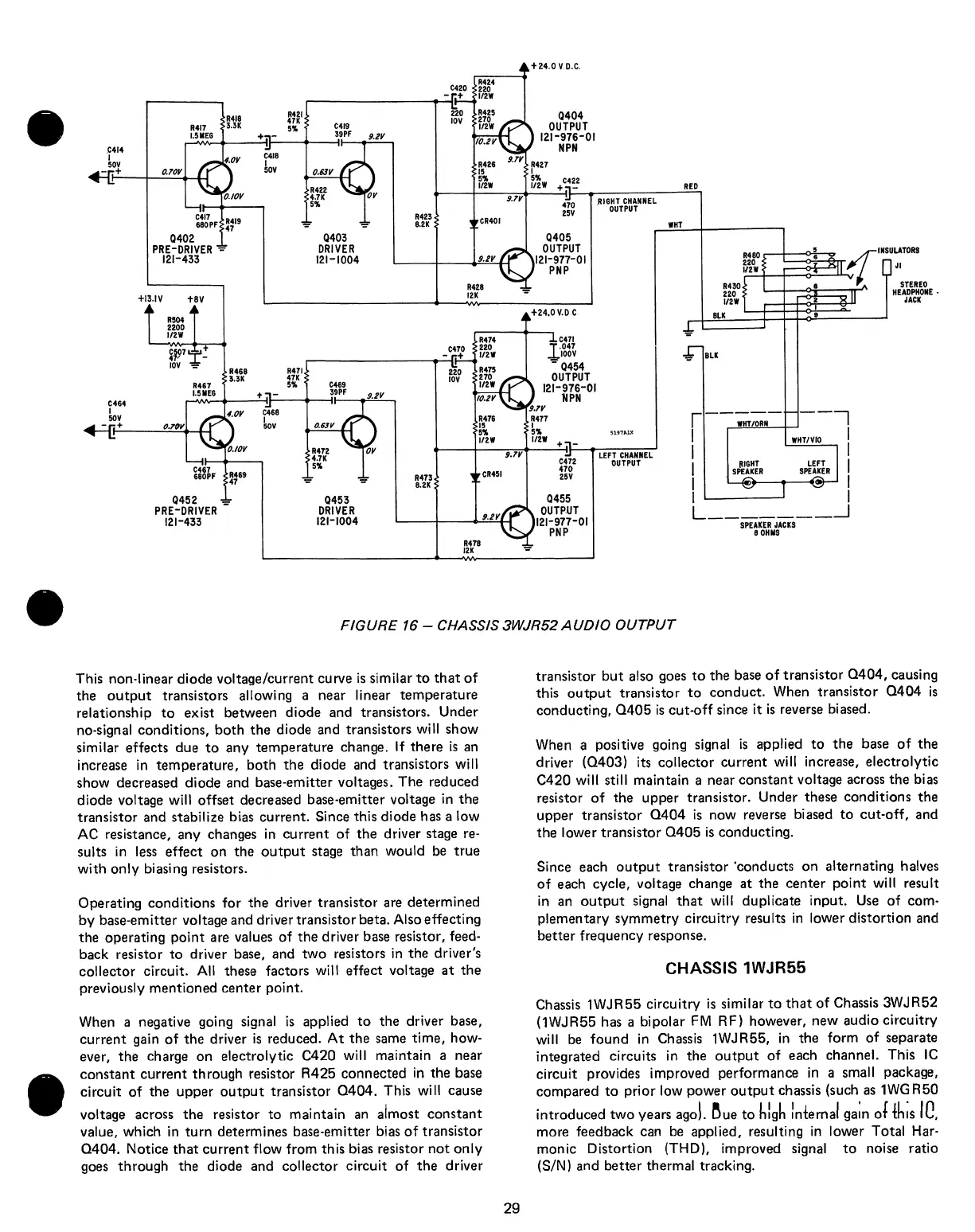
FIGURE
16
-
CHASSIS
3WJR52
AUDIO
OUTPUT
This
non-linear
diode
voltage/current
curve
is
similar
to
that
of
the
output
transistors
allowing
a
near
linear
temperature
relationship
to
exist
between
diode
and
transistors.
Under
no-signal
conditions,
both
the
diode
and
transistors
will
show
similar
effects
due
to
any
temperature
change.
If
there
is
an
increase
in
temperature,
both
the
diode
and
transistors
will
show
decreased
diode
and
base-emitter
voltages.
The
reduced
diode
voltage
will
offset
decreased
base-emitter
voltage
in
the
transistor
and
stabilize
bias
current.
Since
this
diode
has
a
low
AC
resistance,
any
changes
in
current
of
the
driver
stage
re
sults
in
less
effect
on
the
output
stage
than
would
be
true
with
only
biasing
resistors.
Operating
conditions
for
the
driver
transistor
are
determined
by
base-emitter
voltage
and
driver
transistor
beta.
Also
effecting
the
operating
point
are
values
of
the
driver
base
resistor,
feed
back
resistor
to
driver
base,
and
two
resistors
in
the
driver's
collector
circuit.
All
these
factors
will
effect
voltage
at
the
previously
mentioned
center
point.
When
a
negative
going
signal
is
applied
to
the
driver
base,
current
gain
of
the
driver
is
reduced.
At
the
same
time,
how
ever,
the
charge
on
electrolytic
C420
will
maintain
a
near
constant
current
through
resistor
R425
connected
in
the
base
circuit
of
the
upper
output
transistor
Q404.
This
will
cause
voltage
across
the
resistor
to
maintain
an
almost
constant
value,
which
in
turn
determines
base-emitter
bias
of
transistor
Q404.
Notice
that
current
flow
from
this
bias
resistor
not
only
goes
through
the
diode
and
collector
circuit
of
the
driver
29
transistor
but
also
goes
to
the
base
of
transistor
Q404,
causing
this
output
transistor
to
conduct.
When
transistor
Q404
is
conducting,
Q405
is
cut-off
since
it
is
reverse
biased.
When
a
positive
going
signal
is
applied
to
the
base
of
the
driver
(Q403)
its
collector
current
will
increase,
electrolytic
C420
will
still
maintain
a
near
constant
voltage
across
the
bias
resistor
of
the
upper
transistor.
Under
these
conditions
the
upper
transistor
Q404
is
now
reverse
biased
to
cut-off,
and
the
lower
transistor
Q405
is
conducting.
Since
each
output
transistor
conducts
on
alternating
halves
of
each
cycle,
voltage
change
at
the
center
point
will
result
in
an
output
signal
that
will
duplicate
input.
Use
of
com
plementary
symmetry
circuitry
results
in
lower
distortion
and
better
frequency
response.
CHASSIS
1WJR55
Chassis
1WJR55
circuitry
is
similar
to
that
of
Chassis
3WJR52
(1WJR55
has
a
bipolar
FM
RF)
however,
new
audio
circuitry
will
be
found
in
Chassis
1WJR55,
in
the
form
of
separate
integrated
circuits
in
the
output
of
each
channel.
This
IC
circuit
provides
improved
performance
in
a
small
package,
compared
to
prior
low
power
output
chassis
(such
as
1WGR50
introduced
two
years
agoj.
Bue
to
high
internal
gain
of
this
IC,
more
feedback
can
be
applied,
resulting
in
lower
Total
Har
monic
Distortion
(THD),
improved
signal
to
noise
ratio
(S/N)
and
better
thermal
tracking.