EasyManua.ls Logo

Zenith J584W - Page 37

Zenith J584W
80 pages
Print Icon
To Next Page IconTo Next Page
To Previous Page IconTo Previous Page
Loading...
35
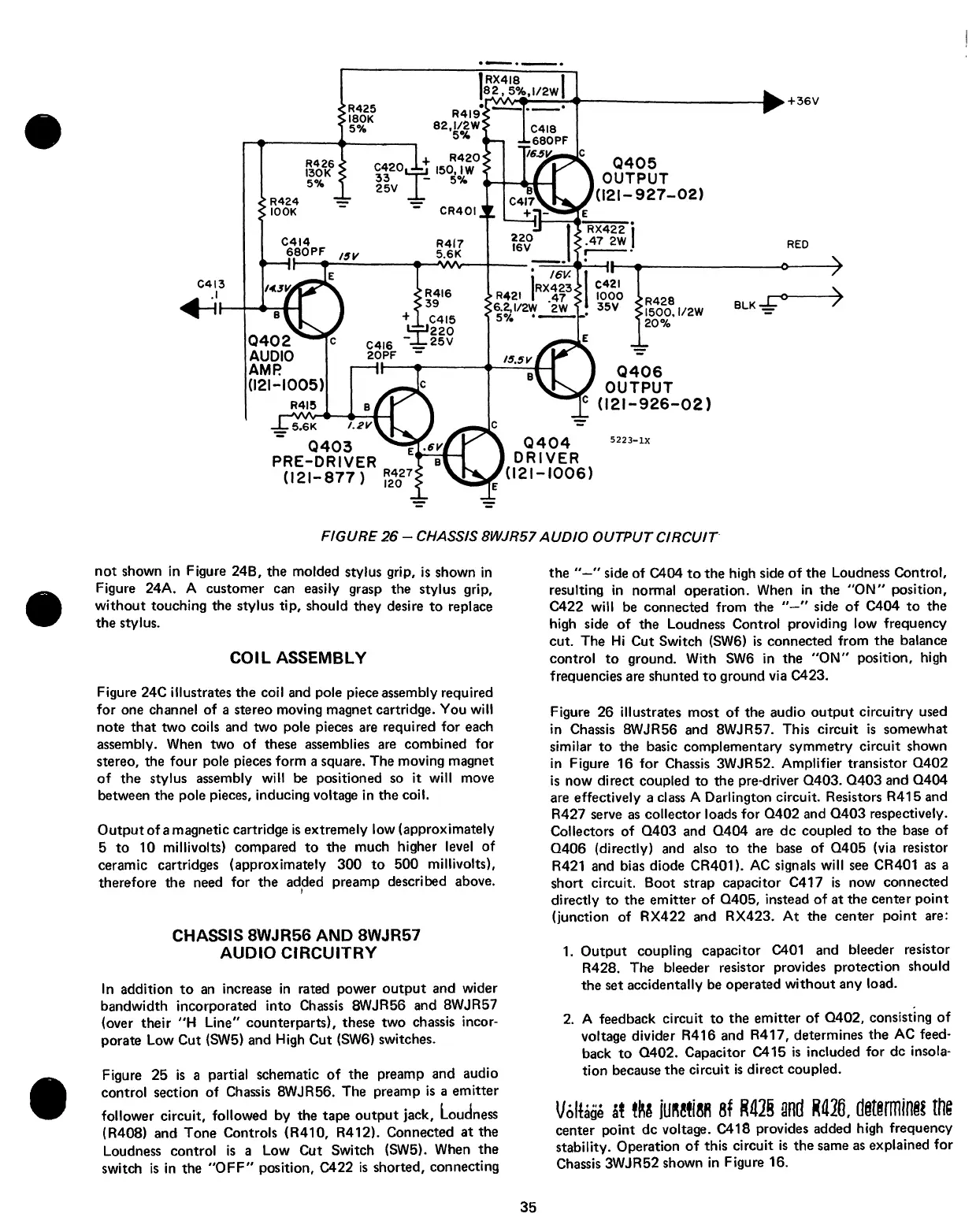
FIGURE
26
-
CHASSIS
8WJR57
AUDIO
OUTPUT
CIRCUIT
not
shown
in
Figure
24B,
the
molded
stylus
grip,
is
shown
in
Figure
24A.
A
customer
can
easily
grasp
the
stylus
grip,
without
touching
the
stylus
tip,
should
they
desire
to
replace
the
stylus.
COIL
ASSEMBLY
Figure
24C
illustrates
the
coil
and
pole
piece
assembly
required
for
one
channel
of
a
stereo
moving
magnet
cartridge.
You
will
note
that
two
coils
and
two
pole
pieces
are
required
for
each
assembly.
When
two
of
these
assemblies
are
combined
for
stereo,
the
four
pole
pieces
form
a
square.
The
moving
magnet
of
the
stylus
assembly
will
be
positioned
so
it
will
move
between
the
pole
pieces,
inducing
voltage
in
the
coil.
Output
of
a
magnetic
cartridge
is
extremely
low
(approximately
5
to
10
millivolts)
compared
to
the
much
higher
level
of
ceramic
cartridges
(approximately
300
to
500
millivolts),
therefore
the
need
for
the
added
preamp
described
above.
CHASSIS
8WJR56
AND
8WJR57
AUDIO
CIRCUITRY
In
addition
to
an
increase
in
rated
power
output
and
wider
bandwidth
incorporated
into
Chassis
8WJR56
and
8WJR57
(over
their
"H
Line"
counterparts),
these
two
chassis
incor
porate
Low
Cut
(SW5)
and
High
Cut
(SW6)
switches.
Figure
25
is
a
partial
schematic
of
the
preamp
and
audio
control
section
of
Chassis
8WJR56.
The
preamp
is
a
emitter
follower
circuit,
followed
by
the
tape
output
jack,
Loudness
(R408)
and
Tone
Controls
(R410,
R412).
Connected
at
the
Loudness
control
is
a
Low
Cut
Switch
(SW5).
When
the
switch
is
in
the
"OFF"
position,
C422
is
shorted,
connecting
the
"
"
side
of
C404
to
the
high
side
of
the
Loudness
Control,
resulting
in
normal
operation.
When
in
the
"ON"
position,
C422
will
be
connected
from
the
"
"
side
of
C404
to
the
high
side
of
the
Loudness
Control
providing
low
frequency
cut.
The
Hi
Cut
Switch
(SW6)
is
connected
from
the
balance
control
to
ground.
With
SW6
in
the
"ON"
position,
high
frequencies
are
shunted
to
ground
via
C423.
Figure
26
illustrates
most
of
the
audio
output
circuitry
used
in
Chassis
8WJR56
and
8WJR57.
This
circuit
is
somewhat
similar
to
the
basic
complementary
symmetry
circuit
shown
in
Figure
16
for
Chassis
3WJR52.
Amplifier
transistor
Q402
is
now
direct
coupled
to
the
pre-driver
Q403.
Q403
and
Q404
are
effectively
a
class
A
Darlington
circuit.
Resistors
R415
and
R427
serve
as
collector
loads
for
Q402
and
Q403
respectively.
Collectors
of
Q403
and
Q404
are
de
coupled
to
the
base
of
Q406
(directly)
and
also
to
the
base
of
Q405
(via
resistor
R421
and
bias
diode
CR401).
AC
signals
will
see
CR401
as
a
short
circuit.
Boot
strap
capacitor
C417
is
now
connected
directly
to
the
emitter
of
Q405,
instead
of
at
the
center
point
(junction
of
RX422
and
RX423.
At
the
center
point
are:
1.
Output
coupling
capacitor
C401
and
bleeder
resistor
R428.
The
bleeder
resistor
provides
protection
should
the
set
accidentally
be
operated
without
any
load.
2.
A
feedback
circuit
to
the
emitter
of
Q402,
consisting
of
voltage
divider
R416
and
R417,
determines
the
AC
feed
back
to
Q402.
Capacitor
C415
is
included
for
de
insola
tion
because
the
circuit
is
direct
coupled.
Voltage
at
tta
juMtiBR
8f
and
R436,
determines
the
center
point
de
voltage.
C418
provides
added
high
frequency
stability.
Operation
of
this
circuit
is
the
same
as
explained
for
Chassis
3WJR52
shown
in
Figure
16.