EVAC reserves the right to make alterations to this specification without prior notice.
© Copyright Evac Oy. All rights reserved.
1
EVAC
Commercial Marine Equipment
VV
VV
V
AA
AA
A
CUUM CUUM
CUUM CUUM
CUUM
TT
TT
T
OILETOILET
OILETOILET
OILET
OPERATION AND MAINTENANCE
Date:
Doc.
23 Aug 2005 3:01025C
5775500 CONTROL MECHANISM, EVAC 90, SQUATTING TOILET
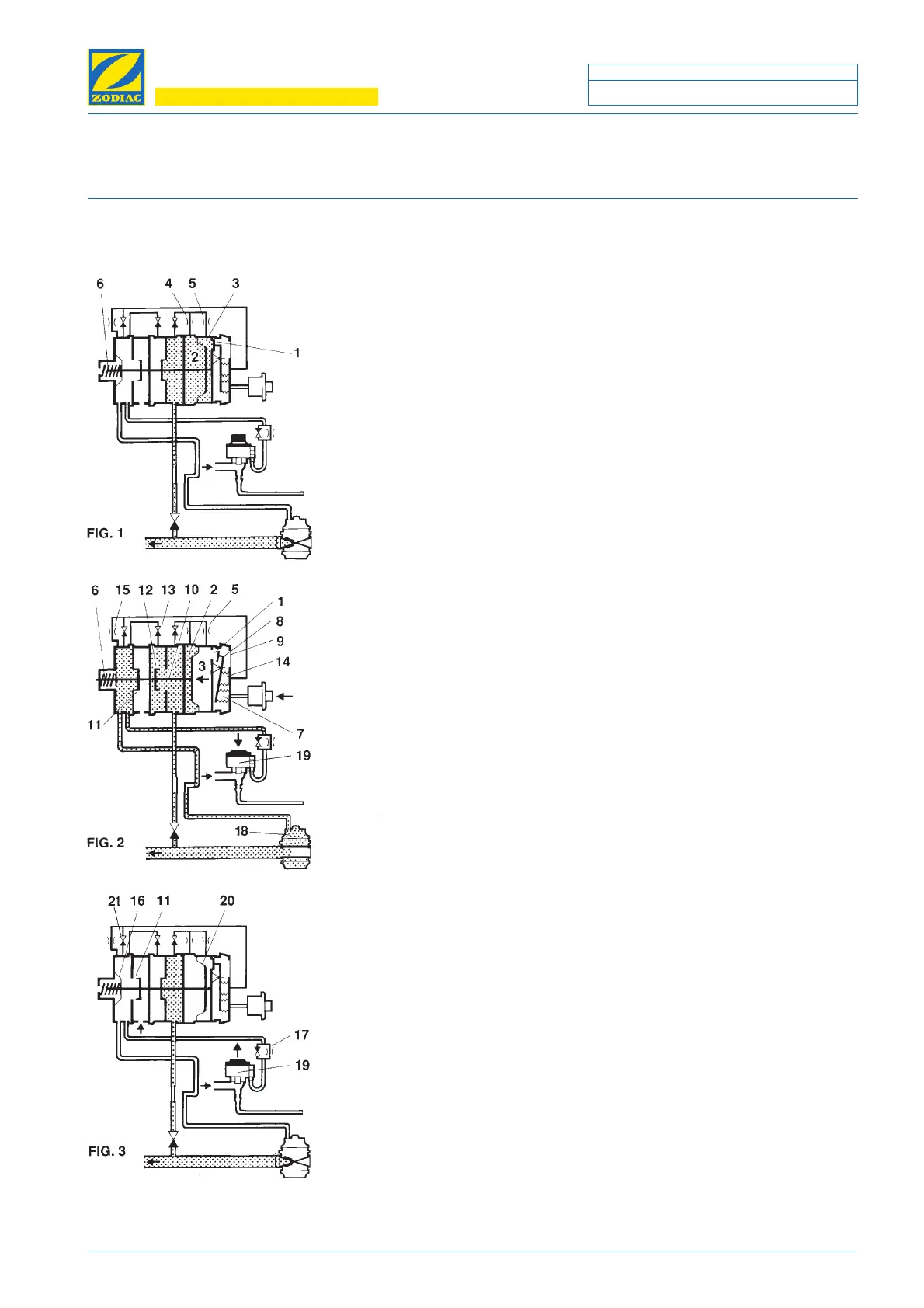
Description of flushing sequence
In the standby position FIG.1
Control valve 1 is closed. Vacuum in chambers 2 and 3 is equalized
by the jets 4 and 5. Spring force 6 holds the mechanism in the
non-activated position.
In the just switched position FIG.2
Air pressure applied from the flush button to chamber 7 has lifted
the lever 8 and opened control valve 1. Atmospheric air has entered
chamber 3 through filter 9 and valve 1. The force from the pressure
difference between 2 and 3 has moved the shaft 10 to the left and
the following sequence of events has occured:
The inlet valve 11 has closed. Vacuum valve 12 has opened.
Vacuum is distributed via check valve 13 to discharge valve 18
and water valve 19 which will both open. Chamber 14 is also
subjected to vacuum through check valve 21.
This vacuum will pull lever 8 and close valve 1 and the timer
function will start. Chamber 3 will be evacuated through jet 5 and
the pressure difference 2-3 equalizes. At a certain level, the
counterforce from spring 6 will outweigh and the cycle will go in
the opposite direction:
The vacuum valve 12 will close. The air inlet valve 11 will open and
atmospheric air enters discharge valve, water valve and chamber
14. The discharge valve 18 will close and somewhat later (because
of the jet 17), the water valve 19 closes when a suitable water
level has been reached at the bottom of the bowl.
Returning to standby position FIG. 3
The whole system goes to standby position ready for another
VT-flush.
! NOTE: Diaphragm 16 has the same effective area as the air
inlet valve 11 to balance the vacuum forces. FIG.3
! NOTE: Check valve 13 ensures that connected valves in activated
position are unaffected by changes in the vacuum supply level.
! NOTE: If vacuum is too low or absent the
function is delayed. Control valve 1 stays open until chamber 14
is subject to vacuum.


 To Next Page
 Loading...