This document serves as the user manual for a portable car refrigerator, designed for domestic indoor use. It outlines important safety information, operational instructions, and troubleshooting tips to ensure proper use and longevity of the appliance.
Function Description
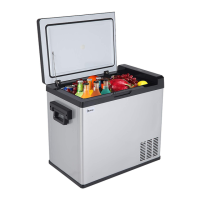
The portable car refrigerator is designed to cool and store items, functioning as a mobile refrigeration unit. It can be powered by both DC (12V/24V) for car use and AC (100-240V) for home use, making it versatile for various environments such as travel, camping, or as an auxiliary refrigerator at home. The unit utilizes a compressor-based cooling system, capable of reaching temperatures as low as -18°C, suitable for storing a range of items from red wine and beverages to vaccines, insulin, fruits, and meat, including ice cream.
The refrigerator features a digital control system for adjusting the thermostat, allowing users to precisely set the desired temperature. It includes an ON/OFF button for power control and a SET button to access advanced parameter modes. These modes enable users to select between different battery protection functions (H1 for low, H2 for medium, H3 for high) to safeguard the vehicle's battery, and to choose between ECO (energy-saving) or HH (fast cooling) modes. Additionally, the control system allows for switching between Celsius and Fahrenheit temperature displays and offers a temperature calibration mode for fine-tuning.
An LED display shows the current temperature and other settings, including fault codes if any issues arise. The unit also has "Power" and "Error" indicators to provide visual feedback on its operational status and any detected malfunctions.
Usage Features
The refrigerator is designed for ease of use and portability. It comes with a telescopic pull rod and side handles for convenient movement. For car use, it plugs directly into a car lighter socket using the DC power cord. For home use, it connects to a grounded outlet with the AC power cord. Interior wire baskets are provided for organized storage of contents.
When operating, users can adjust the temperature within a range of -25°C to 2°C using the "+" and "-" buttons. The battery protection function is crucial for car use, preventing excessive discharge of the vehicle's battery. It is recommended to set battery protection to H2 (medium) for car use and H2 (medium) or H1 (low) when using an external or backup battery. If the car engine is off, adjusting to H1 (low) is advised to conserve battery power.
The ECO mode optimizes energy consumption, while the HH mode provides faster cooling when needed. The temperature calibration feature allows for precise temperature adjustments if the displayed temperature deviates from the actual internal temperature.
The manual emphasizes proper positioning, recommending at least 2 inches of clearance on the sides and 4 inches at the rear for adequate heat ventilation. It also advises against moving the unit without emptying its contents and securing the door.
Maintenance Features
The manual provides guidelines for basic maintenance to ensure the refrigerator's optimal performance and longevity. Before initial use, all interior and exterior packaging should be removed, and the unit should be cleaned with lukewarm water and a soft cloth.
For troubleshooting, the manual includes a comprehensive section detailing common issues and their possible causes and solutions. These include problems like the unit not receiving power, making strange noises, leaking, or displaying error codes. For instance, if the unit is not receiving power, users are advised to check if it's plugged in, try a different outlet, or test with a different power cord. If the unit makes a continuous metallic knocking sound, it might indicate a damaged compressor, requiring professional service.
The error indicator and LED display are key maintenance features, as they provide immediate feedback on potential problems. Fault codes such as F1 (Voltage failure), F2 (Fan current failure), F3 (Compressor starting failure), F4 (Minimum speed failure of compressor), F5 (Controller temperature fault), E0 (Broken sensor circuit), and E1 (Sensor short circuit) help users diagnose issues. In case of an abnormal system, users are instructed to check battery voltage and wait 3 minutes before restarting. If the problem persists, contacting customer service is recommended.
The manual also highlights general safety practices, such as using two or more people to move the unit to prevent injury, keeping the power cord away from heated surfaces, and unplugging the unit during cleaning or extended periods of non-use. It warns against using solvent-based cleaning agents or abrasive solutions that could damage the unit. Regular cleaning of the interior surface is recommended to maintain hygiene and efficiency.


 To Next Page
 General