

EasyManua.ls Logo

ZT Model Global Hawk EP Airplane - User Manual

ZT Model Global Hawk EP Airplane
12 pages
Print Icon
To Next Page IconTo Next Page
Loading...
ZT MODEL
Global Hawk EP Airplane
FEATURES/SPECIFICATIONS:
Powerful 2830-1300kv motor with 30A ESC
All servos and linkages preinstalled
Easy to Assemble!
Durable EPP foam construction.
Wingspan: 1220mm, Length: 915mm, Flying weight: 1000g
Flight Battery: 11.1V 3S 1800~2200mAh 25C Lithium Polymer Battery (T-style plug)
3S LiPo Battery Charger
Required:
(4) 1.5V AA size batteries for the transmitter.
IMPORTANT! Read the ENTIRE instruction guide to become familiar with the model before operating. This
guide contains instructions for safety, operation, and maintenance. It is essential to read and follow all the
instructions and warnings, prior to assembly, setup, or use, in order to operate correctly and avoid damage
or injury.
NOTICE: All instructions, warranties and other collateral documents are subject to change at the sole
discretion of ZT Model.
Question and Answer IconNeed help?

Do you have a question about the ZT Model Global Hawk EP Airplane and is the answer not in the manual?

Overview

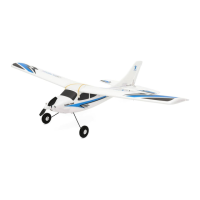
The ZT Model Global Hawk EP Airplane is a remote-controlled aircraft designed for hobbyists, featuring durable EPP foam construction and pre-installed components for easy assembly. It is suitable for ages 14 and above.

Function Description:

The Global Hawk EP Airplane is a remote-controlled glider designed for flight. It offers three distinct flight modes:
  • Manual Mode: Provides the most control, allowing for aerobatics like loops and rolls. Gyros remain active to assist in strong winds, offering minimal stabilization.
  • Semi Stability Mode: Offers moderate control authority and is suitable for more aggressive flying while still providing mild stability control and self-recovery capabilities.
  • Full Stability Mode: Provides the smoothest flight, ideal for beginners learning to control the airplane. In this mode, the aircraft automatically returns to level flight when the control sticks are released. This mode is best for gentle flying. The transmitter also includes a "HELP!" button, which, when pressed, quickly rolls the plane upright and level to assist the user in regaining orientation if disoriented. The "Throttle Cut" feature locks the motor to prevent accidental activation.

Important Technical Specifications:

  • Motor: Powerful 2830-1300kv motor
  • ESC: 30A Electronic Speed Controller
  • Servos: All servos and linkages are preinstalled.
  • Construction Material: Durable EPP foam
  • Wingspan: 1220mm
  • Length: 915mm
  • Flying Weight: 1000g
  • Flight Battery: 11.1V 3S 1800~2200mAh 25C Lithium Polymer Battery (T-style plug)
  • Charger: 3S LiPo Battery Charger (C-420 charger)
  • Transmitter Batteries (Required): (4) 1.5V AA size batteries

Usage Features:

  • Easy Assembly: The model comes with pre-installed servos and linkages, making assembly straightforward.
  • Charging: The C-420 charger is used to charge the 11.1V 3S LiPo battery. The charger indicates charging status with red LEDs and completion with green LEDs. It is crucial to never leave the charger and LiPo battery unattended while charging.
  • Transmitter Setup: Requires (4) 1.5V AA batteries. The transmitter features throttle cut, throttle trim, rudder trim, elevator trim, aileron trim, and a "HELP!" button for flight recovery.
  • Control Setup: Before flight, the control directions (rudder, elevator, ailerons) must be checked and adjusted if necessary. Control surfaces should be centered by adjusting clevises.
  • Propeller Installation: The propeller assembly (prop collet, thrust washer, spinner backplate, propeller, and nut) is pushed onto the motor shaft, leaving a 0.5mm gap, and tightened with a 10mm wrench. The spinner cone is then attached.
  • Float Conversion: The airplane can be converted for water take-offs and landings by removing the wheels and tail wheel, attaching floats to the main gear, and installing a water rudder.
  • Center of Gravity (CG): Proper CG is critical for stable flight. The aircraft's balance should be checked by lifting it at the stickers under the wing. Battery position or additional weight may be adjusted to achieve balance.
  • Pre-Flight Check: Before each flight, the transmitter must be turned on, and the throttle stick moved full up and then full down to arm it. The battery is then plugged into the aircraft, and it is placed on a level surface.
  • Flight Adjustments: Trim buttons on the transmitter can be used during flight to fine-tune the airplane for straight and level flight. Control throws can be adjusted by changing the clevis location on the control surface or servo arm.
  • Take-off: For runway take-off, place the aircraft on a smooth surface facing the wind, gently advance the throttle, and control altitude with throttle and elevator. For water take-off, gently place the aircraft in the water, taxi to face the wind, advance throttle, and use a small blip of up elevator to break free.
  • Flying Tips: Control turning with aileron stick and a little elevator. For quicker turns, coordinate rudder with ailerons. Gentle movements are recommended to avoid over-controlling.
  • Landing: Point the plane into the wind, keep wings level, lower throttle to descend, and add a little elevator to flare the nose before touchdown. After water landing, slowly taxi back to shore and stop the motor before retrieval.
  • ESC Operation: Features a low voltage cutoff, which reduces power when the battery is low, signaling the need to land. If signal is lost, the throttle shuts down, and the motor beeps. An overheat protection circuit lowers power if the motor overheats.
  • Transmitter Linking: If the airplane does not respond, it may need to be relinked by plugging in a charged battery (prop removed), lowering the throttle stick, holding a trim button while turning on the transmitter, and then moving the throttle from low to high and back to low.

Maintenance Features:

  • Damage Repair: Damaged parts can be purchased separately or repaired with glue (CA or epoxy) and tape.
  • Post-Flight Check: After every flight, check the plane for loose parts and ensure all adjustable links are secure.
  • Electrical Connectors: Periodically check all electrical connectors for security.
  • Battery Storage: Always remove batteries from the transmitter for long-term storage.
  • Battery Handling: Always remove and unplug the flight battery after every flight to prevent discharge and damage. Allow the battery to cool before recharging.
  • Propeller Safety: Always remove the propeller when working on the aircraft with the battery installed to prevent injury from accidental motor activation.

Safety Precautions:

  • Never leave the charger and LiPo battery unattended while charging.
  • Do not charge LiPo batteries on flammable surfaces or near combustible materials.
  • Do not charge inside a vehicle or where damage could occur from a LiPo fire.
  • Keep LiPo batteries out of reach of children and animals.
  • Do not charge or use damaged, deformed, bent, or crushed batteries.
  • Disconnect the battery and unplug the charger if charging exceeds 3 hours or after charging is complete.
  • Never disassemble, modify, or puncture battery cells.
  • Do not short circuit the battery by touching exposed wires.
  • Recycle or dispose of LiPo batteries properly.
  • Do not modify or alter the model.
  • Always disconnect and remove the battery from the airplane when not in use.
  • Do not operate near people or animals.
  • Always remove propellers when working on the airplane.
  • Examine all parts for damage before each flight and repair as needed.
  • Keep the airplane and battery away from direct sunlight and heat sources.

ZT Model Global Hawk EP Airplane Specifications

General IconGeneral
BrandZT Model
ModelGlobal Hawk EP Airplane
CategoryToy
LanguageEnglish