E. OPERATION
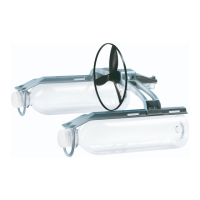
Test the motor before putting the Bottle Catamaran in water. Move the switch to the 'O N ’ position to make
sure that th e motor runs and that the propeller spins freely. Switch off again.
Test your Bottle C atamaran in a bath of shallow water. Lower your Bottle Catamaran into the water. It
should float easily on its bottles. If the catamaran tilts forwards or backw ards, adjust the position of the
crossbeam as explained in step 1 to make it balance. Turn th e motor on and allow the propeller to run up
to maximum speed. Point the Bottle Catamaran in the direction you w ant it to go before releasing it. Your
Bottle Catamaran will skim across the water, pushed by its propeller.
More fun
• You could try adding a little water in one of the bottles to increase its weight. Add water to the right-hand
bottle to make the catamaran turn to the right. Add water to the left-hand bottle to make the catamaran
turn left.
• Why not try as many different bottles as you can find. Your catamaran will look great w ith two 1.25-litre
bottles installed.
Warning
• Always check the propeller is unbroken before each use (see note 6 in Safety Messages).
• Be careful not to drop the Bottle Catamaran into the water upside down, or let water splash into the
battery case or motor. You could dam age the motor or the battery case.
E TROUBLE SHOOTING
If the m otor does no t run:
• Check that you are using fresh batteries.
• Check th a t the batteries are inserted the correct way round in the battery case.
• Check that all four wires are touching the metal terminal caps.
• Check if any water has been splashed into the battery or motor case. If so, take the battery case and
motor case apart and let everything dry out.
If the fan turns the wrong w ay:
• you have connected the wires the wrong w ay round. See step 8.
6. FUN FACTS
How does it work? The batteries provide electricity to the motor, which turns the propeller at high speed.
The propeller blades force air backwards. The laws of physics say that every force has an equal force that
pushes in the opposite direction. So when the propeller pushes air backwards, the air pushes the propeller
forwards. This pushes the Bottle Catamaran along. The model is quite light, which allows the propeller to
accelerate it quickly. The floats sink only a little way into th e water. This means they can slide easily
through the water.
Catam arans A craft with tw o floats (or hulls) is called a catamaran (cat for short). Cata m arans are faster
than single-hulled boats (monohulls) because they cut more easily through the water. There are all sorts
of catamarans, from super-fast sailing dinghies to giant, high-speed ca r ferries.
Trim arans A trim aran is a craft with three hulls - normally a large central hull and two smaller side hulls.
In 2 0 0 7, the trim aran yacht Groupama 3 crossed the Atlantic a t an average speed of 29.3 knots (54.3
kilometres per hour).


 To Next Page
 Loading...