EasyManua.ls Logo

4M Green Science 00-03448 - User Manual

4M Green Science 00-03448
2 pages
Print Icon
To Next Page IconTo Next Page
Loading...
HYBRID
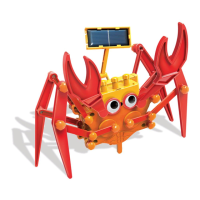
CRABOT
A. SAFETY MESSAGES
1. Please read through all the instructions and keep them since they contain important information. 2. Adult assistance and supervision
are required. 3. This kit is intended for children 5 years or older. 4. This kit and its finished product contain small parts which may cause
choking if misused. Keep away from children under 3 years old. 5. To prevent possible short circuits, never touch the contacts inside the
battery case with any metal. 6. Only install batteries after the kit is assembled. Adult supervision is required.
B. USE OF BATTERIES
1. Requires one 1.5V AAA batteries (not included). 2. For best results, always use fresh battery. 3. Make sure you insert the battery with
the correct polarities. 4. Remove the battery from the kit when not in use. 5. Replace exhausted battery straight away to avoid possible
damage to the kit. 6. Rechargeable batteries must be removed from the kit before recharging. 7. Rechargeable batteries must be
recharged under adult supervision. 8. Make sure that the supply terminals in the battery case are not short circuited. 9. Do not attempt to
recharge non-rechargeable batteries.
C. CONTENTS
13. Add the moving eye to each of the claws (parts L and M), then add the claws to the front of the body. Also attach the rear legs (parts
P and Q) to the rear of the body.
14. Operation: Insert a 1.5V AAA battery into the battery holder, making sure the flat end of the battery rests against the spring in the
holder. Add the battery cover and secure it with a screw. Adult supervision is required.
15. If the Sun is out, slide the switch to solar-powered mode and twist the solar panel to face the Sun. The Hybrid Crab Robot will operate
under solar power.
16. Switch to battery powered by sliding the switch to battery mode where sunlight is not available. When the robot is not in use, move the
switch to solar-powered mode to power off.
E. TROUBLESHOOTING
If the crab does not move in solar-powered mode or battery mode:
Check that you have made the correct connections on the terminal blocks (see section D, step 7). Check that the bare metal on all the
wires is in contact with the metal terminals. If the gears do no have enough lubrication, apply cooking oil or lotion to help the system run
smoothly. Friction between the gear wheels will affect the performance of the motor.
If the motor does not run in solar-powered mode:
The sunlight may not be strong enough. Adjust the angle of the panel so that it directly faces the sun. Check that the gears are
lubricated.
If the motor does not run in battery mode:
Check that you have a fresh battery and that the battery is inserted into the battery holder the correct way round. Check that the gears
are lubricated.
F. HOW IT WORKS
The solar panel turns light energy from the Sun into electricity. This electricity, or electricity from the battery, powers the motor. Inside the
robot’s body, gears transfer the movement of motor to the wheels on the from and back of the body, and also reduce the speed of turning
between the motor and the wheels. The leg mechanisms turn the rotation of the wheels into side to side movement of legs. The legs
move in turn, which makes the robot walk sideways.
G. FUN FACTS
The word ‘hybrid’ means a mixture of two forms of power. The Hybrid Crab Robot uses a mixture of solar power and battery power. A
hybrid car uses a mixture of engine and battery power. Solar-powered cars are not powerful enough for everyday driving, but
experimental cars have travelled 3,000 kilometres in special races. Crabs have ten legs. The rear pair of legs is designed for swimming
and the front pair has claws that the crab uses to catch and eat prey. Crabs can walk forwards and backwards, but they find it easiest to
walk sideways. Walking robots with four or more legs, like the Hybrid Crab Robot, are very stable because one leg can be lifted at a time
without the robot falling over.
WARNING:
CHOKING HAZARD - Small parts.
Not for children under 3 years.
TO PARENTS: PLEASE READ THROUGH THESE
INSTRUCTIONS BEFORE PROVIDING GUIDANCE
TO YOUR CHILDREN.
PLEASE SCAN THE QR CODE TO VIEW MULTI-LANGUAGE INSTRUCTIONS
Part A: Robot body, Part B: Motor cover, Part C: Battery holder, Part D: Solar panel holder, Part E: Solar panel, Part F: Battery cover,
Part G: Motor, Part H: Right leg x 2, Part I: Long linkage x 4 , Part J: Short linkage x 4, Part K: Left leg x 2, Part L: Left claw, Part M: Right
claw, Part N: Left linkage x 2, Part O: Right linkage x 2, Part P: Left rear leg, Part Q: Right rear leg, Part R: Peg x 30, Part S: Moving eye
x 2, Part T: Pair of wires, Part U: Support arm, Part V: Screw x 4, and Part W: Terminal cap x 3. Also required but not included in the kit:
1 x 1.5-volt AAA battery, a small crosshead screwdriver.
2x2R
Content
A
13 14
15 16
D
B C
E F
F
G
S
U
S
T
V W
H
I
I
J
L
L
M
M
N
O
P
P
Q
Q
K
R
+1.5V AAA -
S
L
M
Q
Question and Answer IconNeed help?

Do you have a question about the 4M Green Science 00-03448 and is the answer not in the manual?

Summary

Safety and Battery Guidelines

General Safety Warnings

Key safety guidelines for using the Hybrid Crab Robot, including adult supervision and choking hazards.

Battery Usage and Safety

Essential guidelines for safe and proper battery installation, handling, and precautions.

Troubleshooting Hybrid Crab Robot

Robot Movement Issues

Solutions for when the Hybrid Crab Robot fails to move in solar or battery modes.

Motor Operation Problems

Troubleshooting steps for motor issues in solar or battery powered operation.

How the Hybrid Crab Robot Works

Fun Facts About Hybrid Technology and Crabs

Hybrid Crab Robot Assembly Instructions

Step-by-Step Assembly Guide

Detailed instructions for assembling the Hybrid Crab Robot, covering all parts and connections.

Summary

Safety and Battery Guidelines

General Safety Warnings

Key safety guidelines for using the Hybrid Crab Robot, including adult supervision and choking hazards.

Battery Usage and Safety

Essential guidelines for safe and proper battery installation, handling, and precautions.

Troubleshooting Hybrid Crab Robot

Robot Movement Issues

Solutions for when the Hybrid Crab Robot fails to move in solar or battery modes.

Motor Operation Problems

Troubleshooting steps for motor issues in solar or battery powered operation.

How the Hybrid Crab Robot Works

Fun Facts About Hybrid Technology and Crabs

Hybrid Crab Robot Assembly Instructions

Step-by-Step Assembly Guide

Detailed instructions for assembling the Hybrid Crab Robot, covering all parts and connections.

Overview

The Hybrid Crab Robot is an educational kit designed for children aged 5 and older, offering a hands-on experience in building a robotic creature that can move using both solar and battery power. This kit provides an engaging way to learn about renewable energy, basic mechanics, and robotics.

Function Description

The core function of the Hybrid Crab Robot is to demonstrate the principles of hybrid power, utilizing both solar energy and a 1.5V AAA battery to drive its movement. When exposed to sufficient sunlight, the solar panel converts light energy into electricity, which powers the motor and enables the robot to walk sideways. In the absence of adequate sunlight, the robot can be switched to battery mode, allowing it to continue functioning using stored electrical energy. The robot's movement is achieved through a system of gears and linkages that translate the motor's rotation into a distinctive side-to-side walking motion, mimicking a crab's gait. The design emphasizes stability, with its multi-legged structure ensuring it remains upright even when one leg is lifted during movement. The kit also includes moving eyes for the claws, adding a playful and lifelike element to the finished robot.

Usage Features

The Hybrid Crab Robot offers flexible operation modes, making it adaptable to various environments. To operate in solar-powered mode, users simply need to insert a 1.5V AAA battery (not included) into the battery holder, slide the switch to the solar-powered setting, and position the solar panel directly towards the sun. The robot will then begin its sideways walk, demonstrating the direct conversion of solar energy into mechanical motion. For indoor use or during cloudy conditions, the robot can be easily switched to battery mode. By sliding the switch to the battery setting, the robot will draw power from the installed AAA battery, ensuring continuous operation regardless of sunlight availability. When not in use, it is recommended to move the switch to the solar-powered mode to power off the robot, conserving battery life. Adult supervision is required during battery installation and operation to ensure safety and proper handling. The kit is designed for easy assembly, with clear instructions guiding users through each step, from connecting wires to attaching mechanical parts.

Maintenance Features

Proper maintenance is crucial to ensure the Hybrid Crab Robot functions optimally and has a long lifespan. Regular checks of the electrical connections are essential; users should verify that all wires are securely attached to the terminal blocks and that the bare metal ends of the wires are in full contact with the metal terminals. Loose connections can prevent the motor from running. The gears, which are central to the robot's movement, require occasional lubrication. If the robot's movement becomes sluggish or the motor struggles, applying a small amount of cooking oil or lotion to the gear wheels can reduce friction and improve performance. It is important to ensure that the gears are well-lubricated to prevent wear and tear and maintain smooth operation.

For battery-powered operation, always use a fresh 1.5V AAA battery and ensure it is inserted with the correct polarities, with the flat end resting against the spring in the holder. Exhausted batteries should be replaced immediately to prevent potential damage to the kit. If rechargeable batteries are used, they must be removed from the kit before recharging and recharged under adult supervision. Non-rechargeable batteries should never be attempted to be recharged. When the robot is not in use for extended periods, the battery should be removed to prevent leakage and corrosion.

In solar-powered mode, if the motor does not run, check the strength of the sunlight and adjust the angle of the solar panel so it directly faces the sun. Ensure the gears are lubricated, as friction can impede the motor's ability to turn. Always keep the battery contacts clean and free from any metal objects to prevent short circuits. The kit is designed to be robust, but gentle handling during assembly and operation will help preserve its components.

4M Green Science 00-03448 Specifications

General IconGeneral
Batteries RequiredNo
Manufacturer Recommended Age8 years and up
Model Number00-03448
Assembly RequiredYes
Brand4M
CategoryToy
Product TypeScience Kit
Product NameGreen Science Weather Station
ThemeScience

Related product manuals