
 Need help?
Do you have a question about the 4M SNAIL ROBOT and is the answer not in the manual?
Adult supervision required, kit for ages 8+, contains small parts, prevent short circuits, install batteries after assembly.
Use two 1.5V AAA batteries, ensure correct polarity, remove when not in use, replace exhausted batteries.
Detailed instructions covering motor insertion, gears, body assembly, hinges, battery case, wiring, shells, and feet.
Check hinge direction, lubricate gears, ensure peg security, verify wire connections and polarity.
Explains conversion of electrical current from batteries to kinetic energy for movement.
Information on snail size, speed, shells, Earth's core, magnetic fields, and bioelectricity.
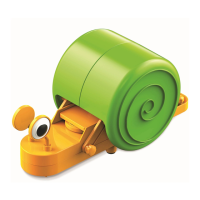
The Snail Robot is an engaging educational kit designed to introduce children to basic robotics and the principles of kinetic energy. This kit allows users to construct a crawling robot that mimics the movement of a real snail, providing a hands-on learning experience about electrical currents and mechanical systems.
The Snail Robot operates by transforming electrical current from batteries into kinetic energy, which powers its gearbox and joint mechanism. When the switch is turned to the "ON" position, electrons flow from the negative pole to the positive pole of the batteries, creating an electrical current. This current drives a motor, which in turn activates a series of gears and a circular joint located at the top of the snail's front body. This mechanical action translates into a cool crawling motion, simulating how a real snail moves. The robot's design allows for variations in crawling movement; inserting a medium peg into the round joint's outer hole creates a longer crawling movement, while inserting it into the inner hole results in a shorter crawl. The robot is adorned with a shell and googly eyes, adding a playful aesthetic to its functional design.
The assembly process is a core feature of the Snail Robot, guiding users through a series of detailed steps to build the device from individual components. The kit includes various parts such as a front hinge connector, gear joint holder, battery case holder, back hinge connector, front body base, front hinges, left and right back hinges, different sized pegs (short, long, medium), a movement joint, left and right eyes, back body base, front body top, motor, shells, battery case, battery case cover, gear axle, small gear, googly eyes, foam feet, and small screws.
The assembly begins with inserting the motor into the front body top and carefully routing the wires to prevent them from being cut. Next, the gear axle and small gear are positioned, followed by fitting the gear joint holder and covering the gears and motor with the front body base, securing it with screws. Attention to detail is crucial here, ensuring the vertical flap of the movement joint holder slides through the designated square hole. The back hinges are then attached to the back body base using short pegs, and the back hinge connector is inserted. The front body is flipped, and the front hinges are attached to the front body top with short pegs, ensuring the protruding joints face outwards. The front hinge connector is then inserted into the slots on the inside of each front hinge, and the front and back hinges are connected with short pegs.
The movement joint is slid underneath clips at the back edge of the front body, and pegs are pushed through its holes and into the back hinge connector and the front body's round joint. The battery case holder is inserted into the slots on the back hinges, with the screw hole facing upwards. The black and red wires from the front body are slid underneath the battery case and movement joint connector. Before inserting batteries, it's essential to ensure the robot is in "off" mode. Two 1.5V AAA batteries (not included) are then inserted into the battery case, which is secured with the battery case cover and attached to the battery case holder. The black and red wires are then inserted into their respective metal holes in the back body and secured with short pegs, ensuring correct polarity.
Finally, the shells are attached to the front hinges, and the googly eyes are stuck onto the left and right eyes, which are then inserted into the holes on the front body top. The plastic film is peeled off the foam feet, and these are stuck onto the bottom of the front and back body, completing the robot.
To ensure the Snail Robot functions optimally and has a long lifespan, several maintenance and troubleshooting tips are provided. Adult assistance and supervision are required at all times, especially during assembly and when handling batteries. The kit is intended for children over 8 years old, and due to small parts, it should be kept away from children under 3 years old to prevent choking hazards.
For smooth operation, it's important to check that the hinges are inserted in the correct direction during assembly. If the robot isn't moving smoothly, adding cooking oil or lubricant to the gears inside the gearbox can help. Users should also ensure that the pegs securing the connection between the front and back body are pressed in firmly to create smooth movement. The red/black wires must be fixed properly into the side and end slots inside the front body and secured by the pegs. It's crucial to connect wires to like colors only and ensure they do not get caught between any moving parts.
Regarding batteries, two 1.5V AAA batteries are required (not included). For best results, fresh batteries should always be used, and they must be inserted with the correct polarity. Batteries should be removed from the kit when not in use to prevent possible damage. Exhausted batteries should be replaced immediately. If using rechargeable batteries, they must be removed from the kit before recharging, and recharging must be done under adult supervision. It's important to ensure the supply terminals in the battery case are not short-circuited. Users should not attempt to recharge non-rechargeable batteries, nor should they mix old and new batteries or different types of batteries (alkaline, standard carbon-zinc, or rechargeable).
These guidelines ensure the robot remains functional and provides a safe and enjoyable learning experience.
 General
| Brand | 4M |
|---|---|
| Product Name | SNAIL ROBOT |
| Age Range | 8 years and up |
| Recommended Age | 8+ |
| Batteries Required | Yes |
| Manufacturer recommended age | 8 years and up |
| Manufacturer | 4M |
| Product Type | Toy |
| Category | Educational |
| Battery Type | AAA |






 To Next Page