Need help?
Do you have a question about the 4M Electric Dragster and is the answer not in the manual?
Read instructions, ensure adult supervision, keep away from small children, and avoid short circuits.
Use correct battery type, polarity, and replace/recharge as needed to prevent damage or short circuits.
Check battery freshness, insertion, and wire connections to the terminal caps.
Verify wire connections for correct motor direction and straighten front axle assembly if it runs off-line.
Detailed steps for assembling the dragster, including connecting components and attaching wheels.
Instructions on how to operate the dragster and suggestions for racing activities.
The Electric Dragster is an engaging educational kit designed for children aged 8 and up, offering a hands-on experience in building a motorized vehicle. This kit allows users to assemble a dragster and explore basic principles of mechanics and electronics. The primary function of the Electric Dragster is to provide an interactive learning platform where users can construct a working model and observe its operation.
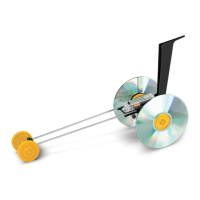
The core function of the Electric Dragster is to move forward at speed, mimicking a real dragster. This movement is achieved through a simple electrical circuit and a gear system. Two "AAA" 1.5V batteries power a motor, which in turn drives a worm gear. This worm gear interlocks with a cog on the long axle, transferring rotational motion to the rear wheels. The rear wheels, made from CDs, are designed to offer minimal rolling resistance, contributing to the dragster's speed. The larger the rear wheels, the greater the potential speed, as the circumference of the wheel directly impacts the distance covered per rotation. The kit also includes a front axle assembly with smaller wheels, which provides stability and steering. The tail fin, a decorative and aerodynamic element, completes the dragster's appearance. The dragster is intended for use on flat surfaces, where its speed and straight-line motion can be best observed.
The assembly process is a key usage feature, guiding users through a series of steps to build the dragster. This involves connecting wires, attaching gears, securing axles, and mounting wheels and other structural components. Adult supervision and assistance are required throughout the assembly, especially for younger users, to ensure correct construction and safety. Once assembled, the dragster is operated by switching on the motor. Users can place the dragster on a flat floor and observe it zoom along. An engaging activity suggested is to mark out start and finish lines, time the dragster's run, and even organize drag races with friends, fostering a sense of competition and encouraging further experimentation. The kit also encourages creativity by suggesting users decorate the tail fin with stickers or use old CDs with interesting graphics for the wheels.
The design of the dragster highlights several interesting concepts. The use of CDs as wheels is a clever feature, as their thin profile and hard edge contribute to very little rolling resistance, enhancing the dragster's speed. This contrasts with wider, softer wheels (like flat bicycle tires) which would create more rolling resistance. The kit also touches upon the concept of a "wheelie," a common occurrence in real drag racing due to the immense power of the engine, where the front of the vehicle lifts off the ground.
Proper maintenance is crucial for the longevity and optimal performance of the Electric Dragster. Battery management is a primary maintenance feature. The kit requires two "AAA" 1.5V batteries, which are not included. Users are advised to always use fresh batteries for best results and to insert them according to the correct polarity. It is important to remove the batteries from the kit when not in use to prevent potential damage. Exhausted batteries should be replaced immediately. For rechargeable batteries, they must be removed from the kit before recharging, and recharging should always be done under adult supervision. Non-rechargeable batteries should never be recharged. Mixing old and new batteries, or different types of batteries (alkaline, standard carbon-zinc, or rechargeable Ni-Cd), is explicitly prohibited to prevent damage and ensure safety. Additionally, users must ensure that the supply terminals are not short-circuited.
Troubleshooting guidance is provided to address common issues. If the motor does not run, users should check for fresh batteries, correct battery insertion, and ensure all four wires are touching the metal terminal caps. If the dragster runs backward, the motor/axle cover should be removed to check if the wires are connected correctly. If the dragster does not run in a straight line, the screws holding the metal rods on the front axle assembly should be loosened, the assembly straightened, and the screws retightened. To prevent possible short circuits, users are warned never to touch the contacts inside the battery case with any metal. The kit also emphasizes the importance of keeping small parts away from children under 3 years old due to choking hazards.
 General
| Power Source | Battery |
|---|---|
| Age Range | 8 years and up |
| Batteries Required | Yes |
| Battery Type | AA |
| Batteries Included | No |
| Manufacturer | 4M |
| Product Category | Science Education |
| Product Type | Educational Kit |

 To Next Page