EasyManua.ls Logo

4M Robotic Hand - User Manual

4M Robotic Hand
2 pages
Print Icon
To Next Page IconTo Next Page
Loading...
We value you as a customer and your satisfaction with this product is important to us. If you have
comments or questions, or you find any part of this kit missing or defective, please do not hesitate
to contact our distributor in your country. You will find the address printed on the package. You
are also welcome to contact our Marketing Support Team: Email: infodesk@4m-ind.com, Fax
(852) 25911566, Tel: (852) 28936241, Web site: WWW.4M-IND.COM
41-03284/1 211209
QUESTIONS & COMMENTSQUESTIONS & COMMENTS
©2009 4M Industrial Development Limited. All rights reserved.
A. SAFETY WARNINGS
1. Please read carefully through all these instructions.
2. Adult supervision and assistance are required at all times.
3. This kit is intended for children over 8 years of age.
4. This kit and the finished product contain small parts which may cause chocking if
misused. Keep away from children under 3 years of age.
5. Use of scissors is required. Adult supervision is required when using scissors.
FOR AGES OVER 8
WARNING:
CHOCKING HAZARD SMALL PARTS.
NOT FOR CHILDREN UNDER 3 YEARS.
5 finger end caps
5 finger tubes
Fishing lines
1 hand frame
3 pull rings
B. CONTENTS
8
10 2 3 54 6 7 8 9 10 1211 13 14 15 1716 18 19 20 2221 23 24 25 26 27 28 29
cm cm
9
D. OPERATION
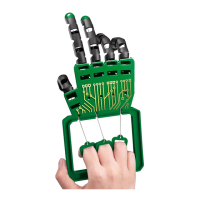
Hold the Robotic Hand with its flat face (i.e. the back of the hand) facing up. Grasp the
frame with your right hand, with its palm facing down. Put your first three fingers into the
pull rings, holding the frame with your thumb and little finger. Pull on the rings to make the
Robotic Handʼs fingers and thumb bend.
Can you grip your other hand? Can you pick up an object? Put a glove onto the Robotic
Hand, and find a shirt or other top with a sleeve long enough to hide your real hand when
you are holding the Robotic Handʼs frame. Shake hands with your friends with your unique
Robotic Hand. They will be amazed!
E. HOW IT WORKS
When you pull on one of the rings, the strings shorten the inside of the fingers attached to
the ring. The outside of the finger remains the same length, so the shortening makes the
fingers bend inwards.
F. FUN FACTS
• Industrial robots work in factories, moving and joining parts of things being made. They
have grippers for picking up objects, with two or three fingers that can open and close.
In robot hands, the fingers are moved by tiny motors, hydraulic rams or air-powered
artificial ʻmusclesʼ.
Robot researchers have built robot hands that look like human hands and have fingers
that move like human fingers. They are very complicated machines, using many joints and
a dozen or more motors.
• Human-like robot hands could be used in humanoid robots.
Robot hands have pressure sensors in the finger tips. When the fingers are gripping an
object, the sensors prevent the fingers from squashing the object.
In human hands, thin tendons running inside the fingers make the fingers bend. The
tendons are pulled by muscles in the forearm.
Prosthetic hands are for people who have lost a hand or arm in an accident. They are like
robot hands, but they are controlled by electrical signals from the remaining muscles in the
arm.
1
2
3
4
5
tie a few knots
tie a knot
6
7
TEMPLATE A
TEMPLATE B
7
7
To Parents: Read all instructions before
providing guidance to your children.
tie a few knots
knot 2
knot 1
knot 1
knot 2 knot 3
C. ASSEMBLY
Remarks: You need to tie a number of knots
on the fishing line in the following assembly
instructions. Fishing line is elastic and the knots may loosen themselves over time. Use the
measurement templates which indicate the knot positions and lengths of line required.
Always tie a few knots to secure the knot in place. Allow extra fishing line when tying the
knots. You can always cut away the excess length after the knots are finished.
1. Starting with the little finger, examine the finger tubes. The end with the narrow ring is
the tip and the end with the wider ring is the finger root, which slots into the hand frame.
Cut a piece of fishing line 28 cm long. Use TEMPLATE A below for measurement. Place the
fishing line on the template and mark the three knot positions with a marker or ball pen on
the fishing line. Thread the line through a finger end cap. Tie a few knots at the first knot
position to stop it slipping back through the hole in the cap.
2. On the inside of the rings on the finger tubes are small sleeves. Feed the other end of the
fishing line through all the sleeves to the end of the finger tube.
3. Now slot the end cap into the end of the finger.
4. Hold the hand frame with the plastic loops facing upwards. Push the finger tubeʼs root
end into the first loop. The sleeves holding the fishing line must also be uppermost so that
the fingers will bend the correct way.
5. Repeat 1 to 4 steps again for the ring finger (the one next to the little finger).
6. Tie the fishing lines from the first two fingers together at the second knot position. The
tied lines should be tight after they are tied. This will allow the fingers to bend properly
when the lines are pulled.
7. Thread the ends of the two fishing lines through the first hole in the square holder frame.
Tie them into the hole in a pull ring at knot position 3. By now the pull ring should be touch-
ing the upper edge of the frame. Cut off any excess fishing line after you have tied all the
knots. Try pulling the pull ring the two fingers should bend properly. If they donʼt, re-do
the knots.
8. Repeat the above steps for the middle and index finger tubes.
9. For the thumb, cut a piece of fishing line 23 cm long and mark the two knot positions
following TEMPLATE B below. Now follow steps 1 to 4. Unlike the first four fingers, the
thumb does not share a pull ring with another finger. Just tie the line directly to the pull ring
at the second knot position.
Check all knots are secured and pull the rings to see if all fingers bend properly. Cut away
the excess length. Congratulations! Your Robot Hand is complete.

Question and Answer IconNeed help?

Do you have a question about the 4M Robotic Hand and is the answer not in the manual?

Summary

Robotic Hand Operation Guide

Operating the Robotic Hand

Instructions on how to hold and operate the robotic hand, including gripping and picking up objects.

How the Robotic Hand Works

Explanation of the mechanism involving strings shortening inside fingers to make them bend inwards.

Fun Facts About Robots

Interesting facts about industrial robots, robot hands, and prosthetic hands.

Safety Warnings for Robotic Hand Kit

Important safety precautions including adult supervision and choking hazards for small parts.

Robotic Hand Contents List

List of components included in the Robotic Hand kit, such as finger end caps and fishing lines.

Assembling the Robotic Hand

Finger Assembly and Connection

Detailed steps for assembling fingers, attaching fishing lines, and connecting them to the hand frame.

Thumb Assembly

Specific instructions for assembling the thumb component of the robotic hand.

Overview

The Robotic Hand is an engaging and educational kit designed to provide users with a hands-on experience in understanding the mechanics of robotic and human hands. This kit allows individuals, particularly those aged 8 and above, to assemble a functional robotic hand, offering insights into the principles of movement and gripping.

Function Description

The core function of the Robotic Hand is to simulate the bending and gripping action of fingers and a thumb. It operates on a simple yet effective mechanical principle: when a pull ring is actuated, attached strings shorten, causing the corresponding finger or thumb to bend inwards. This action mimics the way tendons and muscles work in a biological hand to facilitate movement. The kit includes components for five fingers and a thumb, each designed to articulate independently or in conjunction with others, depending on the assembly.

The Robotic Hand serves as an excellent educational tool, demonstrating basic engineering concepts such as tension, leverage, and the conversion of linear motion into rotational motion. By assembling and operating the hand, users can grasp fundamental principles of robotics and biomechanics. It also provides a tangible example of how complex movements can be achieved through relatively simple mechanical designs.

Usage Features

The Robotic Hand is designed for interactive use, allowing users to perform various actions once assembled.

  • Gripping and Manipulation: Users can hold the Robotic Hand by its frame and, by pulling on the designated rings, make its fingers and thumb bend. This enables the hand to grip objects, providing a practical demonstration of its functionality. The ability to pick up items allows for experimentation with different shapes and sizes, highlighting the hand's versatility within its mechanical limitations.
  • Simulated Human Interaction: The manual suggests engaging in activities such as attempting to grip one's own hand or shaking hands with others. This feature encourages imaginative play and helps users relate the robotic hand's movements to human actions, fostering a deeper understanding of its design.
  • Customization and Enhancement: The kit encourages creative extensions, such as putting a glove or a shirt sleeve over the Robotic Hand to conceal the user's real hand. This not only adds to the aesthetic appeal but also enhances the illusion of a fully autonomous robotic limb, making interactions more engaging and surprising for others.
  • Educational Exploration: Beyond simple operation, the Robotic Hand invites users to explore the underlying mechanisms. By observing how the strings and sleeves interact to produce finger movement, users can gain a clearer understanding of the engineering principles at play. This hands-on exploration reinforces learning about mechanical systems and their real-world applications.
  • Comparative Analysis: The kit implicitly encourages a comparison between the robotic hand and human hands. The manual includes "Fun Facts" that provide context on industrial robots, advanced robot hands, and human hand anatomy (tendons, muscles, pressure sensors, prosthetic hands). This comparative approach enriches the learning experience, connecting the simple model to more complex biological and technological systems.

Maintenance Features

Maintaining the Robotic Hand primarily involves ensuring the integrity of its mechanical connections and components.

  • Knot Security: A critical aspect of the Robotic Hand's assembly and long-term function is the security of the knots tied in the fishing lines. Since fishing line is elastic, knots can loosen over time. The manual explicitly advises tying "a few knots" to secure each connection and to allow for extra fishing line during tying, which can be trimmed later. Regularly checking these knots for tightness is essential to ensure the fingers bend properly and consistently. If a finger's movement becomes inconsistent or fails, re-tying the relevant knots is the primary maintenance step.
  • Line Tension: The proper tension of the fishing lines is crucial for the correct articulation of the fingers. The manual emphasizes that tied lines should be "tight" to allow fingers to bend properly. If the fingers do not bend as expected, adjusting the tension by re-tying the knots at the correct positions (as indicated by the templates) is necessary.
  • Component Integrity: While the kit is designed for durability, users should periodically inspect the plastic components, such as the hand frame, finger tubes, end caps, and pull rings, for any signs of wear or damage. Although not explicitly detailed as a maintenance step, ensuring all parts are intact and correctly seated will contribute to the hand's optimal performance.
  • Cleaning: As a plastic-based toy, the Robotic Hand can be easily cleaned with a damp cloth if it becomes dusty or dirty during use. Avoid harsh chemicals that might degrade the plastic or fishing lines.
  • Troubleshooting: The manual implicitly provides troubleshooting guidance by instructing users to "Check all knots are secured and pull the rings to see if all fingers bend properly. If they don't, re-do the knots." This highlights that most operational issues are likely related to knot security or line tension, making these the primary points of maintenance and repair.

The Robotic Hand is more than just a toy; it is an interactive learning experience that combines assembly, operation, and educational insights into the fascinating world of robotics and human anatomy. Its design encourages hands-on exploration and problem-solving, making it a valuable tool for fostering scientific curiosity.

4M Robotic Hand Specifications

General IconGeneral
CategoryRobotics
Name4M Robotic Hand
Recommended Age8 years and up
MaterialPlastic
Educational FocusSTEM
Product Name4M Robotic Hand

Related product manuals