-----------------------------------------------------------------------------,
Connecting the speakers to the
amplifier
Height Many people like the
speakers in line with the height of
their ears when seated. This has the
advantage of improving dispersion by
raising the speakers above the
surrounding furniture.
Wire Use two-conductor stranded-
type, insulated wire to connect the
speakers to the amplifier. "Lamp"
wire or "zip cord" works well for
speaker wire. Use 16 gauge for short
runs of less than 50 feet, and larger
wire for longer runs. Using 18 gauge
or smaller wire won't do harm, but
may result in a peak in the speaker's
bass response.
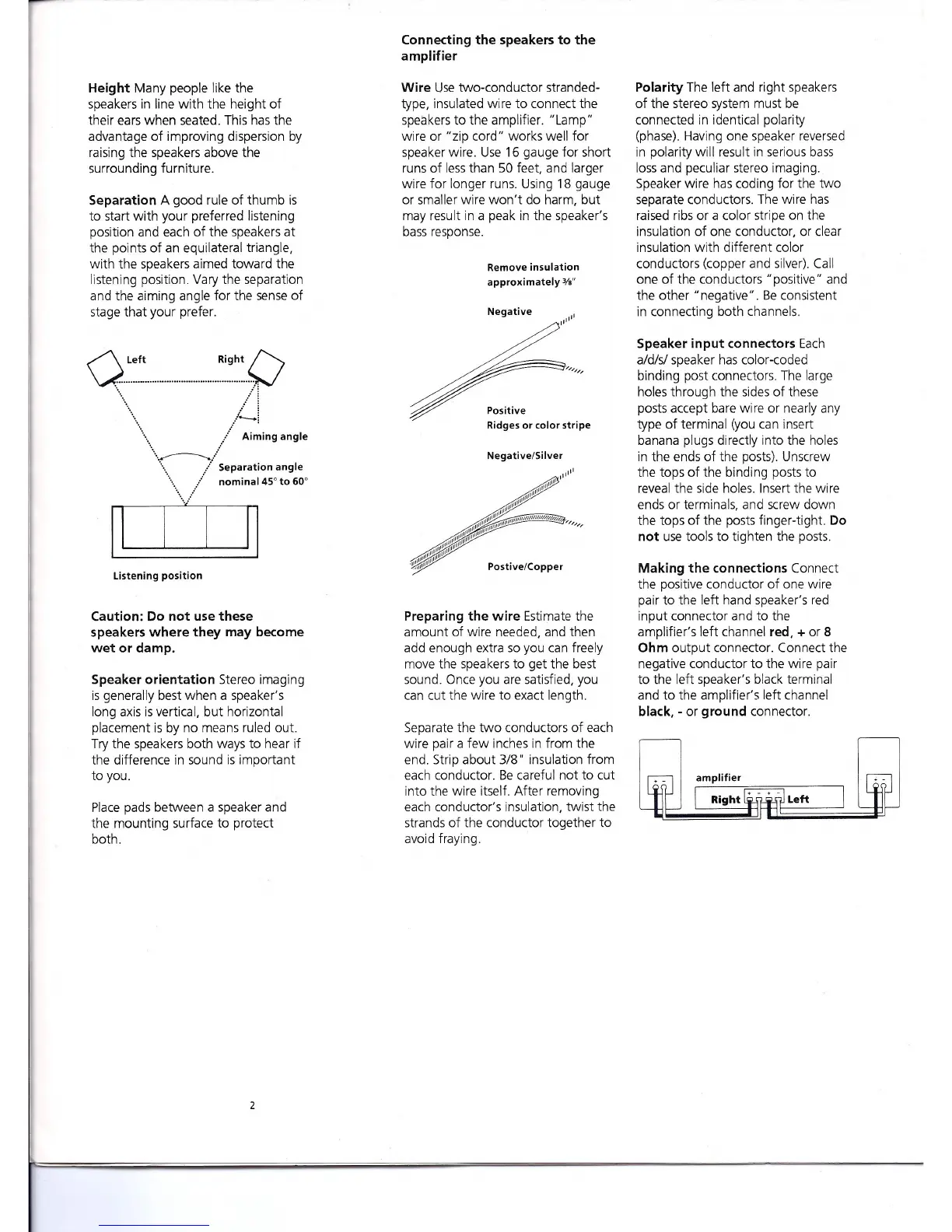
separation A good rule of thumb is
to start with your preferred listening
position and each of the speakers at
the points of an equilateral triangle,
with the speakers aimed toward the
listening position. Vary the separation
and the aiming angle for the sense of
stage that your prefer.
Remove insulation
approximately
3/8"
Negative
o
Left Right
0
\:~~-------------;Zi
\. ;' Aiming angle
........
~//
\. ./ Separation angle
bID""·'"
Positive
Ridges or color stripe
Negative/Silver
Listening position
Postive/Copper
Caution: Do not use these
speakers where they may become
wet or damp.
Preparing the wire Estimate the
amount of wire needed, and then
add enough extra so you can freely
move the speakers to get the best
sound. Once you are satisfied, you
can cut the wire to exact length.
Speaker orientation Stereo imaging
is generally best when a speaker's
long axis is vertical, but horizontal
placement is by no means ruled out.
Try the speakers both ways to hear if
the difference in sound is important
to you.
Separate the two conductors of each
wire pair a few inches in from the
end. Strip about
3/8"
insulation from
each conductor. Be careful not to cut
into the wire itself. After removing
each conductor's insulation, twist the
strands of the conductor together to
avoid fraying.
Place pads between a speaker and
the mounting surface to protect
both.
2
Polarity The left and right speakers
of the stereo system must be
connected in identical polarity
(phase). Having one speaker reversed
in polarity will result in serious bass
loss and peculiar stereo imaging.
Speaker wire has coding for the two
separate conductors. The wire has
raised ribs or a color stripe on the
insulation of one conductor, or clear
insulation with different color
conductors (copper and silver). Call
one of the conductors" positive" and
the other "negative". Be consistent
in connecting both channels.
Speaker input connectors Each
aid/sf speaker has color-coded
binding post connectors. The large
holes through the sides of these
posts accept bare wire or nearly any
type of terminal (you can insert
banana plugs directly into the holes
in the ends of the posts). Unscrew
the tops of the binding posts to
reveal the side holes. Insert the wire
ends or terminals, and screw down
the tops of the posts finger-tight. Do
not use tools to tighten the posts.
Making the connections Connect
the positive conductor of one wire
pair to the left hand speaker's red
input connector and to the
amplifier's left channel red,
+
or 8
Ohm output connector. Connect the
negative conductor to the wire pair
to the left speaker's black terminal
and to the amplifier's left channel
black, - or ground connector.



 To Next Page
 Loading...