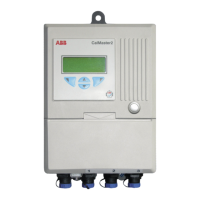
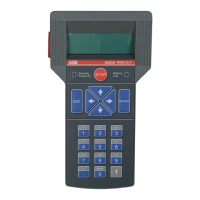
This document describes the BullsEye®7, a product designed for use with ABB robots, specifically for installation, preventive maintenance, troubleshooting, and operation.
Function Description
The BullsEye®7 is a device that helps define the Tool Center Point (TCP) for ABB IRB robots, particularly the S4C and S4Cplus models. The TCP is an invisible reference point located at the precise point where the welding wire tip would touch the workpiece, at a pre-determined wire stickout distance from the bottom of the gas nozzle. This automated TCP definition is crucial for accurate robot operation in welding applications.
The system allows for the physical movement of the torch back into alignment if it is impossible to adjust the misalignment automatically. It also enables automatic redefinition of the TCP to compensate for torch misalignment. The BullsEye®7 system updates the current TCP definition, and the torch will rotate around the TCP as before, with the robot arm adjusting its path to compensate for the torch misalignment.
The BullsEye®7 system is designed to simplify and automate the process of setting up and maintaining the TCP, which is critical for consistent and high-quality welding. It provides a robust solution for ensuring that the robot's tool center point is accurately defined and maintained, even if the torch experiences minor misalignments.
Important Technical Specifications
The BullsEye®7 has the following key technical specifications:
Unit Specifications:
- Electrical: 40 mA, 24 VDC
- Robot Connections: One sensor signal, 24 VDC, and 0 VDC
- Software: Furnished with equipment (requires 250 kb free user memory)
- Repeatability: ± 0.006" (0.163 mm)
Physical Dimensions:
- For variant 501 527-880: The device has a width of 248 mm. Other dimensions include 63 mm, 18 mm, 119.5 ±0.02 mm, M6, and Ø6 H8.
- For variant 550880-001: The device has a height of 676 mm. Other dimensions include 38 mm, 150 mm, 57 mm, 160 mm, 12 mm, 114.50 mm, 26 mm, 89 mm, 77 mm, Ø15 (4x), 215 mm, 20 mm, and 255 mm.
Software Compatibility:
- Version 7.0 of BullsEye® is compatible with Motion Supervision available in BaseWare 3.2 rev.20 and higher.
Usage Features
The BullsEye®7 offers several usage features that streamline the setup and operation of welding robots:
Installation:
- The BullsEye® can be bolted to the floor (freestanding) or in a position where the robot can reach it and where it is not in the way of personnel working around the robot.
- The software is installed and executed (see Section 4.3). The robot will swivel around the weld wire plus and minus 30 or 45 degrees (See Figure 7). Forty-five (45) degrees will achieve the best accuracy. The position chosen for mounting the BullsEye® must not only allow the robot to reach it, but this position must also allow the robot to easily maneuver around its TCP within the BullsEye® work envelope without causing the robot to exceed its joint limits.
- The BullsEye® is pre-wired at the factory for easy assembly. The cable connects from the receptacle on the BullsEye® unit to the controller cabinet.
- Wiring connections are clearly defined for different variants, specifying which wires connect to 24V DC, 0V, and the sensor input.
- The system includes software installation procedures, which involve loading the BullsEye® System Module and TCPData Program Module from a floppy disk or other drive location. Required modules include BullsEye.sys, BE_text.sys, and TCPData.mod.
- Setup involves preparing the robot, torch, and BullsEye® for use. This includes selecting "MODULE," highlighting "BULLSEYE," and pressing ENTER. The setup routine "SetupBullsEye" must be run to prepare and enable the device.
- The setup process guides the user through defining parameters such as degree of rotation, robot mounting position, gun alignment, and stick-out distance.
- The system provides feedback during setup, indicating if the robot is positioned correctly and if adjustments are needed. It can detect and report errors such as the beam not being found or issues with torch alignment.
Operation:
- The BullsEye® system uses a CheckTCP routine to measure the TCP. It integrates with EasyArc software, allowing operators to easily execute the procedure and handle movements from the system’s safe position.
- If the TCP is very close to the Day-1 TCP values, no update is made, and the robot returns to production.
- If the TCP is within a predetermined allowed error (X, Y, & Z combined) of its Day-1 set up TCP, BullsEye® will automatically update it and allow the robot to return to production.
- The system provides messages and prompts to guide the operator through the process, including options to manually adjust the torch if necessary.
- It can detect and report if the system has detected that the beam is not broken or if the robot is out of sync.
- The system can perform an automatic TCP and gun alignment routine. The operator is kept informed of the update process by messages displayed on the Teach Pendant.
- The system stores the setup tool center point (TCP) data and allows for easy recall.
- The system provides error messages for various issues, such as invalid setup numbers, beam not found, TCP estimation failures, torch alignment issues, and measurement failures.
- It supports different tool orientations, including 5-point TCP&Z and 6-point TCP&ZX, which define the TCP and elongator point using various axes and directions.
Global Routines in BullsEye.sys module:
- IsTCPOK: Function for TCP quick check. Returns TRUE if the tool is within specified tolerances.
- Arguments: SetupNo (1, 2, or 3), WobJ (work object data).
- GetNewTCPData: Instruction used for TCP check. Returns TCP values calculated by the BullsEye® routine.
- Arguments: YourTool (tool data), SetupNo (1, 2, or 3), DoSetup (switch), MaxQChkErr (num), MaxFrDay1 (num), GasCupAlign (num), GasCupMinDia (num), GasCupOffs (num), DistGasCup (num), MnitMove (num), SliceGap (num), ForceTcpQuat (num), WireScanLngth (num), CupScanLngth (num), WobJ (wobjdata).
- GetGantryFrame: Calculates a new frame. Instruction to moveAbsJ toJointPos,Speed,fine,tool0 that returns the frame of tool0 when the location is reached.
- Arguments: ToJointPos (jointtarget), Frame (pose), ExtAxes (extjoint), Speed (speeddata), Ax7-Ax12 (num).
Maintenance Features
The BullsEye® is designed for ease of maintenance:
- The BullsEye® is shipped complete and requires very little maintenance aside from keeping the unit clean.
- Replacements parts may be obtained from After Sales at +46 584 81666.
- ABB provides complete information on the part(s) needed for maintenance.
- A spare parts list is provided, detailing ordering numbers, quantities, descriptions, and remarks for various components of the BullsEye® system, including the TCP gauging unit, gauging prod with sleeve, fibre-optic, special tool, optoelectronic sensor, BullsEye frame, adapter cable, receptacle, and cable.

 Need help?
 General

 To Next Page