Need help?
Do you have a question about the ABB CIRCUIT SHIELD 437W Series and is the answer not in the manual?
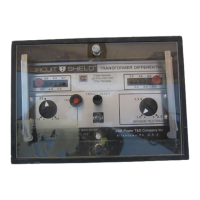
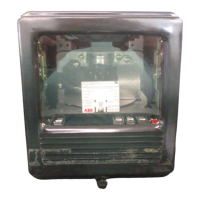
The ABB Circuit-Shield Type 32R Reverse Power Relay is designed for the anti-motoring protection of generators and their prime-movers, as well as for applications requiring action at a set power level, such as on a tie between two systems where power flow needs to be restricted or an alarm sounded at a certain level in one direction. This relay is housed in a case suitable for conventional semiflush panel mounting, with all connections made at the rear and clearly numbered.
The Type 32R relay measures power according to the formula P = V * I * cos θ, making it a "true" directional power relay. It is particularly preferred in cases where significant third-harmonic current may be present. The relay provides wide sensitivity ranges and high continuous ratings, allowing full use of its sensitivity. Only one single-phase relay is typically required for reverse power protection, as reverse power will be essentially equal in all phases. A relay setting of 20-50% of the power required to motor the particular machine being protected is suggested.
The relay is equipped with a time delay on pickup, which is continuously adjustable from 1 to 30 seconds on standard units (definite time characteristic). This time delay should be set to prevent nuisance operations due to temporary self-correcting power reversals, such as those occurring during synchronizing. A typical setting of 15 seconds is recommended. For 437W/437G series units, an internal link allows selection between a definite-time characteristic and an inverse characteristic for the timing function.
For current-directional types (237P/237F/437P/437F series), the operating characteristic is based on current magnitude and direction, which does not change with the magnitude of polarization voltage. While the normal polarization voltage is 120 Vac, the relay remains fully polarized at voltages down to 10 volts. An internal phase-shift circuit provides the necessary 30-degree shift for proper comparison of line-to-line polarization voltage with line current. If phase A-to-neutral voltage is used, the internal phase-shift link should be set to 0°.
The 437W/437G series units include an internal link to select the maximum torque angle, allowing it to be set for either I lag V by 0 degrees or I lag V by 30 degrees. When set to 30 degrees, the line-to-line input voltage is internally adjusted by a 1/√3 factor to maintain correct scaling for single-phase watts. These units can also be reconnected to provide reverse VAR detection, particularly when set up with an internal 0-degree phase-shift.
Most settings are made on the front panel of the relay, protected by a removable clear plastic cover. A continuously adjustable pickup dial is provided to set the sensitivity of the relay to power reversal or power flow. The approximate range is marked on the front panel, and the dial is non-linear for greater resolution at more sensitive settings. Pickup can be set by test if desired.
A light-emitting-diode (LED) pickup indicator assists in testing and provides operating personnel with information on the relay's status. This indicator lights when the relay's timer is timing, and if the condition persists, the relay will operate. If the indicator flashes, system conditions are near the operating threshold, but the timer resets when the LED goes out, preventing operation.
A target indicator signals electronically when the relay's output contacts transfer to trip the breaker, displaying an orange indication. This target retains its indication even upon loss of control voltage and must be reset manually. To reset the target, control power must be present, and the inputs to the relay must be below pickup.
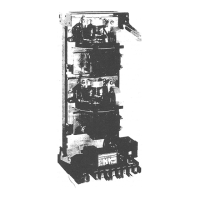
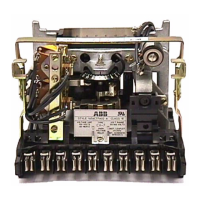
The 437 series relays feature totally drawout construction with integral test facilities. Current transformer shorting is automatically accomplished by a direct-acting spring and blade assembly upon removal of the relay from its case. Sequenced disconnects prevent nuisance tripping during withdrawal or insertion of the relay if the normally closed contact is used. The 237 series relays are of partial drawout construction, with the input transformers remaining in the case upon withdrawal of the lower circuit board.
For units with dual-rated control voltage, a control voltage selector plug on the lower circuit board must be placed in the correct position. On earlier 437 series units, separating the upper and lower circuit boards may be necessary to access this plug. For 237 series units, a shorting link or jumper is required from terminal 16 to terminal G.
No routine maintenance is required for the Type 32R relay. It is recommended that an inoperative relay be returned to the factory for repair, though schematic diagrams are available upon request for troubleshooting. Renewal parts can be quoted by the factory.
Drawout circuit boards of the same catalog number are interchangeable for 237P/237F series units. The board is removed using metal pull knobs on the front panel, and this process does not open-circuit the current transformers. An 18-point extender board (cat 200X0018) is available for troubleshooting these units.
For 437P/437F/437W/437G series units, metal handles provide leverage to withdraw the relay assembly from the case. Removing the unit will cause a trip if the normally closed contact is used. Test connections are easily made using standard banana plugs on the drawout relay unit. Current connections are made to vertical posts at the blade assembly, while control power and output connections are made at the rear vertical circuit board, which is marked for easy identification.
Separation of the upper and lower circuit boards may be necessary for some units, requiring the removal of screws attaching handle assemblies and, in some cases, screws securing the lower board to the backplane. An 18-point extender board (cat 200X0018) is also available for accessing this assembly. For 437W/437G series units, a 3-conductor color-coded cable connects the upper and lower circuit boards; this cable must be carefully removed before separating the boards and reconnected in the correct orientation before testing or returning the relay to service.
A test plug assembly (cat 400X0001) is available for 437 series units, plugging into the relay case on the switchboard to allow access to all external circuits.
High potential tests are not recommended, as a hi-pot test is performed at the factory. If control wiring insulation tests are required, specific procedures are outlined for each catalog series. For 237 series units, the drawout element must be withdrawn, and a link or jumper between terminals 16 and G on the rear of the relay case must be disconnected to prevent current leakage to ground during testing. For 437 series units, the drawout element must be withdrawn, and a temporary link on the upper circuit board (labeled "Remove for Hipot") must be removed for high potential tests.
 General
| Series | 437W |
|---|---|
| Category | Relays |
| Manufacturer | ABB |
| Frequency | 50/60 Hz |
| Communication | Modbus |
| Humidity | 95% non-condensing |
| Standards | IEC 60255 |
| Operating Temperature | -20°C to +60°C |


 To Next Page