EasyManua.ls Logo

ABB ELR72P - User Manual

ABB ELR72P
2 pages
Go to English
Print Icon
To Next Page IconTo Next Page
Loading...
IEC/EN 60947-2 Annex M
0,5
0,3
1
1,5
2
3
0,5
0,4
0,3
0,2
0,1
0,06
0
Ι∆n (A)
t (s)
ELR ID
:T
R ID:
ON
FAULTALARM
TEST
off
tx10
Fault
Alarm
Ι∆nx1
Ι∆nx10
tx1
on
off
Ι∆nx0,1
FAIL SAFE
ALARM
RESET
ELR72P
ON
FAULT
ALARM
8
2
5
6
7
*
ouput relays
V aux.
10
11
12
TRIPALARM
remote RESET
in current
test signal
current transf. TR...
1
3
9
13
14
15
16
4
ELR72P
*
Aux
321 4 5 6 7 8 9 10 11 12 13 14 15 16
ouput
relay
TRIP
ouput
relay
ALARM
V aux
input
current
remote
RESET
(auto reset)
out test
signal
T2-T1 S2-S1
234 1
ALIMENTAZIONE
TERRA
N L1 L2 L3
Ba
TR...
72
80
(con calotta)
72
102
68
68
R3
629 12
67
I
x0,1
tx1
on
Fault
Alarm
I
x1
I
x10
tx10
off
FAIL SAFE
off
A
B
C
D
E
F
ALARM
1
0
ELR72P
2CSG152424R1202
ELR72V24P
2CSG452424R1202
Relé differenziale
elettronico
da fronte quadro
Descrizione
Schema di collegamento
Programmazione Minidip
Legenda:
1) - Regolazione della sensibilità n
2) - Regolazione del tempo di intervento
3) - Pulsante di test
4) - Pulsante di reset
5) - LED verde: segnalazione della presenza di alimentazione del dispositivo
6) - LED giallo: intervento del contatto di allarme
7) - LED rosso: intervento del relè
8) - Morsettiera per l’alimentazione ausiliaria e connessione del toroide
9) - Morsettiera per la connessione dei contatti in uscita
Caratteristiche tecniche Caratteristiche dimensionali (mm)
Tensione di alimentazione ausiliaria
ELR72P: 110, 230, 400 V ca (±20%); 50-60Hz
ELR72V24P: 24/48 V ca/cc (±20%); 50-60Hz
Consumo max 4 VA
0,03 ÷ 0,3 A per K = 0,1
Regolazione sensibilità n 0,3 ÷ 3 A per K = 1
3 ÷ 30 A per K = 10
Regolazione tempo di intervento t
0 ÷ 0,5 sec. per K = 1
0,5 ÷ 5 sec. per K = 10
Segnalazioni led ON, led ALARM, led FAULT
Intervento contatto di allarme 60% soglia intervento n (disattivabile)
Trasformatori torodali Serie TR…
Portata dei contatti in uscita 5 A 250V
Funzioni programmabili Alarm, Fail Safe, Reset da remoto, Autoreset
Temperatura di funzionamento -10 ÷ 60°C
Temperatura di stoccaggio -20 ÷ 70°C
Umidità relativa 95 %
Prova di isolamento 2,5 kV 60 sec.
Posizione di montaggio Indifferente
Tipo di collegamento Tramite morsettiera a vite (sez max cavo 2,5 mm²)
Grado di protezione
IP 52 frontale con calotta
(IP40 frontale) - IP 20 zona morsetti
Norme di riferimento CEI EN 60947-2 Annex-M
Esempio di collegamento con bobina di apertura a lancio di corrente e modalità Fail
Safe disattivata. Con utilizzo di bobina di minima tensione occorre cablare i morsetti
10-11 del contatto di fault.
A - Funzione di allarme
in posizione 1 la funzione allarme è disattivata
in posizione 0 la funzione allarme è attivata
B - Impostazione della costante di moltiplicazione del tempo di intervento
in posizione 1 K = 10
in posizione 0 K = 1
C/D - Impostazione della costante di moltiplicazione della sensibilità
con c,d in posizione 0 K = 0,1
con c in posizione 1, d in posizione 0 K = 1
con c,d in posizione 1 K = 10
E - Sicurezza positiva (Fail Safe) del contatto di Trip
in posizione 1 il relè è eccitato a riposo (sicurezza positiva, Fail Safe)
in posizione 0 il relè è diseccitato a riposo
F - Sicurezza positiva (Fail Safe) del contatto di Allarme/ Trip2
in posizione 1 il relè è eccitato a riposo (sicurezza positiva, Fail Safe)
in posizione 0 il relè è diseccitato a riposo
Minidip
1
5 6 27
3 4 8 9
PANNELLO ANTERIORE PANNELLO POSTERIORE
Alimentazione ausiliaria Vaux:
ELR72P
morsetti 2 - 3 = 110 V ca (±20%)
morsetti 1 - 2 = 230 V ca (±20%)
morsetti 1 - 3 = 400 V ca (±20%)
ELR72V24P
morsetti 2 - 3 = 24 V ca/cc (±20%)
morsetti 1 - 3 = 48 V ca/cc (±20%)
Connessione al trasformatore toroidale:
- Connettere i morsetti 7 e 8 all’avvolgimento
di misura del toroide.
- Connettere i morsetti 5 e 6 all’avvolgimento
di test del toroide.
Reset da remoto / Autoreset:
-
Per realizzare il reset da remoto connettere i morsetti
15 e 16 ad un pulsante normalmente aperto.
- Per realizzare la funzione di reset automatico
cortocircuitare i morsetti 15 e 16.
TERRA
ALIMENTAZIONE
BOBINA A
LANCIO DI
CORRENTE
2CSG444008D5101

Question and Answer IconNeed help?

Do you have a question about the ABB ELR72P and is the answer not in the manual?

Overview

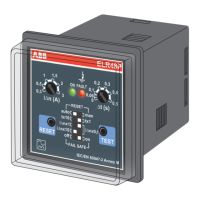
This document describes the ELR72P and ELR72V24P electronic residual current relays, designed for front panel mounting.

Function Description

The ELR72P and ELR72V24P are electronic residual current relays that monitor the electrical system for earth faults. When a fault current exceeds a set threshold (sensitivity IΔn) for a specified duration (time delay tΔ), the relay trips, activating an alarm and disconnecting the affected circuit. The device features a "Fail Safe" function, which can be configured for positive safety, meaning the relay is energized in a normal state and de-energizes upon a fault or power loss, ensuring a safe state.

The relay includes several programmable functions accessible via minidips:

  • Alarm Function (A): Can be enabled (0) or disabled (1). When enabled, a yellow LED indicates an alarm condition.
  • Time Delay Multiplier (B): Sets a multiplier for the intervention time. K=1 (0) or K=10 (1).
  • Sensitivity Multiplier (C/D): Sets a multiplier for the sensitivity (IΔn). K=0.1 (0,0), K=1 (1,0), or K=10 (1,1).
  • Trip Contact Fail Safe (E): Configures the trip relay for positive safety. In position 1, the relay is energized in the normal state (positive safety, Fail Safe). In position 0, the relay is de-energized in the normal state.
  • Alarm/Trip2 Contact Fail Safe (F): Configures the alarm/trip2 relay for positive safety. In position 1, the relay is energized in the normal state (positive safety, Fail Safe). In position 0, the relay is de-energized in the normal state.

Important Technical Specifications

Auxiliary Supply Voltage:

  • ELR72P: 110, 230, 400 V AC (±20%); 50-60Hz.
  • ELR72V24P: 24/48 V AC/DC (±20%); 50-60Hz. Maximum Consumption: 4 VA. Sensitivity (IΔn) Adjustment:
  • 0.03 - 0.3 A for K = 0.1
  • 0.3 - 3 A for K = 1
  • 3 - 30 A for K = 10 Time Delay (tΔ) Adjustment:
  • 0 - 0.5 sec. for K = 1
  • 0.5 - 5 sec. for K = 10 Signaling: LEDs for ON (green), ALARM (yellow), and FAULT (red). Alarm Contact Intervention: 60% of IΔn threshold (can be disabled). Toroidal Transformers: TR series. Output Contact Rating: 5 A 250V. Programmable Functions: Alarm, Fail Safe, Remote Reset, Auto Reset. Operating Temperature: -10 ÷ 60°C. Storage Temperature: -20 ÷ 70°C. Relative Humidity: ≤ 95%. Isolation Test: 2.5 kV 60 sec. Mounting Position: Indifferent. Connection Type: Screw terminals (max cable section 2.5 mm²). Protection Degree: IP52 frontal with cover (IP40 frontal), IP20 terminal area. Reference Standards: CEI EN 60947-2 Annex-M.

Usage Features

The device is designed for front panel mounting and includes a clear display of its status via LEDs and an intuitive interface for settings.

Front Panel Controls:

  1. IΔn Adjustment: Rotary switch for setting the residual current sensitivity.
  2. tΔ Adjustment: Rotary switch for setting the time delay before tripping.
  3. TEST Button: Used to test the relay's functionality.
  4. RESET Button: Used to reset the relay after a trip or alarm.
  5. Green LED (ON): Indicates the presence of auxiliary power.
  6. Yellow LED (ALARM): Indicates an alarm condition.
  7. Red LED (FAULT): Indicates a trip condition.
  8. Terminal Block: For auxiliary power supply and toroidal transformer connection.
  9. Terminal Block: For output contact connections.

Wiring Connections: The relay connects to the auxiliary power supply (Vaux) and a toroidal transformer (TR...) for current measurement. Output contacts are available for alarm and trip signals.

  • Auxiliary Power Supply (Vaux):
    • ELR72P: Terminals 2-3 (110 V AC), 1-2 (230 V AC), 1-3 (400 V AC).
    • ELR72V24P: Terminals 2-3 (24 V AC/DC), 1-3 (48 V AC/DC).
  • Toroidal Transformer Connection: Connect terminals 7 and 8 to the measurement winding of the toroidal transformer. Connect terminals 5 and 6 to the test winding of the toroidal transformer.
  • Trip Coil Connection: An example connection with a shunt trip coil is provided, showing how to wire it to the relay's output contacts. For undervoltage release coils, terminals 10-11 of the fault contact must be wired.

Maintenance Features

Remote Reset / Auto Reset:

  • Remote Reset: To enable remote reset, connect terminals 15 and 16 to a normally open push-button.
  • Auto Reset: To enable the auto-reset function, short-circuit terminals 15 and 16.

The device is designed for durability with a wide operating temperature range and high ingress protection (IP52 frontal). Regular testing using the "TEST" button is recommended to ensure proper functionality.

ABB ELR72P Specifications

General IconGeneral
BrandABB
ModelELR72P
CategoryRelays
LanguageEnglish

Related product manuals