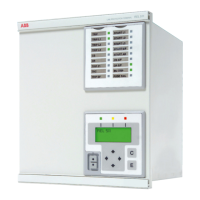
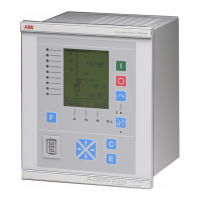
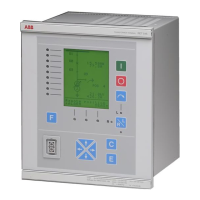
The REL 551-C1*2.3 is a line differential protection terminal designed for installation and commissioning in electrical substations. This device is part of a comprehensive user manual (UM) package, which includes an Application Manual (AM), Technical Reference Manual (TRM), Operator's Manual (OM), and Installation and Commissioning Manual (ICM). The ICM, in particular, provides detailed instructions for mechanical and electrical installation, energizing, external circuitry checks, setting and configuration, verification of settings, and directionality tests.
Function Description:
The REL 551-C1*2.3 primarily functions as a line differential protection terminal. It is designed to detect and respond to faults on electrical transmission lines by comparing current measurements at both ends of the protected line. This differential protection scheme ensures rapid and selective fault clearance, enhancing the reliability and stability of the power system. The terminal incorporates various protection functions, including definite and inverse time-delayed residual overcurrent protection (TEF), instantaneous overcurrent protection (IOC), thermal overload protection (THOL), and trip logic (TR). It also features monitoring capabilities for AC and DC analog measurements, event recording, and disturbance reporting.
Important Technical Specifications:
The terminal's technical specifications are detailed across the various manuals. Key aspects include:
- Current Inputs: Designed for a maximum continuous current of four times the nominal value. CT circuits support solid conductors with cross-sectional areas between 2.5-6 mm² (AWG20-10) or stranded conductors with areas between 2.5-4 mm².
- Voltage Inputs: VT circuits are connected using COMBICON plug-in screw connectors, supporting solid or stranded conductors with cross-sectional areas between 0.5-2.5 mm² (AWG24-12). Ferrules with plastic collars can be used for connecting two conductors with areas between 0.5-1.5 mm² (AWG20-18).
- Auxiliary Power Supply: The auxiliary supply voltage must remain within permissible ranges, and polarity must be correct as per the front plate technical data.
- Communication Modules: Supports various digital communication modules, including fibre optical modems (short-range and long-range galvanic) and interfaces for V.36, X.21, RS530, and G.703 co-directional.
- Fibre Optical Modem (Short Range): No HMI settings; configuration via DIP-switches (switches 3 and 4 for timing source). Supports multimode fibres (attenuation < 6 dB for Low setting, > 10 dB for High setting, 6-10 dB for either) and single-mode fibres (attenuation > 5 dB for High setting, 0-5 dB for either). Synchronization (Master/Slave) is configurable.
- Galvanic Modem (Short Range): No HMI settings; configuration via DIP-switches (switches 1 and 2 for timing signal).
- V.36, X.21, RS530 Interfaces: Connectors are 15-pin DSUB for X.21 and 25-pin DSUB for RS530/V.36. Transmission rates (56 or 64 kbit/s) for co-directional operation are set via HMI under
Configuration/TerminalCom/RemTermCom/BitRate.
- G.703 Co-directional Interface: No HMI settings; configuration via DIP-switch (switch 1 for timing source).
- Grounding: Requires connection to protective ground with a green/yellow conductor (at least 1.5 mm² / AWG18). Screened cables require 360° full screen cable bushings, with screens earthed at both ends for galvanic communications (56/64 kbit/s) and at the sending end for other signals (receiving end floating). Short ground connections (max. 10 cm) with adequate cross-section (at least 6 mm² / AWG18) are recommended.
- Operating Time: For line differential protection, the operating time for a single-phase current injection (4 times operating current) is typically 28-33 ms + 2 times the communication transmission delay. The transmission delay should not exceed 12 ms.
Usage Features:
- Local HMI: Provides an interface for setting parameters, viewing service values (logical signals, phasors), and monitoring self-supervision data. The HMI displays "Ready" for successful startup and "Fail" for internal failures, indicated by a flashing green LED.
- PC Communication: Settings and configurations can be downloaded from a PC using CAP 535 (including CAP 531 and PST) or CAP 540 software via front or rear optical ports.
- Test Mode: The terminal can be set to a test mode to facilitate individual function testing and prevent unwanted operations. This mode is indicated by a flashing yellow LED. Functions can be blocked or released individually.
- Setting Groups: Supports multiple setting groups, allowing for flexible configuration based on operational requirements.
- Disturbance Report: Records disturbances, with settings to control how information is displayed on the HMI (stored, scrolled, LED indications) and whether it's stored in the terminal.
- Event Function (EV) and Event Recorder: Allows for event masking and reporting, with options to block individual event blocks during testing.
Maintenance Features:
- Self-Supervision: The terminal includes a self-supervision function that detects hardware errors and issues warnings or failures (e.g.,
InternFail, MPM-modFail, ADC-module = Fail). The HMI provides detailed information on the cause of the failure or warning.
- Module Replacement: Designed for easy replacement of modules. Flush-mounted terminals should allow sufficient space for adding and replacing modules without excessive demounting.
- Reset Functions: Thermal memory can be reset for thermal overload protection. Modems can be reset after DIP-switch changes.
- Troubleshooting: The manuals provide guidance for checking external circuitry (CT/VT circuits, power supply, binary I/O circuits), verifying communication, and performing secondary injection tests to confirm settings.
- Jumper Settings: Specific jumpers on communication modules (e.g., S3, S4 on short-range optical modem) allow for functionality changes, which are accessible after removing the back plate and connectors. Care is advised to avoid electrostatic discharge during these operations.

 Need help?
 General

 To Next Page