
 Need help?
Do you have a question about the ACC GD30FDC and is the answer not in the manual?
Details the product's purpose, key features, and design basis.
Specifies operational temperature ranges for evaporation, condensation, and ambient conditions.
Provides essential guidelines for wiring and connecting the compressor and driver.
Explains how to manage voltage drop based on wire cross-section and length.
Describes the Serial Port Interface, its connector, and its use for programming and communication.
Details optional configurations for the SPI, including LED display and external control.
Specifies the allowed range of DC voltage for the compressor.
Explains standard and special voltage supply modes for the driver.
Details how to set up battery protection parameters via programming.
Explains external battery protection setup using SPI connections.
Describes setting compressor speed to fixed or externally switched values.
Explains variable speed operation based on thermal load and voltage.
Details operation for four hours with limited speed, with optional sleep state.
Describes a four-hour operation with progressively decreasing speed.
Explains variable speed control by an external Electronic Integral Manager.
Outlines the sequential steps required to program the electronic driver.
Covers selection of standard, Smart Speed®, Sleep, and Slave modes.
Details setting internal and external battery protection modes and values.
Lists protections against battery discharge, fan over current, starting failure, overload, and overheat.
Explains how LED flashes indicate specific alarm causes.
Advises on fan cooling based on speed and evaporation temperature.
Lists physical and electrical specifications of the compressor.
Covers electronic driver, SPI, protections, running modes, and default settings.
Details how the compressor and driver are supplied and what the pack contains.
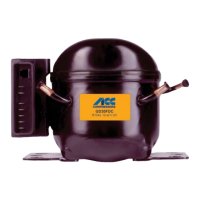
The GD30FDC is a 12-42V Direct Current Compressor designed for cooling appliances in various mobile applications, such as trucks, caravans, boats, and cars. It is also suitable for medical appliances in ambulances. This compressor operates with the environmentally friendly refrigerant R134a and is built to be compact, highly reliable, and efficient, even at tilt angles up to 30°. Its design is based on ACC's "D" series, which has a proven track record since 1984.
The GD30FDC compressor is powered by a dedicated electronic driver, FDC1, which allows it to operate within a wide DC voltage range of 12V to 42V. The FDC1 driver automatically adjusts to the power supply voltage and incorporates comprehensive protection features for both the battery and the compressor motor. It is designed for capillary tube expansion systems.
The electronic control unit FDC1 is equipped with an exclusive Serial Port Interface (SPI) with an RJ11 connector. This SPI allows for programming the electronic driver using a dedicated software package provided by ACC. It also facilitates communication with an Electronic Integral Manager (EIM) of the appliance, enabling the compressor to operate in slave mode.
The FDC1 driver includes "Smart Speed®" as a programming option, which is a plug-in system that automatically adapts the compressor speed to the current thermal load. This feature minimizes thermostat cycles by optimizing compressor speed, extending on-time, and significantly reducing start/stop energy losses. Lower speeds lead to higher evaporating temperatures, better Coefficient of Performance (COP), and reduced energy consumption. During pull-down, the compressor operates at maximum programmed speed for quick cooling. Smart Speed® requires no specific design parameters for the compressor or appliance, making it easy to integrate.
Another programming option is "Sleep and Sleep Energy Saving," specifically designed for mobile air conditioners. In Sleep mode, the compressor runs for four hours after start-up, with speed limits set by a fixed programmed value or available battery voltage, or external switching. In Sleep Energy Saving mode, the compressor runs at maximum programmed speed for the first hour to provide high cooling capacity, then progressively lowers its speed to a minimum of 1,500 rpm over the next three hours, balancing comfort and energy efficiency.
The GD30FDC boasts a low starting capability, operating effectively at voltages as low as 10V under balanced pressure conditions. It can also handle some remaining differential pressure when the thermostat off-time is unusually short. To further enhance starting capability, the FDC1 driver includes a 3-minute minimum thermostat off-time, which can be disabled if not required. A 1-second filter at the thermostat input prevents incorrect operation due to micro-switching caused by vibrations, eliminating the need for analogical filtering.
The compressor's operation can be configured in various running modes:
The FDC1 driver's terminal board facilitates all connections, including battery power, fan, and thermostat. For optimal performance and reliability, adequate heat removal from both the electronic driver and the compressor is crucial. Free air circulation over these components must always be ensured. The recommended cooling method (static or fan) depends on compressor speed and evaporation temperature, with condensation temperature being a secondary factor.
The GD30FDC is electronically protected against a range of malfunctions and failures:
In case of an alarm, the system attempts to restart the compressor automatically. For most alarms, there are ten automatic restart attempts. For battery protection alarms, the number of attempts is unlimited. If the sequence of automatic attempts is exhausted, the unit remains off until manually reset by switching the power supply off and on. Thermostat intervention during restart attempts interrupts and resets the sequence.
The SPI can be configured to connect an LED that displays alarm interventions and identifies their cause through a sequence of flashes. Each flash sequence corresponds to a specific alarm type (e.g., 1 flash for battery protection, 2 for fan overcurrent, 3 for starting failure, 4 for compressor overload, 5 for electronic driver overheat, 7 for internal error). If the FDC1 driver is connected as a slave to an EIM, a digital alarm code is transmitted to the EIM for display and action.
Proper wiring is essential for reliable operation. The compressor must always be powered through the FDC1 driver, and direct connection to a battery or AC source is strictly prohibited. The FDC1 driver should not be replaced with any other electronic driver. Correct battery polarity must always be observed. Fuses are required between the positive battery terminal and the positive power input terminal of the electronic driver, with specific amperage ratings for 12V, 24V, and 42V systems. To prevent excessive voltage drop, the length and cross-section of power leads must be chosen according to specified guidelines. Any connectors or switches in the power path should have a resistance less than 10mΩ to avoid issues.
 General
| Power Source | Electric |
|---|---|
| Tank Capacity | 30 gallons |
| Pump Type | Oil-Free |
| Voltage | 110-120V |
| Noise Level | 78 dBA |

 To Next Page